


All too often in our lives as scholars and organizers, we move from one project to another. It is both out of dedication to our communities through transformative labor and a work ethic in navigating the waters of the academy. What often gets lost and forgotten are moments to celebrate. We fail to acknowledge our own achievements, as well as the achievements of those we labor with, those who mentor us, and those we mentor. Against that tendency, this article serves as a loud shout-out of, “Dr. Rabab won again!”
Or, in a more conventional tone, Dr. Rabab Abdulhadi has been awarded the Jere L. Bacharach Service Award of the Middle East Studies Association (MESA). Those of us who nominated Dr. Abdulhadi for this award are publicly sharing a revised version of our nomination letter to MESA in the following article. It is our wish that sharing this article will inspire and inform readers by providing a quick dive into her long history as a pillar within the Palestinian community. Her nomination has also been supported by her colleagues and graduate students, including Dr. Juan Cole, Dr. John Chalcraft, Dr. Nancy Gallagher, Dr. Michelle Hartman, Dr. Rosalind Petchesky, Heather Porter Abu Deiab, Dr. Nada Shabout and Dr. Stephen Sheehi.
An organic intellectual
Dr. Abdulhadi is an organic intellectual and a renowned scholar-activist who has applied her scholarship and service, and dedicated her life, to developing and broadening our understanding of topics that lie at the heart of and are thus directly relevant to MESA. From establishing departments and institutions to her wide-ranging professional service and advocacy, she has worked tirelessly to build the intellectual infrastructure for interdisciplinary Middle East Studies. She has fostered a broad understanding of the Palestinian struggle, and the many peoples and societies of the Middle East against the dominant Zionist, Orientalist, and imperialist frames.
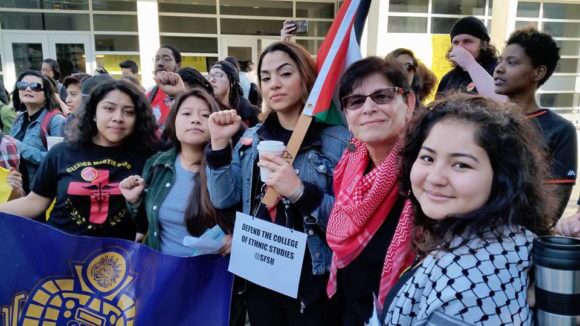
From defending academic freedom to mentoring and recruiting thousands of students, emerging scholars, and activists, she has bolstered and expanded the spaces and voices of creativity, dissent, and justice that would have been marginal or otherwise silenced. Her extraordinary contributions, courage, generosity, creativity, and commitment have inspired and engaged generations to continue defying the use of gender and sexuality as instruments of policing, racism, and imperialism.
And she has done all of that while modeling how to fight for freedom from all forms of oppression and the refusal to advocate for one struggle at the expense of another.
Dr. Abdulhadi’s exceptional record of establishing institutional spaces and intellectual infrastructures for the study of the Middle East comes across through her accomplishments and contributions, as outlined below. Hence, she was honored as the co-recipient of the award from MESA, which “recognizes the contributions of individuals through their outstanding service to MESA or the profession.”
Dr. Rosalind Petchesky, Distinguished Professor Emerita of Political Science at Hunter College and the Graduate Center, City University of New York, whose relationship with Dr. Abdulhadi as a colleague, mentor and friend stretches back to the 1980s, had this to say in her recommendation letter:
“The greatest part of Dr. Abdulhadi’s talents and energies have gone toward directing her consummate gifts as a teacher and communicator to expanding public knowledge of the history and political and social realities of Palestinian and Muslim lives. … For Rabab Abdulhadi, there simply is no way to analyze the forces of racism, misogyny, violence and economic exploitation without thinking through our responsibility to change them.”
Early career
Her early interventions as a junior scholar and academic evidence her commitment to producing knowledge and pedagogy that is liberatory and transformative. Upon receiving her PhD from Yale University, and despite her junior academic status as a starting assistant professor, Dr. Abdulhadi was appointed to represent the Department of SAPE (Sociology, Anthropology, Psychology and Egyptology), the largest social science department at the American University in Cairo (AUC), to the leadership of the Program in Forced Migration and Refugee Studies (FMRS) where she directly contributed to the creation of the Graduate Certificate in Forced Migration and Refugee Studies.
After less than a year at AUC, she received a Teaching Exceptional Award due to her popularity among her students, colleagues, and academic supervisors at the university. As a Postdoctoral Fellow at the Center for the Study of Gender and Sexuality at New York University (CSGS-NYU), she worked closely with CSGS Director, Professor Carolyn Dinshaw, to create the undergraduate major and the Graduate Certificate in Gender and Sexuality Studies. She also led a university-wide Colloquium on Gender, Sexuality, and Nationalism in the critical Post 9/11/2001 period, sacrificed her own publications and her plans to turn her dissertation into a book, in favor of pedagogical praxis and challenging NYU’s disciplinary mechanisms against student activists.
These include unofficially mentoring members of Student for Justice in Palestine and regularly meeting outside her office hours. These meetings frequently lasted until midnight, a consistent indication of the dedication and drive she brings to the many liberation groups, movements and projects she has been involved with. Her intellectual contributions at NYU are evident in the courses she developed and the initiatives she led that fostered public engagement at the university and among the broader U.S. network of scholars of Gender and Sexuality Studies with the Middle East and its diasporas.
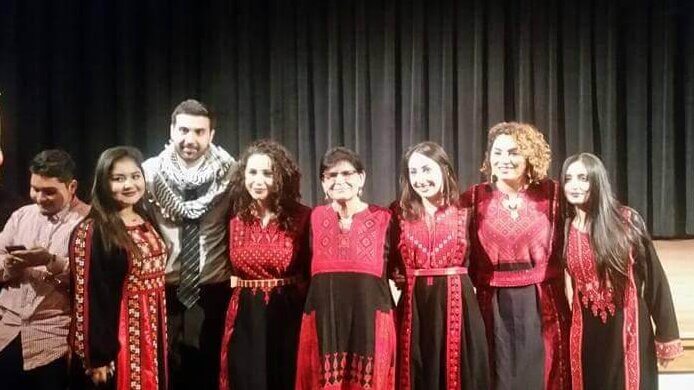
Upon Edward Said’s passing in 2003, Dr. Abdulhadi initiated and led a group of students and faculty to organize a tribute to him that was targeted by NYU Zionists in the English Department. She prioritized the convening of the tribute, inviting two NYU junior faculty members who were mentored by Said at Columbia University to moderate in her place. Working closely with her Third World and feminist and queer graduate students, she coined the term, imperial feminisms, and convened several public movement meetings during this period when the academy and public intellectuals were peddling colonial and Orientalist feminist tropes of “medieval,” “gender apartheid,” and the “backwardness” of Arabs and Muslims that exceptionalize the Middle East and its diasporas in terms of patriarchy and homophobia. Such tropes were advanced forcibly by liberal and white supremacist feminism through organizations like the Moral Majority in alliance with the Bush Administration, along with Christopher Hitchens and Arab and Muslim native informants, such as Fouad Ajami.
Dr. Abdulhadi co-led and co-organized a major collaboration between AUC’s Women and Gender Studies and NYU’s CSGS, its Middle East Studies Department and its Kevorkian Center for Near East Studies. In 2004, Dr. Abdulhadi was awarded the New Century Scholarship (NCS) of the Fulbright Commission for her groundbreaking work on gender, nationalism and colonialism through and she was asked to co-chair the working group on “Negotiating Citizenship and Diversity: Gender, Nation, and Diasporas” within the NCS project “From Self-Determination to Self-Rule (and Back to Occupation): What Prospects for Palestinian Women?”
Dr. Abdulhadi was the first director of the Center for Arab American Studies and Associate Professor of Sociology at the University of Michigan-Dearborn.
Building institutions
Subsequently, she became the founding director and Senior Scholar of Arab and Muslim Ethnicities and Diasporas Studies (AMED) at the College of Ethnic Studies at San Francisco State University (SFSU).
Since 2007, she has collaborated with and played a leading role in the development of the “Islamophobia in Systems of Knowledge Project,” which included the establishment of the Islamophobia Research and Documentation Project (IRDP) at the Center for Race and Gender at the University of California, Berkeley; the founding of the peer-refereed academic publication, Islamophobia Studies Journal; and the organizing of annual international Islamophobia Conferences by the IRDP at UC Berkeley and CADIS at the Ecole des Hautes Etudes en Sciences Sociales, where she was invited as a visiting scholar to mentor doctoral students in gender and sexuality studies on “Revising Narratives: Feminist and Palestine Studies,” “Motherhood deficiency?” and Islamophobia.
IDRP has developed further despite Islamophobic and Zionist attempts to shut it down. It has now culminated in the International Islamophobia Research Association (IISRA), of which Dr. Abdulhadi is a co-founder and board member.
Dr. Abdulhadi initiated and led the “Mapping Arab Diasporas Archival Project” at CAAS in Michigan. She co-led several collaborative research initiatives with Buena Vista Community Institute (2004-2013); and “Archiving Transnational Feminist Histories,” a cluster project supported by the Center for Race and Gender at UC Berkeley (2013). She also co-created, along with SFSU General Union of Palestinian Students alum, the Edward Said Scholarship Award to encourage and reward student scholarship and community service.
At AMED Studies, Dr. Abdulhadi has modeled how to maintain a rigorous academic program through which students, peers, staff and community members can collectively engage in the struggle she has defined as the indivisibility of justice, a praxis to which she is committed in her own scholarship, teaching and advocacy. Through this conceptual framework, she challenges the conventional academic wisdom of “neutrality” in the face of injustices, insisting on justice-centered knowledge production and demanding that we resist camouflaging the repressive status quo to evade accountability.
She relentlessly challenges the disciplinary boundaries and silos that seek to constrain and limit the spaces and modalities for the study of the Middle East, and its diverse societies, peoples and diasporas. Her definition of AMED Studies stresses the constant need to study diverse ethnicities in Arab-majority societies and multiple spiritualities in Muslim-majority communities. Furthermore, she argues against keeping Indigenous and racialized communities from advocacy on “foreign policy” issues under the guise of confining such debate to government “experts” and media pundits, as exemplified in her chapter, “Contesting the Foreign/Domestic Divide: Arab Revolutions and American Studies,” in Shifting Borders: American in the Middle East/North Africa (2014).

Dr. Nancy Gallagher, in her letter supporting Dr. Abdulhadi’s nomination for the MESA award, wrote that “she maintains a rigorous academic program through which students, staff and members of the community can collectively engage in the struggle for international justice. She has worked to develop critical intellectual and scholarly thinking while opening up spaces for advocacy for justice, dignity, and peace.”
In the course of creating AMED Studies, Dr. Abdulhadi articulated a bold, interdisciplinary and broad program of scholarship, pedagogy and advocacy on the Middle East. She argued for and developed a curriculum that “recognizes, validates and legitimizes the lived experiences and the knowledge produced by and about Indigenous communities, communities of color, poor and marginalized communities.” (2017, The Spirit of ‘68 lives on!)
While opening spaces for junior and senior colleagues, her graduate and undergraduate students, and community youth and elders, she developed AMED Studies to offer General Education courses that are timely, urgent, and necessary for justice-centered public knowledge while de-exceptionalizing the Middle East and its diasporas. These courses include: Islamophobia; Palestine: Ethnic Studies Perspective; Arab and Muslim-American Civil Liberties post 9/11/2001; Introduction to Arab and Arab American Feminisms; Arab Media Images; Muslims in America; Postcolonial Arab and Arab American Identity; Comparative Border Studies: Palestine and Mexico; Queer Arab Diasporas; Gender and Modernity in Arab and Muslim Communities; Edward Said; and the Palestinian Mural and the Art of Resistance.
This curriculum expands the confines of conventional knowledge production, challenging tired (but dangerous) stereotypes while fostering teaching that expands the imagination of students and their thinking about the Middle East beyond inherited dogmas. It connects U.S.-based experiences and communities to those living thousands of miles away in Palestine and at sites across the Global South, wielding the limiting academy as an instrument of movement building and anti-imperialism.
Through institutional building over a long arc of academic, activist and journalistic career, Dr. Abdulhadi’s work has inspired thousands of students, instructors and faculty to study, research and teach on the Middle East and its diasporas globally. Significantly, the students she mentors have joined graduate programs across Ethnic Studies, Anthropology, Gender and Sexuality Studies, and Religious Studies at UCLA, McGill University, UC Riverside, UC San Diego, University of Minnesota, the Pacific School of Religion and beyond.
The junior scholars mentored by Dr. Abdulhadi have been well-placed in faculty positions and have received fully-funded prestigious scholarships and academic excellence awards while maintaining their post-graduation community work and activism, as has been the case for the authors of this piece.
Dr. Abdulhadi sits on several Ph.D. committees for students to support cutting-edge and innovative research by doctoral students, and mentors other graduate students by providing constructive criticism and tough love. She has organized several mentoring institutes for graduate students, including two collaborative institutes for graduate students at Al-Quds University and the Center for Arab American Studies (CAAS), Palestinian Youth Movement’s Summer Schools in Basque Country and France, the American Sociological Association, and the National Women’s Studies Association.
Heather Porter Abu Deiab had the following to say about her professor in her letter to MESA supporting the nomination, “I have had the pleasure of knowing Dr. Rabab Abdulhadi for twelve years, in which I was mentored by her and worked with her extensively in multiple capacities. She has consistently shown that she is on the front line of Middle East studies, and her revolutionary approach to all aspects of her work is remarkable.”
Mentoring and community engagement
In this and many other instances, Dr. Abdulhadi has tirelessly mentored, encouraged, empowered and inspired generations of women and feminists from all backgrounds as scholars and advocates, deliberately ensuring the participation of members of BIPOC and LGBTQIS+ communities. In a world where Palestinian, Arab and Muslim women are framed almost exclusively as victims of their families and cultures, her life and work expose this racist lie while showcasing the women and radical feminist traditions central to the Palestinian liberation struggle.
Notable in that regard is her decades-long engagement with and contributions to feminist theory and transnational feminisms, including her scholarship and advocacy on gender and sexual justice within and beyond Arab and Muslim communities. She is the lead co-editor of the award-winning, Arab and Arab American Feminisms: Gender, Violence & Belonging (Syracuse University Press, 2011), which started as two roundtable discussions at the 2003 meeting of the American Studies Association, following the U.S.-led invasion of Iraq, and was initially published as MIT Electronic Journal of Middle East Studies.
Her post 9/11/2001 formulations built on her widely cited reflection, “where is home?” and her coinage of imperial feminisms, along with her earlier leadership in co-building the Union of Palestinian Women’s Associations which grew to be the largest Palestinian, Arab, SWANA, or ME women’s in North America.
Her publications also include the influential and much-cited classical articles, “The Palestinian Women’s Autonomous Movement: Emergence, Dynamics & Challenges” (1998) and “Tread Lightly: Teaching Gender and Sexuality in Time of War” (2005); as well as the more recent, “Framing Resistance Call & Response: Reading Assata Shakur’s Black Revolutionary Radicalism in Palestine” (2018), and Israeli Settler Colonialism in Context: Celebrating (Palestinian) Death and Normalizing Gender and Sexual Violence (2019). In “Framing Resistance Call & Response,” Dr. Abdulhadi reminisces about learning of Dr. Davis at a young age:
“Growing up under Israeli occupation of Palestine, I clearly recall my mother pointing to Angela Davis’s picture in the local paper and declaring emphatically, ‘She is framed.’ My father [..] turned to her, asking, ‘What makes you so sure that she is framed?’ Without skipping a beat, she replied, ‘She is Black. Of course she is framed.’ My mother was affirming what we grew up knowing with absolute certainty about the United States…” (p.226)
The power of this story preserved and transmitted alongside many others in Dr. Abulhadi’s work in that it serves as a reference for resistant histories, militant feminist connections and radical genealogies that are difficult if not impossible to memorialize and share within the prevalent conditions of race and empire today.
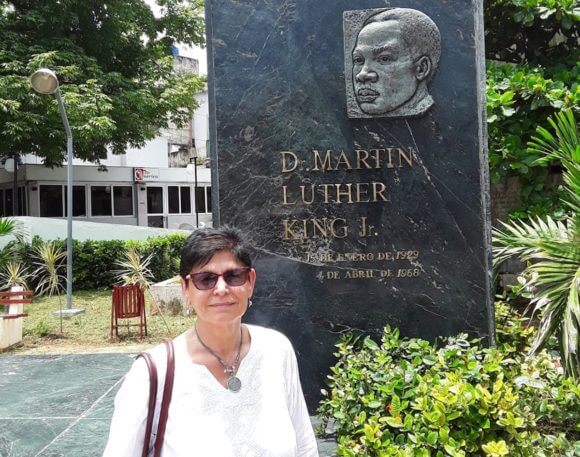
In 2017, Dr. Abdulhadi, along with Suzanne Adely (President of the National Lawyers Guild), Angela Davis and Selma James (feminist activist and partner of the Black radical thinker C.L.R. James), co-authored an article in Mondoweiss titled, “Confronting apartheid has everything to do with feminism” arguing against colonial, white feminist and Zionist attacks against the International Women’s Strike in March of that year. Through her scholarship and writing, Dr. Abdulhadi not only argues against hegemonic models that call for colonial saving narratives and misrepresent Middle East societies and communities as exceptionally homophobic and misogynistic. They also brought diverse radical feminist traditions of Indigenous, Black, Palestinian and Third World movements and communities into a generative conversation and nuanced engagement with one another.
Touching on these aspects of Dr. Abdulhadi’s contributions and her unfaltering generosity to the women and people she interacts with, Dr. Michelle Hartman, Professor and Director of the Institute of Islamic Studies at McGill University, writes in her letter to MESA in support of the nomination:
“I met Professor Rabab Abdulhadi when I was an undergraduate student in the 1990s at Columbia University at [Sisters In Struggle: Women’s Alliances for Change] a feminist-centered event highlighting the struggles of women of color in and beyond the academy. The event itself, and her words, are indelibly etched in my mind and no doubt one of the reasons that I stayed in academia, believing that principled people, who believe that they can work to make the world a better place, can find a space in the university to do this work and should do this.
[…]
To fast forward to about two weeks ago, around when I was asked to write this letter and thinking about Prof Abdulhadi’s contributions. I was meeting with a young Palestinian student, about to graduate from my university, who was full of enthusiasm recounting how she’d just heard Prof Abdulhadi at a conference. She recounted her excitement at the ideas she was engaging and feeling seen and heard by her. With even more energy, she told me how they had spoken afterwards and the encouragement and support Professor Abdulhadi had offered her—even though they’d just met.
Professor Rabab Abdulhadi has shown how you can back up this human side of the profession with action and concrete contributions to the profession more generally and the field of Middle East Studies more specifically. […] The work of Professor Abdulhadi, however, has created a space for women and others who are marginalized within Middle East Studies to find a place, find a voice, and advance our work.”
Furthermore, Dr. Abdulhadi has long been committed to critical and global scholarship that builds communication, understanding, and forges links with scholars and research institutions in the Middle East. She has organized dozens of delegations, exchanges, events, panels, open classrooms, conference programs, research initiatives and collaborations involving universities, organizations and scholars in the Middle East and globally.

For example, along with her SFSU graduate student, she established a collaborative (an MOU) agreement between SFSU and An-Najah National University in Nablus, Palestine. She is a co-founder and Executive Committee member of California Scholars for Academic Freedom; a founding member of the Palestinian Forum on Migration, Refugees and Return; a co-founder and a member of the advisory board of the U.S. Campaign for the Academic and Cultural Boycott of Israel; and co-chair of the Feminists for Justice in/for Palestine at the National Women’s Studies Association.
As a policy advisor for the Palestinian Policy Network, Al-Shabaka, she helped shape the framework of this widely recognized and key organization. She serves on the Board of the Afro-Middle East Center (Johannesburg, South Africa); the Academic Advisory Council of Jewish Voice for Peace; the Critical Middle East Studies Advisory Committee at City College of San Francisco; the Editorial Board of the Journal of Chicana/Latina Studies; and the Advisory Board of National Students for Justice in Palestine. She is the co-founder and co-chair of the Palestine, Arab and Muslim (PAM) Caucus of the Racial and Social Justice Council of her union at SFSU, the California Faculty Association.
As a community organizer, she co-founded the Palestine Solidarity Committee (formerly the November 29th Coalition for Palestine) and the Union of Palestinian Women’s Associations in North America; and served as a founding member of the recently launched Palestinian Feminist Collective. She has served on the Board of the Arab and Cultural Community Center in San Francisco, the Brecht Forum (formerly the Marxist School), the Arab Movement of Women Arising for Justice and the World Congress of Middle East Studies (WOCMES) until she resigned from the Board in 2022 to protest their lack of transparency and their collusion with Orientalist and pro-Israel academics.
In addition to being an active member of her union at SFSU, Dr. Abdulhadi has acted as a faculty advisor for the short-lived Afghan Student Association and Saudi Student Association, and the ongoing General Union of Palestinian Students, Muslim Student Association, and Muslim Women’s Students Association, while coordinating with the Friends of AMED community board. With such contributions in mind, Dr. John Chalcraft, London School of Economics and Secretary of BRISMES, wrote in his support letter for Dr. Abdulhadi’s nomination:
“I have long been an admirer of Prof Abdulhadi’s scholarship and engagement, and would like in particular to emphasize her tremendously energetic service in terms of building programmes and institutions in Middle East Studies especially in the field of race, ethnicity and diaspora. She has done more than almost any other scholar I can think of in the United States and internationally in terms of engaging grassroots and diaspora communities with educational endeavors of a critical and progressive kind. This is the kind of vital, connecting, outreach work – often undertaken with considerable courage and persistence – that keep our field organically connected to lives and issues beyond the academy, enabling Middle East Studies to flourish as a relevant endeavor in the 2020s and beyond. I certainly salute Professor Abdulhadi for her work over the years, and would like to see it recognized by our association.”
Building solidarities through praxis
In 2016, Dr. Abdulhadi co-initiated and co-led in 2018 the Teaching Palestine: Pedagogical Praxis & the Indivisibility of Justice delegation and conference project, the sixth of its kind, articulating resistance to (settler) colonial and racist historical erasures. It also reflects her consistent commitment to collaborative processes that challenge and undermine the hegemony of the global North by insisting on principled and equitable collaborations with institutions in the global South as well as South-South collaborations.
Bringing together AMED Studies with Birzeit University and An-Najah National University in Palestine, McGill University, the University of Johannesburg and the Afro-Middle East Centre in Johannesburg in South Africa, along with community partners, Teaching Palestine challenges hegemonic narratives on Palestine and demands the decolonization of the curriculum. Through this project, Dr. Abdulhadi initiated and co-organized conferences, symposia and panels at Birzeit and An-Najah National Universities (Palestine); the World Congress of Middle East Studies (Seville, Spain); McGill University (Montreal, Canada); the Caribbean Studies Association (Havana, Cuba); the American Studies Association (Atlanta, Georgia); the Afro-Middle East Center (Johannesburg, South Africa), and several community spaces and campuses for Students for Justice in Palestine, and other student and faculty lectures and talks.
She also co-organized and led six delegations to Palestine, such as the 2005 and 2006 delegations and Institutes for the training of U.S. and Palestinian graduate students in American Studies and Arab American Studies with Al-Quds University (CAAS, UMD); the 2011 Indigenous and Women of Color Feminist Delegation; the 2014 Academic and Labor Delegation; and the 2016 US Prisoner, Labor and Academic Delegation. Each delegation included prominent U.S.-based activists and public intellectuals, including Angela Davis, Emory Douglass, Diane Fujino, Barbara Ransby, Beverly Guy-Sheftall, Joanne Barker, Junaid Rana, Chandra Mohanty, Dennis Childs, Hank Jones, Johanna Fernandez, Robin D. G. Kelley, Laura Whitehorn and Waziyatawin.
Participants came away from these study trips with a greater understanding of settler colonialism and resistance in Palestine and Turtle Island. The experiences had a lasting effect in informing and influencing their scholarship, advocacy and/or organizing about justice in and for Palestine which is part and parcel of the indivisibility of justice while providing a critical pedagogical tool for global comparative analysis.
Well before the post-pandemic conversion to remote learning, Dr. Abdulhadi initiated the Teaching Palestine Open Classroom Series, along with cosponsors like National Students for Justice in Palestine, Addameer, National Black Education Agenda, the US Campaign for Palestinian Rights, Al-Adab Journal (Lebanon), Eyewitness Palestine, and the Palestinian Youth Movement. Teaching Palestine provided accessible, free, and quality educational programming that was streamed live in an interactive format for both student and community audiences.
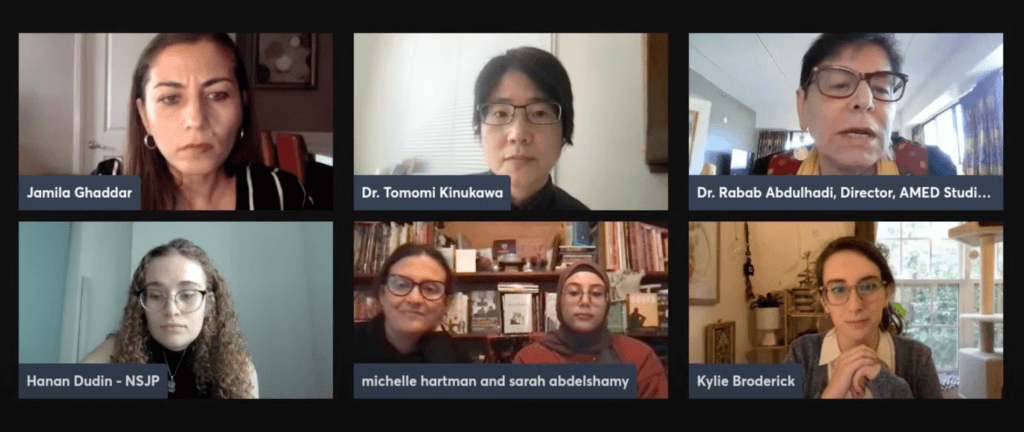
Exemplifying her commitment to the theory and praxis of critical and accountable public education, these open classrooms challenge institutional barriers to community-wide access to education. They routinely feature a mix of high-profile and emerging scholars and public intellectuals, as well as luminaries in various global liberation struggles, while attracting tens of thousands of people from diverse communities and social movements.
Through this series, Dr. Abdulhadi challenges the traditional definition of the classroom while organizing a rich living archive of conversations, oral histories and intergenerational discussions that historicize contemporary issues and debates. They also provide rich, contextual information and analysis on the connection between Palestine, and key events and developments around the world over the last few centuries.
They include discussions on Black Liberation and its interconnection to Palestine; gender and sexual justice; colonialism; Zionism; queer justice; and the connection to land and refugees; political prisoners and their relationship to empire; and the growth of political consciousness within social movements. This analysis lends itself to multi-sited scholarship emphasizing power relationships and positionalities among, within, and between communities. It centers an analysis of the differences and similarities of settler-colonial projects around the world as well as the necessity of locating modes of resistance.
Fostering self-reflection, Teaching Palestine also challenges us to understand our differentiated positionality within the U.S. context, and what it means to read from North America by recognizing and critically revisiting dominant historical narratives that demand dismantling.
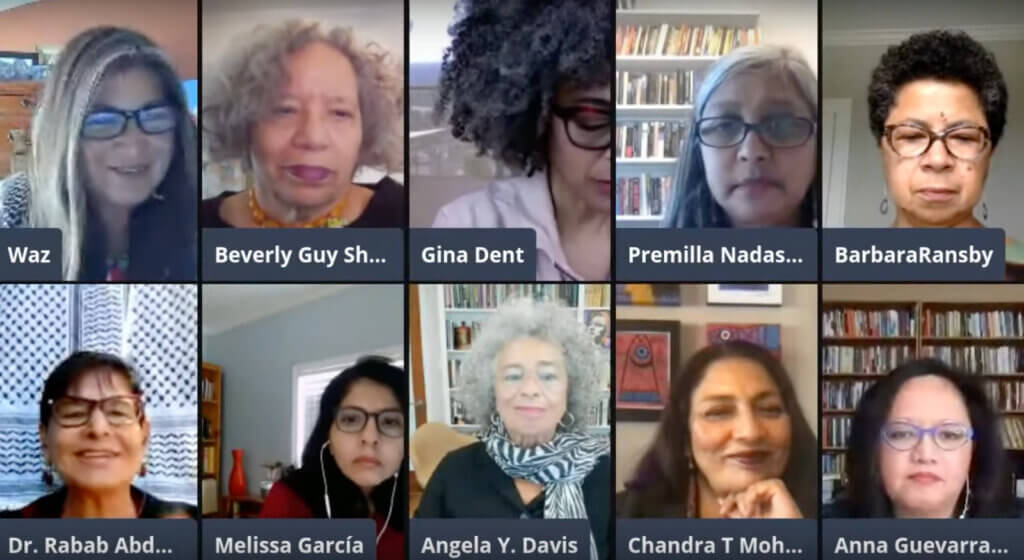
As these interventions demonstrate, Dr. Abdulhadi’s commitment to developing critical intellectual and scholarly thinking centers local perspectives, histories and knowledges while bringing participants across borders and communities into intergenerational conversations with one another, and into the field of Middle East Studies and overlapping studies and perspectives. Dr. Stephan Sheehi, the Sultan Qaboos Professor of Middle East Studies, and Director Decolonizing Humanities Project at William & Mary University had this to say about the series:
“In fact, her international and national workshops, conferences, projects, collaborations and her ‘open classrooms’ exemplify bringing the university to the people and, indeed, the people to the university. She does this, I must add, in truly ethical ways that does not put the onus on the public to leave their communities. Rather, she often brings the university to them, whether in Palestine, California, New York, South Africa or via-the-cyber-sphere. In this regard, I would call Rabab the President-Provost-Dean-and-Professor of her own ‘Open University,’ granting access to as many people as possible. As someone who is interested in abolition, race, gender and sexuality, and colonialism in North America and the Global South, her ‘open courses’ on political prisoners, Asian Americans, Black-Palestinian solidarity, queer and trans rights, settler colonialism and resistance, and Islamophobia remain trail-blazing and timely. [emphasis added]”
More recently, Teaching Palestine marked several watershed historical moments that shape and influence the Palestinian struggle for justice, freedom and Return, such as the 40th anniversary of Israel’s 1982 invasion of Lebanon, the siege of Beirut, and the Sabra and Shatila massacre (Sept. 16-18, 1982), the 50th anniversary of the assassination of Ghassan Kanafani in 1972; the 20th anniversary of Israel’s reinvasion of Palestinian Authority areas (Mar. 29, 2002 – May 10, 2002), the Jenin massacre (April 3-11, 2002), the 20th anniversary of the beginning of Israel’s Apartheid Wall; and the 15th anniversary of the siege on Gaza (Summer 2007).

As part of the Teaching Palestine project, Dr. Abdulhadi led the collective organizing of three events to commemorate these anniversaries: an international conference in Beirut, Lebanon (September 10-11), followed by an international delegation co-hosted by Beit Atfal Assumoud and other Palestinian and Lebanese academic, research, and community groups (Sept. 12-16); and an international symposium in Tunis, Tunisia (Sept. 20, 2022).
The latter was co-sponsored by the Insaniyyat International Forum for Humanities and Social Sciences, the International Association of Middle East Studies and the Institut de recherche sur le Maghreb contemporain (IRMC).
Attempts to silence Dr. Abdulhadi
As is widely recognized, Dr. Abdulhadi’s work has been crucial to the continuity, vibrancy and radical ethos of the Palestinian liberation struggle and those of feminist movements across its Diasporas. Why else would she be a target of the Israel lobby industry, which has waged an especially vicious McCarthyist campaign to silence her, dismantle the departments and programs she created, and muzzle campus activism at SFSU?
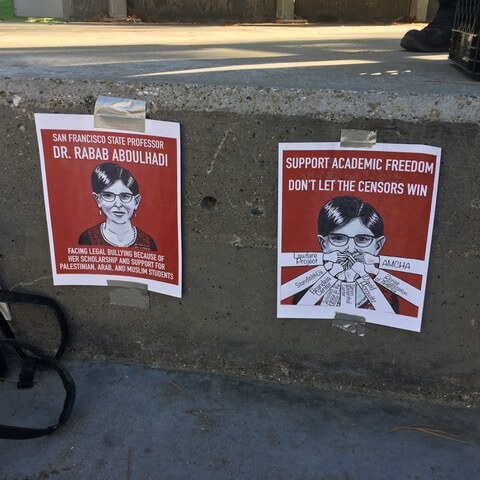
Dr. Abdulhadi has been relentlessly attacked and harassed by Zionist, rightwing and white supremacist Islamophobes, such as David Horowitz, Canary Mission, Campus Watch/Middle East Forum, AMCHA, StandWithUs, Zionist Organization of America, the Anti-Defamation League, the Lawfare Project and the Academic Engagement Network, to name a few.
As the long history of U.S. repression against oppositional voices teaches us, anti-racist and anti-colonial critics who contest the status quo are systematically targeted, smeared, bullied and threatened. In his support letter of Dr. Abdulhadi’s nomination to the MESA award, Dr. Cole stated, “She’s been indefatigable in her service activities, often under adverse circumstances.” Dr. Abdulhadi was the only professor named in a lawsuit against the SFSU and California State University administrators and staff, filed by the Lawfare Project, whose stated goal is to wage a legal war to exact a price from critics of Israel. After almost two years of litigation by a wealthy and internationally connected San Francisco law firm, Federal courts dismissed the lawsuit with prejudice on October 30, 2018.
Despite winning this precedent-setting case against scholars and advocates for justice in Palestine for herself and her university, Dr. Abdulhadi was forced to file several grievances against the SFSU administration to hold it accountable for its collusion with Zionist groups. She was recently vindicated when three independent Faculty Hearing Panels unanimously ruled in favor of Dr. Abdulhadi and her colleague, Dr. Tomomi Kinukawa, ordering the university to apologize to them for violating their academic freedom and fostering a hostile work environment.
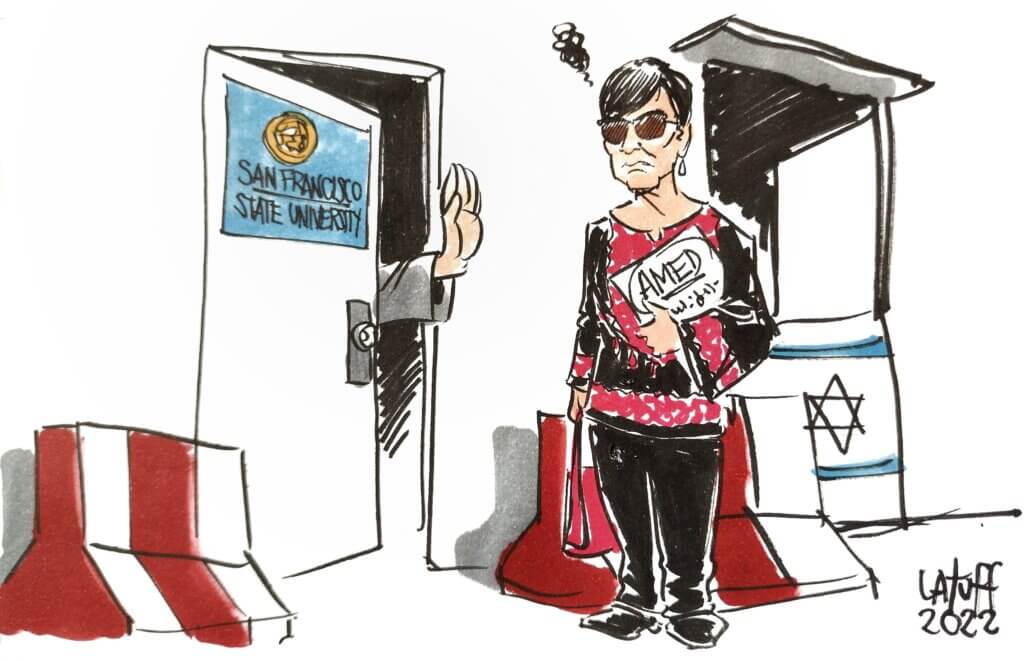
Refusing to take individual credit, she has modeled how to collectively build a movement, as she consistently insists. These victories are for everyone insofar as they block the setting of dangerous precedents of repression, criminalization and silencing for all scholars of the Middle East, as well as social movements and oppressed communities. Arguably, the greatest contribution of all is how Dr. Abdulhadi gives us the courage and hope to continue the fight. Through her unwavering and fearless persistence, and her many victories against brutal attacks, she reminds us every day of the agency and power we have even when the odds seem overwhelming or impossible.
In 2020, the American Association of University Professors honored Dr. Abdulhadi with the Georgina M. Smith Award for her “courage, persistence, political foresight, and concern for human rights.” Dr. Nada Shabout, an artist and professor of art history and coordinator of the Contemporary Arab and Muslim Cultural Studies Initiative at the University of North Texas, in supporting Dr. Abdulhadi’s nomination, wrote to MESA that, “Dr. Abdulhadi’s important and exemplary work, unwavering dedication and continuous engagement in the face of numerous challenges have been an inspiration to all of us in the field.”
Dr. Abdulhadi’s work has been simultaneously deeply theoretical, pedagogically ground-breaking, ethnographically thick, and demonstrative of critical analysis of power, gender, class and imperialism. By pushing back against the stereotypes of Middle East communities, societies and narratives that dehistoricize and marginalize voices and scholarship, she has fostered a broad and nuanced understanding of the region. She is a bold and fearless visionary with an uncompromising commitment to cutting-edge research and pedagogy despite the climate of hostility, discrimination and harassment that she has faced alongside many scholars on Palestine and the Middle East. An inspiration to generations of women and feminists, to scholars and social movements globally, she has indelibly shaped the western academy and field of Middle East Studies, along with the struggle for justice in Palestine. In the spirit of the indivisibility of justice that exemplifies Dr. Abdulhadi’s life, career and commitments, the recognition of her invaluable contributions through this award has never been more timely or appropriate.

I would like to congratulate Dr Rabat Abdulhadi on receipt of this prestigious award, but more so I want to thank her for being a beacon of light in the midst of a great deal of darkness. She works to end oppression with every breath of her body .
A truly inspirational lady, long may you continue your wonderful work.
“organic intellectual”!