
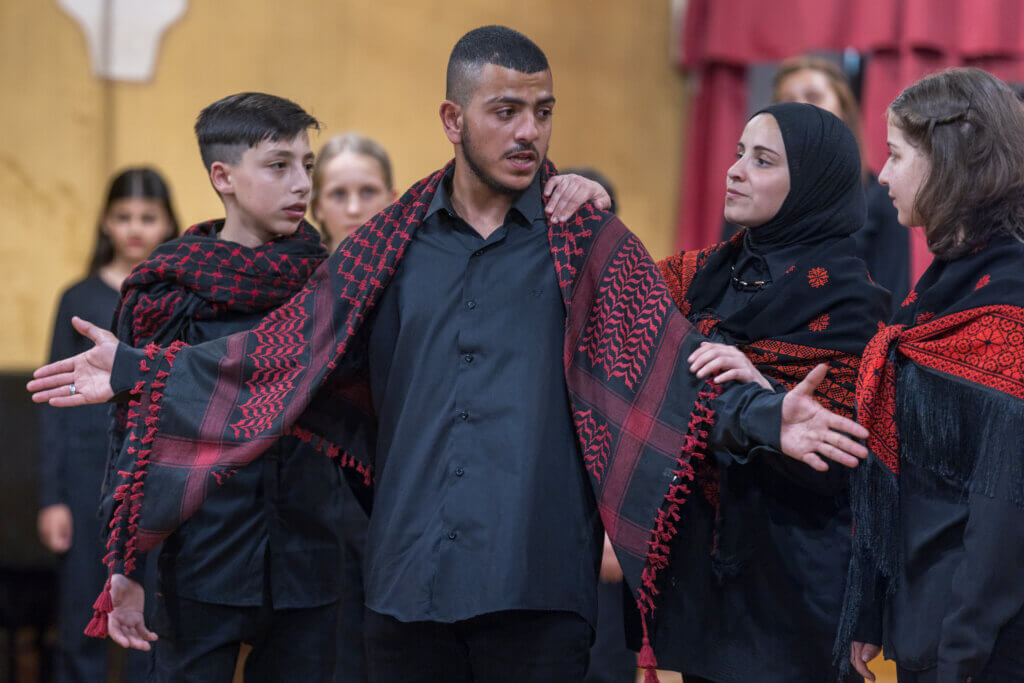
For three weeks this month, Palestine and Italy meet face-to-face.
Palestine’s Amwaj Choir has embarked on an ambitious eight-stop tour of Italy, performing three contrasting programs in Vicenza, Brescia, Avesa, Torino, Genova, Roma, Castelnuovo di Porto, and Supino. An opera, “Amal — Oltre il Muro” (Amal, beyond the wall), alternates with two concert programs: “Dialogo Corale” (Choral dialogue) and “Onde Corali” (Coral Waves).
The Amwaj Choir is an independent educational program for children and youth established in 2015, based in the Palestinian towns of Bethlehem and Hebron. Led by a team of French and Palestinian educators and under the direction of founder Mathilde Vittu, a professor of music at Paris Conservatory, Amwaj offers high-quality music tuition through an intensive pedagogical program based on collective singing. Today, Amwaj counts 60 girls and boys from 8 to 18 years of age from towns, refugee camps, and rural areas in both the Bethlehem and Hebron regions of the West Bank.
Amwaj’s social vision is inclusive, promoting gender equality, non-affiliation to any specific social, religious, or political context, and focusing on cultural exchanges and intercultural dialogue. Collaboration with other artists and pedagogues within Palestine and abroad is central to the project. The choir’s repertoire is broad, from Medieval to contemporary premieres, to Arabic, as well as other non-Western music. The choir’s Italian tour follows three highly successful tours to France, including a residence at the esteemed Paris Philharmonie.
I spoke with Director Vittu, who explained that
Discovering the world through music is one of the goals of the Amwaj Choir: since the very beginning, 8 years ago, children have had the opportunity to sing in more than 30 languages. This allows them to face the imposed closure by “travelling” with songs. When the travel becomes a real one, despite the 36 hours’ journey to reach Europe — because as Palestinians they must go via Amman — all their energy is gathered to show the beauty of Palestine and its culture. Arriving in Italy, being hosted in local families and sharing the stage with Italian musicians and singers, this allows a dialogue, a unique encounter for everybody to believe in the future.
For me, the opportunity to hear this Palestinian choir without having to endure Israeli “security” at Ben-Gurion airport or the Allenby Bridge was too good to resist. I caught a flight to Venice and nailed a good seat in the full house awaiting their first performance: the opera Amal — Oltre il Muro, in the beautiful small northern city of Vicenza.
While I doubt that art can (or indeed should) ever be disconnected from society, for people under military apartheid, art is, by definition, political. Amal is overtly so, as it is based on the novel, The Oil’s Secret Tale, written in prison by Palestinian prisoner Walid Daqqah. Israel imposed a thirty-seven-year sentence on Daqqah in 1986, at the age of 23, for his role in a resistance operation in which an Israeli soldier was killed. This children’s opera adaptation of his novel is the fruit of a 2020 Amwaj choir commission to composer Camille van Lunen and librettist Cornelia Köhler, with an instrumental ensemble of strings, percussion, and kanoun. The opera’s original English was translated into Italian for the tour.

In the opera — as in real life — a vast wall dissects the earth, darkens the sky, and separates people, animals, and trees from each other.
An ancient olive tree, one of the story’s main characters, explains:
Two-thousand years — a very long time. Alfeyn sane.
– A time full of history. Which story, whose story? Two-thousand years. Waq’t taweel k’teer — a very long time I lived in peace and freedom, in wartime and upheaval.
– Two-thousand years — a very long time. Alfeyn sane.
– I met Jews and Greeks and Romans and Arabs, crusaders and soldiers, peasants and herdsmen.
– I met girls and boys, wise and foolish, brave and strong, happy and sad.
– I met men and women, working and loving and kissing and fighting and struggling for life.
– Two-thousand years, Alfeyn sane — a very long lifetime
– But never had I seen a wall before…
When the wall blocks Amal and his brothers from visiting their father in prison beyond the wall, animals team up to help. Ideas and attempts alternate: Shall they dig a tunnel under the wall? Fly over it? Sway the guards? Their best efforts fail, but one further accomplice offers help: the ancient olive tree.
“Children,” she says, “I heard your story, and I saw your tears. I will help you. The oil of my fruit is magical. Pick my olives and rub yourself with their oil. It will make you invisible and enable you to sneak into the prison and meet your father. Together with him you will free the oldest prisoner.” Amal asks, “Who is the oldest prisoner?” To which the tree answers only, “You have to find out.”
The plan works. The ancient tree’s magic oil enables them to reach the other side of the wall, enter the prison, and find their father. All along, they wonder if he is the oldest prisoner who they will free. But he is not. They learn that injustice’s oldest, ultimate prisoner is the future.
Through their perseverance, they will free the future.

Author Walid Daqqah married his wife Salameh after thirteen years in prison and, infuriating his jailers, fathered their daughter Milad by secreting sperm out of the prison. He is now dying of advanced bone marrow cancer.
The choir and musicians all have their own stories of life under Zionist fascism. Limiting examples to a few adult members, in 2021 Israeli soldiers arrested Palestinian contrabassist Mariam Afifi and dragged her away by her hair for resisting the ethnic cleansing of Sheikh Jarrah. When in 2015, Palestinian violinist and mezzo-soprano Aleen Masoud went to the USA with journalist Gideon Levy for a talk + performance in Westchester (NYC area), Zionist mobilization led police to try to scupper the event but thanks to WESPAC managed only to disrupt it. Violist Omar Saad, one of four Galilee-native siblings among the tour’s musicians, was imprisoned in 2014 for refusing to serve in the IDF.
Israeli oppression is designed to suffocate all aspects of normal daily life, including culture. A web of Israeli settlements and IDF activity lies between the Choir’s home cities of Bethlehem and Hebron, and Israeli apartheid forces Palestinians traveling abroad to fly from Jordan, which in turn requires a costly and laborious exit through Israel’s extortionist control of the Palestine-Jordan border.
But achievements like the Amwaj Choir are defiant proof that Israel’s seventy-five-year campaign to erase Palestinian civilization is futile.
See also, The remarkable rise of the Amwaj Children’s Choir of Palestine, Mondoweiss, 2018
Thomas Suárez
Thomas Suárez is a London-based historical researcher as well as a professional Juilliard-trained violinist and composer. A former West Bank resident, his books include three works on the history of cartography, and four on Palestine, most recently “Palestine Hijacked – how Zionism forged an apartheid state from river to sea”.

Thank you so much Thomas for writing, “Palestine Hijacked”, which revealed the inability of the British to control the Zionist endeavour both during the British Mandate and following their withdrawal ; and also for highlighting the steadfastness of Palestinian cultural resistance. In spite of 75 years of oppression they continue to stand tall. Well done Amwaj children’s choir. What a great achievement to sing in different languages, and perform an opera honouring Walid Daqqah’s book “The Oil’s Secret Tale”. How I hope your brief break from the Palestinian Occupied Territories fortified you for your return to the ongoing Nakba back home.
Because the article mentions an olive tree, I must point out how alien Zionist treatment of an olive tree is to Rabbinic Judaism.
Here are sections 8 and 9 of RAMBAM’s Mishneh Torah Melachim uMilchamot – Chapter 6
8 We should not cut down fruit trees outside a city nor prevent an irrigation ditch from bringing water to them so that they dry up, as Deuteronomy 20:19 states: “Do not destroy its trees.” Anyone who cuts down such a tree should be lashed.
This does not apply only in a siege, but in all situations. Anyone who cuts down a fruit tree with a destructive intent, should be lashed.
Nevertheless, a fruit tree may be cut down if it causes damage to other trees or to fields belonging to others, or if a high price could be received for its wood. The Torah only prohibited cutting down a tree with a destructive intent.
9 It is permissible to cut down any non-fruit bearing tree, even if one has no need for it. Similarly, one may cut down a fruit bearing tree that has become old and produces only a slight yield which does not warrant the effort required to care for it.
What is the yield that an olive tree must produce to warrant that it should not be cut down? A quarter of a kav of olives. Similarly, a date palm which yields a kav of dates should not be cut down.