
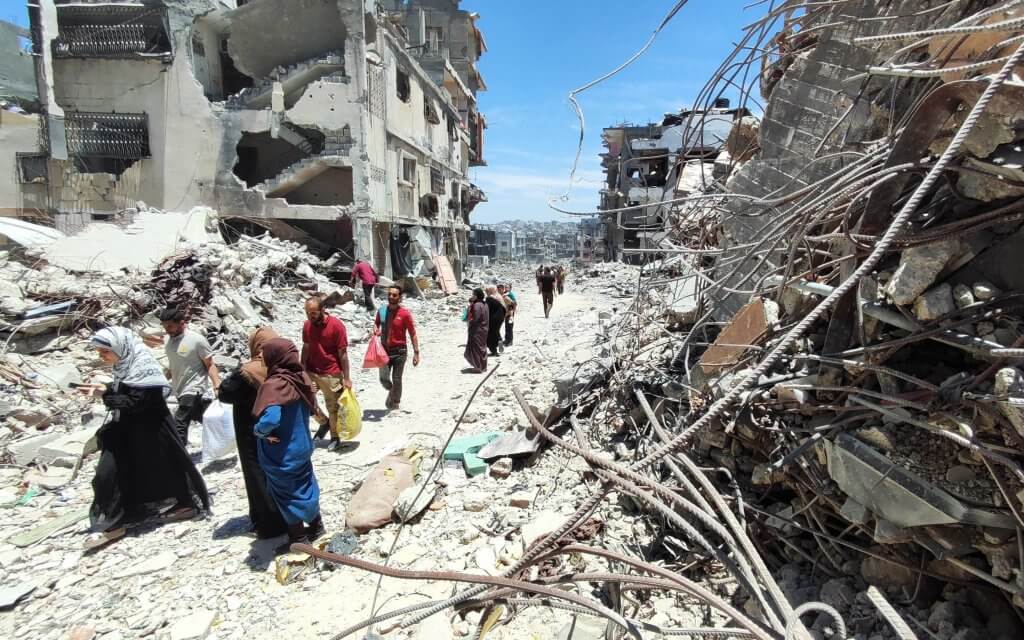
After a bloody 3-week invasion, the Israeli army finally withdrew from central parts of the Jabalia refugee camp, remaining in central locations on the outskirts of Jabalia and Beit Lahia. It left devastation in its wake.
This is the second time that the army has launched a ground invasion of the camp and its neighboring town. At the start of the year, Israel had declared the end of the “intensive” phase of fighting in northern Gaza, withdrawing from Jabalia and other parts of the north after having supposedly “dismantled” Hamas’s military presence there. Almost five months later, the resistance had already regrouped in the north. By early May, the second invasion of Jabalia, the al-Zaytoun neighborhood, and the Tuffah area commenced, but three days in, the Israeli army withdrew from al-Tuffah and al-Zaytoun, east of Gaza City. Jabalia, however, was different.
Most reports kept repeating the same mantra: the fighting in Jabalia this time around was fiercer and more violent than the first invasion. It could be noticed in the marked rise of Israeli military casualties since the start of the Rafah invasion to the south. Resistance factions launched repeated salvos of rockets toward Israel, targeted Israeli tanks on the ground in Jabalia with mortar fire and RPGs, and shot at soldiers in sniping operations. Footage of those operations was broadcast online and on Aljazeera’s round-the-clock coverage.
But what was most significant about the Jabalia invasion was the news that the Qassam Brigades had captured more Israeli soldiers in an ambush on May 26.
The media spokesperson for the Qassam Brigades, Abu Obaida, announced that resistance fighters had targeted 100 Israeli tanks in ten days.
“The Israeli enemy is entering hell again in Gaza, facing more resistance,” Abu Obaida said. “They thought that they would not encounter significant resistance. But they were surprised and confronted with stronger fighting than the first day of the ground invasion.”
The military spokesman also stated that fighters targeted an Israeli force in an ambush, and had managed to capture several soldiers, vowing that more details would be released at a later date.
On the first day in Jabalia, Israel leveled over 300 houses, clearing the rubble with D9 bulldozers to pave the way for the entry of tanks inside the camp. People in the camp started telling each other that it looked like the same operation Israel had launched during its second invasion of al-Shifa Hospital, where it massacred hundreds of Palestinians and buried them in mass graves. When the graves were unearthed, many of the bodies were found with hands bound and medical catheters still attached.
Knowledge of what happened at al-Shifa drove people to attempt to leave Jabalia when the invasion began, fearing that they would meet the same fate. Yet a considerable number of people also remained.
Jabalia refugee camp is considered one of the most essential popular bases of the Hamas movement. Due to the significant number of resistance members who lived there, it came to be called “Jabalia military camp” (mu’askar Jabalia). In 1987, the spark of the First Intifada was lit in Jabalia. The camp’s terrain is composed of densely packed buildings with complex and narrow alleyways that can only accommodate two people walking abreast. Anyone who grew up in the camp and later became a resistance fighter was able to move around the battlefield that was once their home with speed and intimate familiarity.
When the Israeli army stormed Jabalia for the second time, thinking it would crush the camp, it was surprised that the fighters had been well-prepared. The number of Israeli casualties reported through the news began to climb. Israeli media reported soldiers’ frustration at going into Jabalia a second time without results.
Due to the indiscriminate artillery shelling of all areas of the camp, some families left Jabalia for less targeted parts of northern Gaza. At the same time, those who remained witnessed fierce battles, and new resistance tactics lured Israeli soldiers to several ambushes.
During the past 3 weeks, the resistance in Jabalia and northern Gaza used new air defense weapons against helicopters and reconnaissance drones, some of which it shot down.
Mirroring the tenacity of the resistance fighters, camp residents also attempted to embody steadfastness by remaining in their homes.
Ahmad Abu Khater, 34, lives in Jabalia, and did not leave the camp at any point since the start of the war. He told Mondoweiss that he witnessed Israeli soldiers enter dozens of demolished homes that had been bombed by Israeli aircraft in advance, and he saw those same homes explode after the soldiers had entered. He also reported witnessing how Israeli military concentrations were targeted with mortar shells.
“We live in fear of an inevitable death, but we know here in Jabalia that every soldier who invades our camp feels the same.”
Ahmad Abu Khater
“We live in fear of an inevitable death, but we know here in Jabalia that every soldier who invades our camp feels the same,” Abu Khater said. “Our resistance is stronger, and everyone here is thankful because we all know that this enemy is fighting Palestinian existence, so they will commit even more horrifying massacres if no one faces them.”
“Jabalia is the birthplace of uprisings,” he added. “The occupier knows this but refuses to accept it. But the occupier will never be able to uproot our resistance.”
Abu Khater also said that the number of young men carrying weapons in the camp has increased of late.
“Young fighters affiliated with different factions are wandering in the alleys and waiting for any soldier or vehicle to attack and fight,” he told Mondoweiss. “They are revolting in anger. The occupation is killing their families and destroying their homes.”
“Everyone in the camp who has lost loved ones, family, who has been through harder experiences than death at the hands of the Israeli army…most of them want to fight,” Abu Khater stressed. “Because they lost everything. They live in pain and sorrow. So if they can, they fight.”
“Everyone wants to resist in Jabalia, each in their own way, and whoever cannot confront the army and soldiers will remain here on their land,” Abu Khater explained. “This is our resistance. Steadfastness and survival is also a fight.”
Thanks for the report, by FAR the most informative I’ve seen or heard about this.
‘The smell of death and blood wafts throughout Jabalia camp’
In northern Gaza, Palestinians have to make an impossible choice after an Israeli attack: leave the wounded to die, or risk their lives trying to save them.
By Ibrahim Mohammad May 29, 2024
“On the morning of May 11, the Israeli army spokesperson announced that the military had begun a new operation in Jabalia, the city and adjacent refugee camp in northern Gaza. Evacuation orders were issued to Palestinian residents of several neighborhoods, but many have been unable to leave; others have decided to stay, given the lack of any safe areas throughout the Strip.
The northern half of the Strip bore the initial brunt of the Israeli army’s bombardment in the first weeks of the war, and, on Oct. 27, was the first region of Gaza to be targeted by the Israeli ground invasion. By March, the north was facing a Phase 5 famine — the highest level measured by the Integrated Food Security Phase Classification, designated as “catastrophe.” Nearly no humanitarian aid is reaching northern residents, and an estimated third of all children there under the age of two are suffering from acute malnutrition.
The situation is perhaps most dire in the Jabalia refugee camp, the largest in Gaza, with a prewar population of over 100,000 Palestinians living in an area of just 1.4 square kilometers. Indiscriminate Israeli attacks in such a densely populated region thus have a massive deadly impact. In October, two 2,000 pound bombs were dropped on Jabalia, killing at least one hundred people. Less than two months later, another attack had a similarly high toll. And, just in the last two weeks, Israeli bombs have destroyed homes, a kindergarten, and the emergency wing of a hospital.”
https://www.972mag.com/jabalia-camp-israeli-attack-gaza-war/