

Primary season is coming to a close as we move closer to the presidential election.
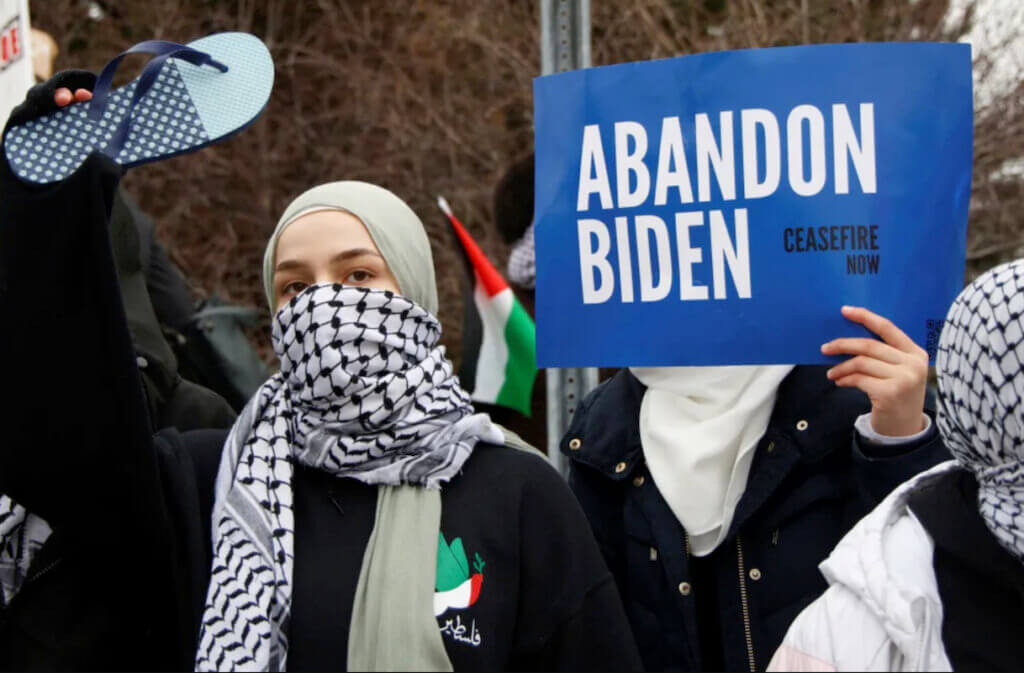
In recent months, thousands of voters have flocked to the polls to vote “Uncommitted,” a symbol of their displeasure with Biden’s support for Israel’s genocidal assault on Gaza.
That electoral push was birthed out of a Listen to Michigan campaign with a small budget and little time. In that state, more than 104,000 people voted Uncommitted. The subsequent national effort has earned the movement almost 40 delegates at the upcoming Democratic National Convention in Chicago.
Where does the movement go from here and what happens to it after November? Mondoweiss U.S. correspondent Michael Arria spoke with Palestinian-American activist and Listen to Michigan Co-Director Lexis Zeidan about these questions.
Mondoweiss: I wanted to start by talking about the demands of the Uncommitted Movement. What is it calling for?
Lexis Zeidan: Since the very beginning of the movement we’ve been demanding President Biden to both back and enforce a permanent ceasefire. There’s also been conversation around demanding that he does an arms embargo on Israel and halts aid as well.
The primary demand is to, again, ensure that there is a permanent ceasefire and one of the things we’ve most recently started discussing is that one of the ways that Biden can start ensuring that is by ending America’s blank check to Israel’s war and the occupation against Palestinians.
Across the primaries so far, we have seen tens of thousands of people throughout the country vote uncommitted or express their displeasure for Biden in other ways if that option wasn’t technically on their ballots. What do you think of the support the movement has gained so far and what do you think the big takeaways are?
This started in Michigan. I was one of the lead organizers and co-directed the campaign alongside Layla Elabed and Abbas Alawieh . We aimed for 10,000 votes and we had gotten that number within the first 10 minutes of the polls being closed. We ended up with an astounding 104,000+ Uncommitted voters.
I think that really showcased how a lot of Biden’s key constituents are just becoming very disillusioned by the Democratic Party and by Biden himself because of this ongoing support of Israel’s occupation of the Palestinians.
The majority of primaries have now been held and we secured nearly 750,000 votes and have 36 DNC delegates.
I think it also revealed a gap in the ecosystem, particularly around this concept of an anti-war, pro-peace Democratic base. The majority of primaries have now been held and we secured nearly 750,000 votes and have 36 DNC delegates.
These aren’t just numbers, they’re numbers that reflect the growing public dissent and the power of grassroots activism. Most campaigns had less than a month to organize, to get people to go out and vote Uncommitted. Furthermore, I think the success has already pushed the Biden administration to reconsider its stance on Gaza by even going as far as endorsing the concept of a ceasefire.
Connected to that, I’m wondering how you think this movement can exert pressure on the Biden administration. I’m also wondering how many supporters will never vote for Biden based on what’s happened so far vs. how many might support him if they see some tangible shifts.
I can share a key data point from Michigan here. We actually got 42% of unlikely and non-likely voters to the polls to vote Uncommitted.
To go back to your original question around exerting pressure on the Biden administration, and this is a conversation I’ve been having quite often, the Uncommitted Movement didn’t get started to particularly highlight this Trump versus Biden election.
A lot of the conversation that people are having is around the idea of Trump vs. Biden, but I think really that the pressure is being exerted to shift the Democratic Party in general.
I think a lot of the conversation that people are having is around the idea of Trump vs. Biden, but I think really that the pressure is being exerted to shift the Democratic Party in general around its human rights policies when it comes to Palestinians. We’re going to continue mobilizing public opinion and leveraging influence both in the Democratic party primary process and the convention. We’re going to continue to push for policies that prioritize peace and human dignity. We’re going to continue to pressure Biden to recognize that his current stance alienates these core constituents that are within his party, that are asking for the party to move to more of a human rights-based [foreign policy.]
So, in relation to people voting Biden or not voting Biden, I can’t speak for the movement, but I can speak to conversations I’ve heard. It’s not a monolithic movement, not everyone has written Biden off but some people have.
We have to remember what the point of the movement is and that’s centering Palestinian lives and human rights.
I think what we have to remember what the point of the movement is and that’s centering Palestinian lives and human rights. At the end of the day, we’re not here to save Biden and we’re not here to hand this election over to Biden. We’re also most definitely not here to hand this this election over to Trump. This core base is a Democratic base. We know what a threat Trump is, but I think, again, going back to the original reason that this movement has started is to center and value human rights in Palestinian lives, to continue to exert pressure, and to remind folks that we have to continue to uplift this idea that Palestinians deserve freedom and democracy just like anybody else.
We’re really trying to use that that lens to exert the pressure and ultimately try to get Biden to see that this core base is really, really critical to him winning the presidency. What ends up happening in relation to him changing course or not is really on him and depends on individual voters. But again, I want to highlight that it’s not a monolithic movement and that he could definitely turn some of these voters come November.
You mentioned that the success of the primaries has earned the movement a number of delegates. I’m not sure most people understand what that means. What does it mean to the movement to have delegates at this convention, and what will the delegates be doing there or pushing for?
Yeah, great question. So ironically, delegates were never in our plan. When we launched the movement across various states, we really set the bar by looking at previous elections to see what kind of vote numbers could influence [policy.] The delegates just ended up being in addition because of how many votes we received, so I think it was a process.
A lot of people didn’t really know how delegates work, myself included. I learned so much in the last several months in relation to how delegates work when it comes to the Democratic National Convention. I think for this particular movement, delegates at the DNC really allows us to influence the party both in the short term and long term.
Again, we’re trying to remind folks that this is not just about Biden. It’s really about long-term advocacy for Gaza and Palestinians and human rights. So just ensuring that our calls for peace and justice in Gaza are heard and considered at all levels, especially the highest levels. It would be outright crazy to have the DNC and not have any mention of what’s happening both in Palestine, particularly in Gaza. We really want to ensure that our delegate are uplifting Palestinian human rights and voices at the DNC. I think this presence is vital in both pushing the party towards more human policies, similar to the efforts by civil rights activists of the 1960s, and really trying to continue to exert pressure on Biden, the administration, and the party to really shift course on Gaza as quickly as possible.
Finally, I wanted to ask what happens to the Uncommitted Movement after November. What does the organizing look like after the election and is that a different calculation depending on whether Biden or Trump prevails?
Yeah, it’s a great question. I think one of the things to highlight is that the plight of the Palestinians, both the genocide, the ethnic cleansing, the occupation, it’s nothing that’s new, right? It’s been happening for the last 76 plus years. All the folks in this movement understand and know that so I think the goal here is that it’s a really long-term play to reestablish the relationship between Palestine and the United States and really ensuring that we secure the rights and the freedoms of the Palestinian people.
Regardless of the election outcome, our movement is going to persist in advocating for justice and peace, not for one person, but for all people.
I think regardless of the election outcome, our movement is going to persist in advocating for justice and peace, not for one person, but for all people.
This movement actually identified a gap in progressive ecology. When you talk about progressive movements, whether it’s Black Lives Matter or reproductive rights or the transgender community, the LGBTQ community, one of the things that we’ve recognized, especially advocating for Palestinian human rights, is that our country funds senseless wars. One of the largest budgets in our $7.2 trillion dollar budget is our military industrial complex budget, our budget that funds wars and policing in this country. We recognize that when we want to up our military budget, we actually cut from health care and we cut from our education.
So I think far beyond just the election, Palestinian human rights activism is being embedded both within organizations and movements inside the Democratic Party ecosystem for the long haul because of this connection to larger issues that we face across many different oppressed groups within our country. While we know Trump would be worse, Biden’s current policies are already alienating these key potential supporters by placing Netanyahu ahead of his own re-election and necessitating continued pressure for meaningful change from us.
Regardless of how the election turns out our our goal is to really shape shift the Democratic Party and reevaluate our policies when it comes to funding senseless wars and what it really looks like to reinvest in communities, whether it’s homelessness or universal health care or reproductive rights for women, our education system, all the things that we all deeply care about that we need to start reinvesting in.

The entire American political set-up is a farce.
Trying to view the genocide in Gaza as somehow an aberration for the Democratic party, is like believing that your cat actually killed the mouse is aberrant behavior for the cat.
In terms of lives lost, the Biden policy in Israel is a distant second to the proxy war this party is waging against Russia, using Ukrainians as cannon fodder; although somehow the deaths of press-ganged soldiers somehow seems less offensive than those of civilians.
The administration has created conditions of censorship and restrictions of speech unprecedented in our history. The energy devoted to legal shenanigans to prevent him from campaigning and running, are also unprecedented, a symbol of the administration’s inability to address the issues that concern the majority of Americans. There are no arrows left in its quiver except fear, censorship, and hate mongering.
As other have noted, rejecting the Democratic and Republic parties as power structures underwritten by those who are profiting from Ukraine, and Palestine, is the essential first step to make any changes. Unfortunately there are no short cuts
“We’re going to continue mobilizing public opinion and leveraging influence both in the Democratic party primary process and the convention. We’re going to continue to push for policies that prioritize peace and human dignity. We’re going to continue to pressure Biden to recognize that his current stance alienates these core constituents that are within his party, that are asking for the party to move to more of a human rights-based [foreign policy.]”
_________________________________________________________
It will be a good day for the people of Palestine when the average American can appreciate just what the agenda is.
I would have voted for Bernie Sanders in the 2016 election if he had gotten to the general election. I don’t recall if I got around to voting in the 2016 Primary, but would have voted for him.
In 2016 and 2020, one year I voted Green Party, and the other year I was so mentally/spiritually exhausted/overwhelmed I didn’t get to the polls.
I plan on voting for Jill Stein or Cornell West at this point.
Sometimes with politicians, you get a trade off. Biden and the Democrats classically have a more societally-oriented policy that cares for society, like the government taking an active role in directly creating jobs. But the Biden administration was more hawkish/Neoconservative/imperialist on relations with Russia/Ukraine.
It’s hard to say whether the Trump administration would de facto have been worse on Isr.-Pal, because we are only looking at one track of history (2020-2024). Trump and his backers at face value were more tied into the Isr. Lobby, such as the Adelsons. In contrast, the Democratic base today tends to be antiwar, pro-Human Rights on the Isr.-Pal. conflict. It’s extremely welcome and hope-giving, compared to the last 5 decades or so. The Trump administration moved the US embassy to Jerusalem.
(continued)
(continued from my last message)
Trump claims that if he were president, the war in Gaza wouldn’t have happened. But in real life we don’t know how the Trump Administration would have reacted to the situation, or if and how he would have prevented it. Suppose for instance that in Sept. 2024 his administration knew that Net.’s administration was planning for a major upcoming assault on Gaza. Conceivably, a hypothetical 2020-2024 Trump adminstration could have seen the Gaza invasion as destabilizing for US relations in the Mideast and could have dissuaded Net.’s plans. So for instance in the runup to the war, we find these headlines.
Tensions ‘beginning to boil’ in Gaza as fears of new conflict mount
By Steve Hendrix and Hazem Balousha, September 21, 2023
https://www.washingtonpost.com/world/2023/09/21/gaza-israel-hamas-palestinians-conflict/
Israeli military attacks Gaza Strip amid protests at border
At least 22 people have been injured in attacks targeting Hamas’s security outposts in the besieged enclave.
22 Sep 2023
https://www.aljazeera.com/news/2023/9/22/israeli-military-attacks-gaza-strip-amid-protests-at-border
Gaza-Israel tensions spiral amid closures and clashes
28 September 2023, By Yolande Knell in Jerusalem & Rushdi Abu Alouf in Gaza City, BBC News
“At a military ceremony on Wednesday, Israel’s Defence Minister, Yoav Gallant, warned that Israel was ready to step up its actions against Hamas in Gaza if necessary…”
https://www.bbc.com/news/world-middle-east-66950112
On the other hand, Trump says that Net. needs to finish the job in Gaza, which could easily be seen as a pro-war statement. And it’s questionable whether a Trump administration would have been more respectful of the free speech rights of US protestors of the Gaza assault.