

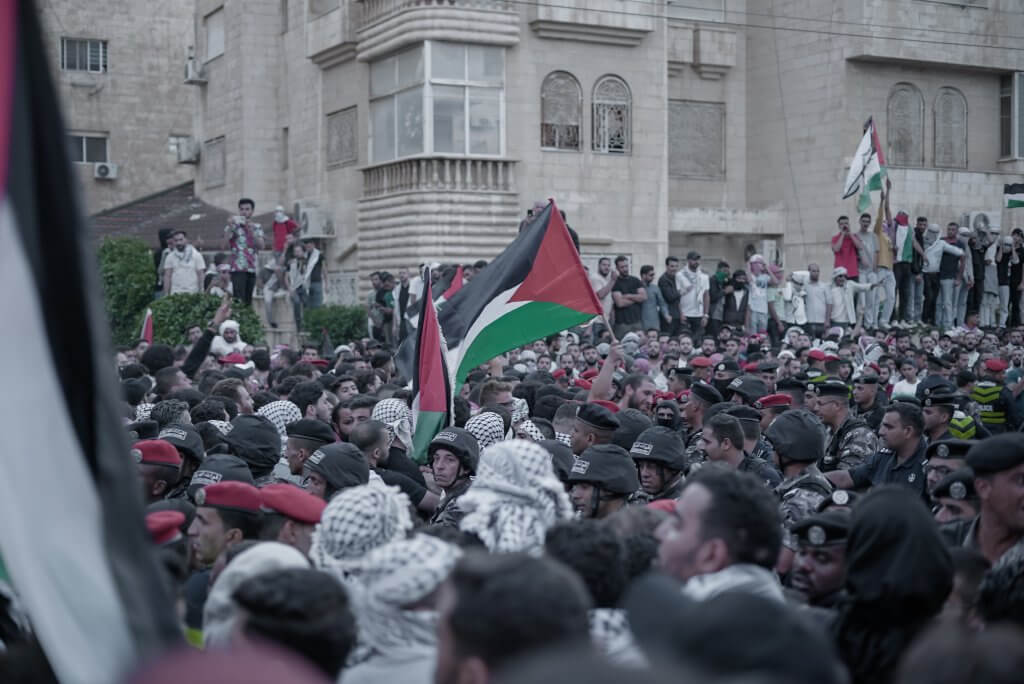
Last week, the border between Palestine and Jordan was on full alert following a shooting attack that killed three Israeli security personnel at the Allenby Bridge border crossing. Israel closed down all border crossings with Jordan, preventing Palestinians from the West Bank to travel for two days before eventually reopening, albeit with more stringent security measures.
The attack was a shock for both Jordan and Israel, not only because it was completely unexpected but also because of the identity of the man behind it.
Maher al-Jazi, 46, was not of Palestinian descent. He was a truck driver from one of the largest and most influential clans in Jordan, the Huweitat clan. He had served in the Jordanian armed forces and had no political affiliations. In essence, al-Jazi came from a sector of Jordanian society that represents a deeply local Jordanian tribal identity, laying bare the extent to which Israel’s genocide in Gaza has reverberated across the region and impacted all of its people.
A week before the attack, I visited Amman for the first time in my life. It was a strange feeling to be in an Arab city not under occupation. It was like being at home, but in very different conditions; the complex urban infrastructure that one would find in any world capital, the freedom to travel across the country for hours without being stopped by the army or police, without being attacked by settlers, without being hounded by the constant sense of vulnerability and anguish — all of it, in a nutshell, felt at once foreign and familiar, reflecting the basic human desire to be free.
It also felt strange to hear Jordanians’ discussions about their daily concerns. The upcoming parliamentary elections that ended up taking place the following week, the economic hardships of the working class, the differences between oppositional political currents — it all felt familiar, but with a crucial difference. Nobody talked about a family member whose house had received a demolition order, or about someone they knew who had their administrative detention renewed. Nobody spoke of how they were trapped in their house for a week because of a military raid in town, or how their property lost all its value because some settler decided that he owned it and set up an outpost on the property.
It felt like Jordan was a “normal” country with “normal” problems, although I remained aware that these problems, like any other Arab country, were only normal in comparison to Palestine’s colonial context.
I always assimilated this idea of “normality” in other countries where I have lived, primarily Europe and America, but to my mind, being in an Arab country was always associated with a life under occupation. In that moment, I realized in a painfully tangible way how cut off we Palestinians have been from the reality of our immediate Arab surroundings, from its daily life and social complexities. Communication with the outside world for many Palestinians of my generation has mostly meant communicating with the Western world.
This is in stark contrast to previous generations, whose interactions were mostly with the surrounding Arab countries. In those days, most of our cultural influences flowed from Cairo or Beirut, and the Palestinian liberation movement was based in exile in different Arab countries. Even though most families in the West Bank have relatives east of the Jordan River, for me and many of my peers, I have always seen Jordan as a stop on our way to somewhere else, a place to stay a night or two at a relative’s home before boarding a plane to Amman’s international airport, which is the only way Palestinians from the West Bank can leave the cage created by Israel.
There was something else I couldn’t miss during my short stay; amid Jordan’s “normality” and Amman’s daily hustle and bustle, Palestine is everywhere. At any public restaurant or coffee shop, there is always a TV screen airing Al Jazeera’s live coverage of the war in Gaza. The word “Gaza” and other symbols of Gaza’s resistance are present on T-shirts in street stalls and adorn posters and graffitied walls.
But Palestine’s presence in Jordan is also deeper than that. It is built into the identity of the place; stores are named after Palestine, Jerusalem, or other Palestinian cities, as they have been for decades; the iconic map of Palestine hangs on young women’s necklaces; bookstores are full of Palestinian literature — I was surprised to find a brand new edition of the complete works of Hussein Barghouthi, a Palestinian novelist from the 1990s, which the bookseller told me sold like hot bread among college students.
Candidates for the parliamentary elections from all political stripes holding public meetings at crossroads always mentioned Palestine and Gaza — with zero exceptions — in the middle of rattling off talking points about the local economy and public services. Some of the references to Palestine didn’t make a lot of sense in the context of the speech, but they were always there as if candidates knew that Palestine was “a must” to win voters’ attention.
That’s when I realized that just as we Palestinians feel isolated from our natural extension in the neighboring Arab region, Arab peoples on the other side of the border feel connected, yet isolated, from their natural extension in Palestine. That is what Jordanians were expressing. In times of war and genocide, they feel frustration at not being able to play a more significant role in attempting to stop the genocide.
Much has been written about the inability of Arabs to play a role in their region’s affairs. But such a role can only be fulfilled if Arab peoples are able to be a part of the Palestine question. The major decisions impacting it are still made in Washington, which has not only alienated Palestinians but the people of the entire region.
The artificial isolation of Palestine from its Arab surroundings never removed Palestine from the consciousness of Arab peoples. Israel fooled itself when it thought that it could keep the Arab street passive forever while doing what it likes to Palestinians. It fooled itself when it thought it could normalize relations with the entire Arab world while sidelining the Palestine question. It fools itself again when it expects to end threats coming from Lebanon and Yemen without ending its genocide in Gaza.
Without solving the question of Palestine through freedom, dignity, and self-determination, all sense of “normality” in the Arab world will never truly be “normal.”


Breaking news and certainly relevant for the topic of Palestine:
The U.N. General Assembly strongly supported a nonbinding Palestinian resolution Wednesday demanding that Israel end its “unlawful presence” in Gaza and the occupied West Bank within a year….The vote in the 193-member world body was 124-14, with 43 abstentions. Among those in opposition was the United States, Israel’s closest ally….Riyad Mansour, the Palestinian U.N. ambassador, called the vote a turning point “in our struggle for freedom and justice.”
https://apnews.com/article/un-israel-palestinians-assembly-vote-gaza-a0136b26cad52070e79628639edbec2c
UN demands Israel end ‘unlawful’ presence in Palestinian territories within 12 months… The United Nations General Assembly on Wednesday adopted a Palestinian-drafted resolution that demands Israel end “its unlawful presence in the Occupied Palestinian Territory” within 12 months.
https://www.reuters.com/world/middle-east/un-demand-israel-end-unlawful-presence-palestinian-territories-within-12-months-2024-09-18/
As a Former Hostage of the Palestinian Resistance, I Refuse to Support GenocideReckoning and dealing with Israel’s culpability, not vengeance, is the only path to ending this recurring nightmare.
…….
Later, my learning continued. I learned that the hijackers who held 300 hostages on three planes in the desert were not religious zealots. The Popular Front for the Liberation of Palestine was a secular group with a Marxist-Leninist ideology, whose goal was to establish one socialist democratic Palestinian state. They were political revolutionaries, seeking justice, to be heard and to return home. But it wasn’t until the Second Intifada in 2000 that I personally began to understand Israel’s provocations and aggression, its goal to undermine an independent Palestinian state with growing numbers of armed and illegal settlements, increasing civilian deaths, and the razing of thousands of farms and homes.
https://truthout.org/articles/as-a-former-hostage-of-the-palestinian-resistance-i-refuse-to-support-genocide/
“Israel fooled itself when it thought that it could keep the Arab street passive forever while doing what it likes to Palestinians….Without solving the question of Palestine through freedom, dignity, and self-determination, all sense of “normality” in the Arab world will never truly be “normal.”
_____________________________________________________________________________
There are Zionists who seek “normality” and those who seek “domination”. The one Palestine engages will determine the future of the Arab world.