

On October 27, a number of Arab American leaders in Dearborn, Michigan, the largest city with an Arab majority in the U.S., held a press conference to appeal to their community ahead of the Presidential elections. During the event, they endorsed Democratic nominee Vice President Kamala Harris for president.
The mood at the press conference was far from jovial. The group took turns sharing their own personal stories of how their lives have been affected by U.S. and Israeli military actions across the Middle East, as well as their disappointment with President Biden’s policies. Despite that, the group argued, a strategic vote must be cast for Harris.
“I’ve heard people in my community say they want to punish Democrats for this war,” James Zogby, the founder of the Arab American Institute said at the press conference. “They’re not going to punish Democrats. They’re going to punish immigrants. They’re going to punish innocent people.”
“Don’t punish the country, the world, your children, your grandchildren, because you’re angry,” Zogby pleaded.
As Zogby and others were inside endorsing Harris, a number of protesters stood outside the Arab American Chamber of Commerce (AACC), denouncing the event, chanting “Arab leaders have some shame!” Some of the protesters called the leaders inside “traitors” who were “endorsing our genocide.”
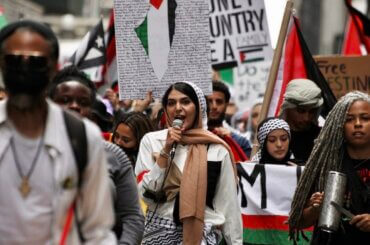
The scene that played out in Dearborn is one of many like it taking place across the country, as the Muslim and Arab communities grapple with, what many describe, as one of the toughest political decisions they’ve faced in their lifetimes: who to vote for in the midst of a U.S.-backed genocide in Palestine.
Outside of Michigan, in another battleground state, prominent Black Muslim leader Ryan Boyer clashed with Pro-Palestinian protesters at a press conference organized by Black Muslims for Harris in Pennsylvania. In a video posted to X by journalist and media critic Sana Saeed, Boyer, visibly agitated, shouts, “I’m talking!” lunging toward the protesters. For many in the community, the moment bore a haunting resemblance to Harris’s own encounter with Palestinian protesters, where she famously silenced them with “I’m speaking!” at a rally earlier this year.
Both episodes reflect the growing tensions within the community over the elections, and as the presidential race hits a fever pitch, the debate in Muslim and Arab-American communities has become about more than politics. Amid the ongoing genocide in Palestine and U.S.-backed war in the Middle East, who to vote for has become a question of morals, religion, and for many, life or death for their friends and family abroad.
Mondoweiss spoke to members of the Muslim and Arab American communities across the U.S. to understand this historic cleavage taking place in the community and the motives and rationales shaping voters’ decisions. No matter their location, political affiliation, age or race, voters across these communities could agree on one thing: with Gaza at the heart of it, a political reckoning is taking place, the reverberations of which will be felt long after this election cycle.
Muslim and Arab voters embrace third party candidates
“If we keep voting for them while they commit atrocities, they’ll never feel pressured to change,”
Saif Kazim, an Indian-American Muslim lawyer from Texas, said of the Democrats, which he called a “genocidal, mass-murdering institution.” Kazim, a longtime Democrat, told Mondoweiss that come November 5, he’s planning to vote third party, likely for Green Party candidate Jill Stein.
“If genocide isn’t a red line for someone, I’d be very concerned. In previous months, I could construct a reasonable argument for why Muslims or anti-war voters might justify voting for Biden, thinking, ‘It’s extremely bad, but Trump would be so much worse’,” Kazim continued.
“But as the situation progresses and the administration reveals itself to be fully aligned with Israel—not just aligned, but actively green-lighting and even encouraging its actions—that argument becomes harder to defend,” he said.
Kazim believes it’s his religious and moral responsibility to challenge what he calls the “political duopoly,” and dismisses arguments, even from within his own community, that Vice President Kamala Harris must be supported to simply prevent former President Trump from winning.
“I don’t care if my vote has personal consequences—I can’t stop caring about this.”
Saif Kazim is not alone. His view reflects a shifting political landscape within the Muslim and Arab American communities.
While Muslim and Arab Americans are credited with helping President Biden win in 2020, third-party candidates like Stein, who has been vocal in her condemnation of the American-backed Israeli genocide, have seen a surge of support from Muslim voters disillusioned with both major parties.
The Council on American-Islamic Relations (CAIR), the nation’s largest Muslim civil rights and advocacy organization, released its latest and final poll of Muslim voter preferences in the 2024 presidential election on Friday, November 1. According to the poll, 42% of Muslim voters now favor Green Party nominee Jill Stein for president while 41% favor Vice President Kamala Harris. “This is a statistical tie similar to the 29% support each candidate received in CAIR’s late August survey,” CAIR noted.
In late September, a group of leading Muslim American scholars and imams signed a letter calling on Muslim voters to rebuff Harris in the upcoming election over the U.S. support for Israel’s genocide.
“We may not know what the future holds, but we know this: we will not taint our hands by voting for or supporting an administration that has brought so much bloodshed upon our brothers and sisters,” the letter said.
Among the signatories were some of the most influential Arab and non-Arab Muslim figures in the country, including Palestinian American Imam Omar Suleiman, Imam Suhaib Webb, and Dr. Yasir Qadhi.
Amar Billoo, a Pakistani American accountant from Southern California, reflects on his shift from voting Democrat to supporting Stein. “There’s a large community fed up with our tax dollars funding the destruction of humanity,” he says, adding that he is also proud of the Imam’s endorsement to vote for third parties.
Billoo sees foreign policy as central to solving domestic issues. “Until we resolve foreign policy, there won’t be resources for domestic reform.”
Sohail, a Pakistani American HR professional from Texas, told Mondoweiss he’s fed up with the “lesser of two evils” argument. “How about we choose the one that isn’t for genocide?” he quipped. “I want our money spent on infrastructure and education, not bombs.”
For many in the Arab American community, it is their own family and friends in Palestine, Lebanon, and the region who are being killed with the weapons supplied by the Biden-Harris administration, leaving voters feeling like they have no choice but to vote third party.
Wael Masri, a Lebanese American voter from North Carolina who was born in Beirut, has witnessed firsthand how decades of American involvement in the Middle East have wrought destruction to his homeland.
And while he voted for Trump in 2020 thinking he would keep America out of more forever wars, Masri says he’ll be voting for Jill Stein this time around, pointing to a powerful speech by Stein’s running mate, Rudolph “Butch” Ware, in his hometown of Raleigh as the catalyst.
“He brought together ideas in a way I’d never seen before—uniting anti-colonialism, anti-genocide, Black identity, Muslim identity, and pro-choice beliefs. He wove these principles with teachings from the Quran in a uniquely powerful way,” Masri said of Ware. “He comes across as a progressive liberal and anti-colonialist Muslim with a profound sense of history.”
“For the first time, it feels like something real is happening,” Masri told Mondoweiss. “This isn’t just a symbolic vote,” he argues, comparing today’s Green Party run with past third-party runs, like those of Ralph Nader or Ross Perot, which he also supported. He sees Stein’s campaign as a foundation for future elections, in which a viable alternative to the two dominant parties could become a reality.
Even in a tight swing state like North Carolina, Masri believes voting for what you truly want is more important than voting against what you don’t. Although Stein may not win, he views her candidacy as part of a growing movement that’s gaining momentum. “This has been a stance that I’ve had for a very long time, which is I do not vote for politicians who kill my own brethren in the Middle East,” Masri said. “North Carolina has become very tight, it’s not only a swing state, but it’s very, very tight. Right now it’s a toss-up. And for that reason, I want to make sure that Harris loses.”
Wael is dismissive of the argument made by many democrats that third-party candidates like Stein siphon votes from Democrats, leading to Republican victories. “People who vote third party are so disgusted by the two main candidates that they wouldn’t vote at all,” he argues. “It’s not just a symbolic act, despite how many people may dismiss it as such.”
As support for Harris erodes, some rally behind Trump
While Stein has seen a rise in support among Muslim and Arab Americans, as well as voters outside of the community who say they won’t vote for genocide, there is far from a consensus within the Muslim and Arab communities on who to vote for.
And it’s not just a decision between Stein and Harris. A growing number of voters in the Arab and Asian communities are also supporting Donald Trump. On October 26, Trump held a rally in Novi, Michigan, where he brought on stage a number of Muslim religious and community leaders, including Dearborn-based Imam Bilal Alzuhairi.
“We as Muslims stand with President Trump because he promises peace. He promises peace not war,” Alzuhairi said to cheers from the crowd. “The bloodshed all over the world has to stop. And I think this man can make that happen,” he said, pointing to the former president.
The endorsement of Trump by Alzuhairi and others drew widespread backlash online, as many Muslims pointed to Trump’s Islamophobic and anti-Arab track record as president, the most infamous of which was the Muslim ban.
More specifically, Trump’s record on Palestine is marked by pro-Israel policies that carried devastating consequences for Palestinians on the ground. During his presidency, Trump recognized occupied Jerusalem as Israel’s capital, recognized Israeli sovereignty over the Israeli-occupied Syrian Golan Heights, shuttered the Palestinian Liberation Organization’s office in Washington, and cut $200 million in aid to the Palestinian Authority, further weakening Palestinian leadership.
He also moved the U.S. Embassy to Jerusalem, which sparked widespread protests in Palestine at the time, leading to a violent Israeli crackdown that resulted in the injury of hundreds and the killing of dozens of Palestinians. Trump’s time in office also saw the U.S. defund UNRWA, the largest UN agency responsible for providing aid to Palestinian refugees.
Since Israel’s genocide in Gaza began last year, Trump has been vocal in his support for Israel. In the Presidential debate with President Joe Biden in June, he urged Biden to “let Israel finish the job” in Gaza.
And while supporting Trump is an unpopular position in the community, the Muslims on stage at the Novi rally aren’t alone. When weighing their options between Harris, who voters see as actively supporting the ongoing genocide, and a third-party candidate like Stein who doesn’t stand to win the election, some voters are opting for Trump.
Rabiul Chowdhury, a Bangladeshi American and former co-chair of Emgage Pennsylvania, has endorsed Trump, saying his community feels ignored by both their leaders and the Democratic Party.
Chowdhury says he met with Trump alongside two Syrian Americans, in Detroit, Michigan in June. “I was the only one with a list of written demands—end the war, release Palestinian prisoners and Israeli hostages, and send hospital ships for the children being slaughtered,” he told Mondoweiss. According to Chowdhury, Trump agreed, asserting such violence “would never have happened under his watch.”
Despite endorsing Trump, Chowdhury remains critical of both parties, believing they have failed the Muslim community, especially regarding the genocide in Gaza. “We lived under Trump, and while his rhetoric is troubling, we didn’t see 200,000 casualties like we’re seeing now under Biden and Harris.”
For Samra Luqman, a Yemeni American activist from Michigan, this election is about accountability. “I’m not under any illusion that Trump will be a savior for Palestine, but with Harris, the genocide will continue.” Luqman, whose community was directly affected by Trump’s inclusion of Yemen in the Muslim ban, understands the deep contradictions in supporting a candidate who has targeted Muslim countries. Yet, she believes the stakes are too high to remain silent.
Luqman notes that the shift toward the Republican Party among Arab Americans, particularly in Dearborn, Michigan, began even before the Israeli genocide in Gaza. “When I endorsed Trump, I received a lot of private support, but people are afraid to come out publicly due to backlash,” she told Mondoweiss.
Luqman explains, “In my precincts in Dearborn, 20 and 21, Biden’s support dropped from 90% in 2020 to under 2% in the 2024 primaries, with only 5 out of over 400 voters choosing him. In the midterms, Republican support jumped from 10% to 45%.”
Luqman believes that even if Trump falls short on Muslim issues, being part of the conversation is crucial. She sees value in engaging Republicans on matters important to her community. “We should push for imams to meet with Trump if he wins, advocate for protecting faith-based organizations’ 501(c)(3) statuses, and actively combat Islamophobia.”
“For decades, we only engaged with Democrats, and when Republicans came into power, we had no seat at the table,” Luqman argues.
When asked about Jared Kushner’s role in the Trump administration, particularly regarding his key role in the Abraham Accords and the embassy move, Luqman is cautious but pragmatic: “Kushner’s influence on Trump worries me, but under Biden, we’re seeing settlement expansion and a move toward regional war. Democrats would likely oppose a Republican president more vocally—under Biden, there’s only silence.”
She elaborates, “Settlements are expanding, and they’re not going into Lebanon to teach a lesson; they’re going to occupy and expand Israel. This isn’t speculation; it’s happening now. When Trump moved the embassy, about 50 Democrats spoke out. But when Biden broke his promise to move it back, all we heard was crickets.”
“I am 100% certain that had Trump been in charge of this genocide, Democrats would have found their moral compass by now and called for a ceasefire,” Luqman said. “So if this would just be done under Trump, any move that he makes, I believe this would be a wake-up call for Democrats to finally speak up for our community. Unfortunately, that’s how the duopoly works.”
And while she also believes Trump’s economic policies, such as tax cuts for the middle class, were “far more effective” than those of the Biden administration, for her, it ultimately comes down to the fact that “there’s nothing worse than a genocide.”
But when asked about voters who are equally disillusioned and voting third party, Luqman is highly critical. “If your vote for Stein causes Trump to lose and Harris wins, how will you feel knowing you missed a 1% chance to change the situation? We need to take a stand against Democrats, even if it means voting for a candidate who is far from ideal.”
As for the very real threat that Luqman may face under a Trump presidency as an Arab and a woman in America, she remains resolute, stating that she is willing to sacrifice her reputation in her community, and the privileges she has at home in America, to stand against the atrocities happening in Gaza.
Reluctant support for Harris remains
Even as significant numbers of Muslim voters depart the democratic party over its support of Israel’s genocide, some are choosing to stay and wait it out, hoping that Harris may be pressured or challenged to shift course once in office.
Vice President Harris has seen segments of Black and Asian Muslim voters rally behind her. For many, it boils down to preventing another four years of Trump, even if Harris’ staunch support of Israel doesn’t sit well with them.
Afshan and Reg Jilani, retired Pakistani Americans from Texas, support Harris, with Mr. Jilani citing Harris’ positions on gun control, middle-class tax cuts, and climate action as being pivotal in his decision to support her.
For the Jilanis, while the situation in Gaza is important to them, they believe Harris offers the best solution. Ms. Jilani expresses her hopes clearly: “First, I want her to distance herself from Biden’s actions and his self-identification as a Zionist. I certainly hope she avoids being labeled as one herself. While she may not be able to do this before the election, she needs to take a clear stance afterward.”
When asked how political parties could better engage with Muslim voters, Ms. Jilani says, “I think it’s up to us. The more we support groups like JVP, who speak out and often do a better job than most Muslim organizations, the greater our impact will be. If we back them financially and on social media, we’ll see a difference in numbers.”
For Ms. Jilani, unlike her husband, her decision to vote for Harris does come with some hesitation. “It’s not as straightforward as it was with Biden in 2020,” she explains. At the heart of her decision to vote for Harris is a deep concern about Project 2025, a wide-ranging policy plan associated with a potential Trump second term. “It scares me. I don’t want my kids or grandkids to live through that,” she says.
The Jilanis support women in leadership and the restoration of reproductive rights, something they fear will be further slashed under a Trump presidency. “Women have been mistreated, as if this world belongs to men. They should have the right to decide what they want to do with their own bodies,” Mr. Jilani explains, expressing confidence that Harris will safeguard those rights.
Veteran Maryland-based human rights and Black civil rights leader Mauri Salakhan initially planned to cast a protest vote for third-party candidate Dr. Cornel West. “When Biden was still in the race, I intended to vote for Cornel West,” Salakhan shared. But with Biden out, Salakhan has redirected his focus to preventing a potentially dangerous Trump re-election and has committed to voting for Harris. “We can’t allow him another term. If there’s any way we can prevent it, we have to do everything we can to keep him from office.”
While disappointed that Harris has not broken from Biden on policies affecting Palestine, Salakhan believes she represents the lesser of two evils. He describes her as “an ambitious politician” but asserts she is “not as bad” as Biden or Trump. Salakhan notes that as vice president, Harris lacks the executive power to drive meaningful changes in foreign policy or the conflict in Gaza.
“I think there’s enough decency in her to be repulsed by what’s happening in Gaza, but she lacks the moral and political courage to act. Even if she wanted to do the right thing, she doesn’t have the authority to stop the genocide. Only the president, as commander-in-chief, has the power to demand a permanent ceasefire and follow through, or to halt additional military assistance to Israel. She simply doesn’t have that power,” Salakhan told Mondoweiss.
“All Harris has is the influence of her voice, and she hasn’t been brave enough to use even that. So while I understand why people are upset with her—I’m upset too—I also understand her motivations. She’s an ambitious politician aiming to make history,” he said.
Despite his disappointment in Harris, Salakhan believes the community’s focus should be on defeating Trump.
“If we allow Trump to win this election, it will only worsen the situation for Palestinians. For many of us, this has become the dominant issue of concern. Not only would they ‘finish the job’ in Gaza, but they would also push forward with ethnic cleansing in the West Bank, and he would allow that to continue unchecked.”
“If Trump wins this election and they start unveiling the Project 2025 agenda, giving Israelis and Zionists the green light to ‘finish the job,’ things will get far, far worse…this election is the most consequential of my lifetime. No matter who wins—Harris or Trump—we’re facing difficult days ahead. But if Trump wins, those days will be even more challenging, both domestically and in foreign policy.”
As for third-party voters? Salakhan was not as critical as others in the community who, like him, plan to vote for Harris and see a vote for her as the best path to defeating Trump.
“On the issue of third-party candidates, let me say for the record that one of my prayers—among many—is for at least one independent candidate, ideally both Jill Stein and Cornel West, to break through. But if even one of them can reach the 5% threshold, I’ll consider it a success. That’s what I’m hoping for.”
Too late for Democrats?
With only days left until the elections, reality appears to be setting in for Democrats that they stand to lose considerable support over U.S. support for Israel, and the Democratic establishment is scrambling to win back some of those voters.
At a Philadelphia rally for Kamala Harris, former president Barack Obama addressed Muslim Americans, questioning why they would support a candidate known for enacting policies like the Muslim ban and casting doubts on their place in America. His comments were met with strong reactions, as critics found his message disingenuous and overly targeted toward Muslims, despite the broader opposition to the Gaza crisis among Christians, Jews, and others. Many critics highlighted the hypocrisy in Obama’s statements, pointing to Obama’s record of illegal drone strikes and war crimes in several Muslim-majority countries.
Meanwhile, Bernie Sanders similarly urged Muslim and Arab voters to support Harris, reiterating on CNN that she should be pressed on policy changes once in office. However, Harris has clarified her opposition to an arms embargo on Israel. Sanders’s argument that “Trump is worse than Harris” sparked further condemnation from Muslim and Arab communities, many of whom felt this comparison dismissed their concerns and attempted to justify policies they find deeply abhorrent.
Despite Sanders and Obama’s appeals, it’s too late for many in the community.
Last week, 50 Black Muslim leaders issued a statement endorsing third-party candidates. “Although some Muslim Americans have nevertheless argued that our community must support Vice President Harris because of her positions on domestic issues or their belief that Donald Trump might be even worse on issues like Gaza, we respectfully disagree with their conclusion,” the statement said.
“As Muslims obliged to uphold justice and as Black Americans whose ancestors experienced the worst of crimes, genocide must be our red line.”
It’s clear that many Muslim and Arab voters are breaking out of what they see as a two-party siege, in hopes of revolutionizing their political power through third party voting. Kareem Rosshandler, Georgia co-chair of the Abandon Harris Campaign, said the group has secured over 10,000 Muslim voter pledges for third-party candidates, as reported by Fox 5 Atlanta on October 4th.
James Arnous, a Palestinian American retiree and the descendant of Nakba survivors, is also voting for Stein. When he reflects on the past year, he recalls how he joined many others in a Virginia phone banking group to make hundreds, sometimes thousands, of calls in a day for months to their congressional representatives, begging for them to support a ceasefire.
Those calls fell on deaf ears. “‘Genocide Joe’ won’t stop the war,” Arnous said, his bitterness palpable.“They are always against Muslims, Arabs, and Palestinians.”
Like many others, Arnous makes it clear that he has lost all faith in the current political options. Regardless of what critics say about third party votes, Arnous’s conscious is clear. “When I meet God, I’ll be able to say I didn’t vote for those genocidal thugs.”

Former Trump Staffer Reveals How Putin Played Him Like a Puppet…Former national security adviser H.R. McMaster says Russian President Vladimir Putin preyed on Donald Trump’s “ego and insecurities.”…“Putin had described Trump as ‘a very outstanding person, talented, without any doubt’, and Trump had revealed his vulnerability to this approach, his affinity for strongmen, and his belief that he alone could forge a good relationship with Putin,” wrote McMaster. “The fact that most foreign policy experts in Washington advocated for a tough approach to the Kremlin seemed only to drive the president to the opposite approach.”
https://newrepublic.com/post/185116/hr-mcmaster-putin-manipulated-trump-ego
Netanyahu will tell Trump what a great statesman he his and how well he runs his businesses, and then he’ll get whatever he wants.
The future will be influenced by the percentage of people who think that Israelis and Palestinians can have a future together.
Side note, as I wrote this morning at this piece of mine? Luqman is apparently one of those “interesting” Berner people who did the Bernie –> Trump switch, hating on the organizational Democratic Party that much. I don’t get it, in that you could vote Stein (or Oliver) to still hate on Democrats without shooting yourself in the foot. But, she’s not the first one I’ve seen doing this.