

On Monday, President Donald Trump told reporters that the U.S. would take over Gaza and permanently relocate its Palestinian residents to neighboring countries like Egypt and Jordan. Israeli Prime Minister Benjamin Netanyahu, the man responsible for Gaza’s devastation, sat beside him and grinned as Trump answered a reporter about whether Palestinians would be allowed to return: “Why would they want to return? The place has been hell.”
But after 15 months of displacement, hundreds of thousands of Palestinians have already made their long-awaited return to their homes in northern Gaza. Most of them had only rubble to go back to, but they insisted on making the long trek on foot, many of them vowing never to leave again. Residents arriving in the north told Mondoweiss they were fully aware that barely any structure remained intact in northern Gaza and expected to enter into a new chapter of suffering. They also said that they would not trade what remained of their homes for anything Trump had to offer.
“The clear goal of this war is to make as many Palestinians as possible in Gaza homeless, because this destruction is deliberate and planned,” Alaa Subaih, a resident of the Shuja’iyya neighborhood in eastern Gaza City, told Mondoweiss. “The aim is to make us suffer from lack of shelter so that we leave our country and move.”
In direct response to Trump’s statements, Subaih said, “Even if this land is hell, it is my land. I do not want to live elsewhere. I returned to revive and rebuild it.”
“If the American president wants to help Israel, the best solution for him is to take all the Israelis to his country, America, not to transfer the owners of the land. We are attached to our land and will not go to any other country. Our country, Palestine, is the most beautiful country on earth,” Subaih added.

‘They returned us to Gaza, but they did not return Gaza to us’
In al-Shuja’iyya, residents are cut off from electricity, water, sewage, and internet lines. Most families have to walk over half a kilometer carrying empty plastic gallons so that they can fill them up at the nearest water supply point, as water trucks cannot reach most areas that have not been cleared of rubble.
According to Gaza’s Government Media Office, which previously announced that the Gaza Strip was classified as a disaster area, the Israeli occupation is delaying the implementation of the agreed-upon stipulations of the ceasefire that would see the influx of aid and humanitarian relief to Gaza as part of the ongoing first phase of the ceasefire agreement.
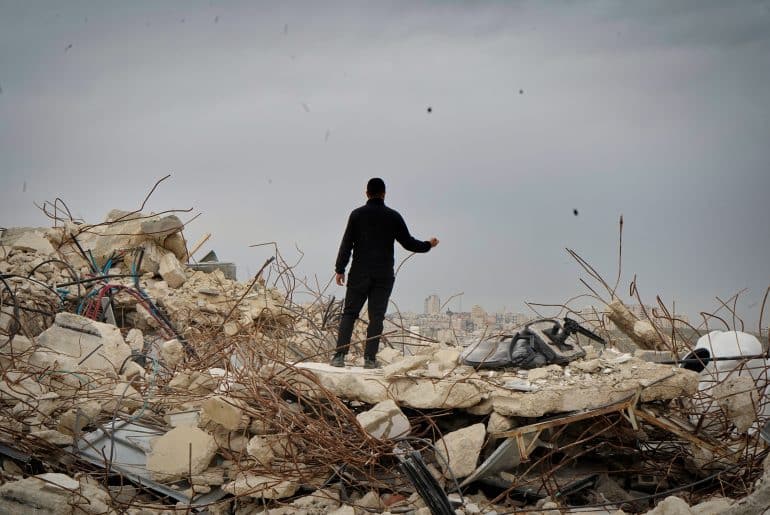
The statement also provided an overview of the scale of the destruction Israel caused in Gaza over the past 15 months, stating that 450,000 housing units were damaged or destroyed — 170,000 of them were “completely destroyed,” 80,000 were “severely damaged,” and 200,000 were “partially damaged.”
“This is not a livable city,” Subaih said after spending nearly a week camped out beside the destroyed remains of his house. “It’s just heaps upon heaps of rubble. We can’t get any basic necessities; there is no water, no housing. It’s as if the war only ended to open a new one.”
But this doesn’t mean he wants to leave it.
“When a city is destroyed, its people return to rebuild it; they do not leave it. If Trump wants to give me a castle in Egypt or Jordan, or even in America, I would not replace it with the rubble of my home.”
Alaa Subaih
“When a city is destroyed, its people return to it to rebuild; they do not leave it,” Subaih said, in response to the U.S. president’s vision for forcing Palestinians to resettle outside of Gaza. “If Trump wants to give me a castle in Egypt or Jordan, or even in America, I would not replace it with the rubble of my home,” he added.
Despite the ubiquitous destruction, signs of life are beginning to return to the area. Near Subaih’s residence in al-Shuja’iyya is Omar al-Mukhtar Street, a once-bustling market in Gaza City adjacent to several historic sites, including the Zawiya Market, the Great Omari Mosque, and the Qaysariya Market. All of them were bombed during the war, but people have now revived these areas and cleared them of debris as best they could. The markets offer a variety of foods, such as vegetables, fruits, dairy, canned foods, and clothes. Prices are still high compared to their prewar levels, but they have begun to go down.
Residents have also organized themselves into groups of volunteers and worked on different sections of neighborhoods to manually clear roads of the rubble. Any serious rehabilitation of Gaza’s urban spaces must await the entry of construction materials and equipment, including cement, iron, bulldozers, trucks, and fuel needed to operate them.
Subaih said that the difficulties Gazans continue to endure deprive them of the joy of returning to their homes. Pointing to the side of the street where his home used to be and where thirty of his relatives and neighbors were killed, he said, “They returned us to Gaza, but they did not return Gaza to us.”
‘We will remain here above the rubble until we rebuild it’
In Jabalia refugee camp, residents returned to neighborhoods that were leveled entirely. Jabalia was the hardest hit by Israel’s relentless bombardment and demolition campaign throughout the implementation of what was known as the “Generals’ Plan” — the failed effort to empty north Gaza of its people during the four months before the ceasefire took effect. Like in Gaza City, families in Jabalia have already begun to remove the rubble and set up camp beside their destroyed homes.
Sanaa Mousa, 29, returned to her home in Jabalia after being displaced to Gaza City for the past four months. The residential block she lived in was completely blown up.
“This massive destruction is meant to force us to leave our country,” Mousa told Mondoweiss. “But we will overcome. We’ll recover and rebuild our homes and celebrate our survival. We’re staying here on our land.”
Mousa and her family tried to find shelter upon their return, but there was no standing structure they could use in the area. This prompted the family to set up a makeshift tent out of nylon tarps, which has become a common sight in Gaza as people camp beside their destroyed homes.
“Life is difficult,” Mousa explained. “We cannot get the minimum requirements for survival and safety. There are no hospitals. Some food is available in the market, but we do not know where and how to cook it. There is nothing here; we cannot get water, and there is no sewage drainage. It is a difficult life, but we will get through it.”
Speaking in Jabalia, Sanaa Mousa said Trump wasn’t the first Westerner with no connection to the land to try to decide its people’s fate. “It’s like the Balfour Declaration,” she explains. “Trump wants to uproot us for the sake of an occupier.”
In response to Trump’s comments, Mousa said that she endured all manner of suffering just to be able to return to her home. “It was the happiest moment of my life, even if my home was destroyed,” she said, adding that she wanted to embrace every grain of sand in Jabalia. She added that Trump wasn’t the first Westerner with no connection to the land to try to decide its people’s fate. “It’s like the Balfour Declaration,” she explains. “Trump wants to uproot us for the sake of an occupier.”
But Mousa believes that no such plan will succeed. “We will remain here above the rubble until we rebuild it,” she says. “Nothing worse can happen than the war of extermination we have already experienced, and even it did not succeed in removing us from our land.”
“If they offered me an entire city instead of the rubble of my home, I would not accept it,” Mousa added emphatically. “Homelands cannot be replaced. Homelands are like your blood and soul…Palestine is our land and our country, and we will not leave it under any pressure or plans.”
Tareq S. Hajjaj
Tareq S. Hajjaj is a journalist and a member of the Palestinian Writers Union. Follow him on Twitter at @Tareqshajjaj.

The only serious idea for peace coming out of Israel:
As we all know, Ami Ayalon, former head of Shin Bet, proposes that Marwan Barghouti be released from jail so talks on the two state solution can begin. Well, now Ephraim Halevy, forme,r head of Mossad, says the same thing:
A former head of Israel’s Mossad spy agency, Ephraim Halevy, has called for Palestinian lawmaker Marwan Barghouti to be freed from prison immediately so that the Israeli government can engage in talks with him. Halevy made his comment during an interview on Israel’s Public Radio….When asked what advice he would give Israeli Prime Minister Benjamin Netanyahu, Halevy said that he would reiterate his call to free Barghouti, explaining that Israel frees many Palestinian prisoners every day “whose hands are stained with blood” and who belong to Hamas…“Barghouti’s record is very bad, but there are those who are worse than him and are being released,” said Halevy. “Barghouti is popular with his people, he has a clear position, he speaks Hebrew well and can negotiate, all of which qualifies him to lead a new path.”…The former Mossad head recalled the past of some Israeli leaders who belonged to Zionist terrorist organisations. “There is a history of people who were prisoners and later became prime ministers in Israel.
https://www.middleeastmonitor.com/20250205-marwan-barghouti-should-be-freed-by-israel-immediately-says-ex-mossad-head/
I read Halevy’s book “Man in the Shadows: Inside the Middle East Crisis with a Man Who Led the Mossad” and he is one frightening guy, you cannot accuse him of being some fuzzy headed peacenik.
All Trump needs to do is change just who the U.S. and his administration would be willing to sink billions of dollars to rebuild Gaza for. The 85% of Gaza turned into rubble with thousands of decaying Palestinians bodies turned into broken bones under that rubble being respectfully removed while rebuilding for Palestinians most who have been traumatized in ways they many never recover from.
Yes to spending billions of American’s dollars spent to rebuild Gaza for and only for Palestinians. Partial repayment for the deadly and horrific support the Biden, Blinken, Harris etc provided for Israel through arms sales to commit their genocide
Trump suggesting the absurd and immoral… more ethnic cleansing of Palestinians from what is left of their historical homeland. Saudi Arabia steps up to the plate and pushing back
Clearly Trump pushes the envelope on every issue possible. This one could push Saudi Arabia away from the deal Israel and Trump want with SA.
Most experts warning Trump has just fueled more anger towards the U.S. and Israel. More anger that could easily turn into more violence.
https://www.reuters.com/world/middle-east/saudi-arabia-says-it-wont-establish-ties-with-israel-without-creation-2025-02-05/?fbclid=IwY2xjawIQYw1leHRuA2FlbQIxMQABHSl6ClIvoOVRV6jC1UDA33e1vyfBlBHyHLfi5mPvg_z7o6CLA9MMX9G9zw_aem_gJPqedtlbArWeSjuXoOBdQ
Official Gaza Death Toll Soars to Nearly 62,000
February 3, 2025
Thousands of Palestinians who had previously been listed as missing are now presumed dead, a Gazan official told a press gathering Monday at the mostly destroyed al-Shifa Hospital.
By Julia Conley
Common Dreams
“Authorities in Gaza and human rights advocates have warned for months that because of the devastation of the enclave’s healthcare system and civil services, the official death toll was likely a significant undercount — and on Monday, officials said thousands more Palestinians had been confirmed killed by Israel’s U.S.-backed onslaught since October 2023.
Salama Maarouf, head of Gaza’s government media office, told the press gathered at the mostly destroyed al-Shifa Hospital in Gaza City that the death toll currently stands at 61,709, with thousands of Palestinians who had previously been listed as missing now presumed dead.
The death toll was previously reported to be 47,487 on Saturday. Journalist Jeremy Scahill of Drop Site News said Monday that the number is rapidly going up as “people returning to their neighborhoods discover mass graves and people buried under the rubble or killed and their bodies left at the scene.”
Maarouf said officials now believe the bodies of about 76 percent of those killed have been recovered, but noted that 14,222 people are still believed to be trapped under rubble or inaccessible to rescue and recovery crews.
Those confirmed to have been killed include 17,881 children, including 214 newborn babies. More than 200 journalists were also killed by Israeli forces before a cease-fire deal was reached in mid-January.
Days after the cease-fire agreement, journalist Prem Thakker of Zeteo News noted that the death toll was expected to explode due to the bodies “recovered.”
“The horrors we are about to discover if a cease-fire actually holds will underscore why Israel didn’t want international journalists inside — and why they kept targeting Palestinian journalists,” said Thakker. “
https://consortiumnews.com/2025/02/03/official-gaza-death-toll-soars-to-nearly-62000/
SURPRISE! SURPRISE! SURPRISE!
■ Report: Jared Kushner Behind Trump’s Call for the US To ‘Take Over’ Gaza | by Dave DeCamp | Antiwar | February 5, 2025
EXCERPT: The online news site Puck has reported that Jared Kushner was involved in crafting President Trump’s plan for the US to “take over” Gaza, which involves the ethnic cleansing of the Palestinian population.
Citing Puck, The Times of Israel reported that Kushner, Trump’s son-in-law, helped prepare the shock remarks the president made on Tuesday night during his press conference with Prime Minister Benjamin Netanyahu. . .
ENTIRE ARTICLE – https://news.antiwar.com/2025/02/05/report-jared-kushner-behind-trumps-call-for-the-us-to-take-over-gaza/
SURPRISE! SURPRISE! SURPRISE!
■ Mulvaney says Trump’s Gaza Strip proposal ‘wasn’t him’ | by Sarah Fortinsky | The Hill | 02/05/25
EXCERPTS: Former White House chief of staff Mick Mulvaney, who served in President Trump’s first administration, said he was puzzled to hear the president lay out a proposal for the United States to take control of the Gaza Strip.
“It wasn’t him. It was not his language,” Mulvaney said in an interview on NewsNation’s “The Hill,” when asked to assess Trump’s remarks. . .
. . . Mulvaney suggested the proposal could have been someone else’s idea.
“And as I sat and I watched the energy level, some of the language, some of the reports that came out afterward in the press, some of the leaks that came out about the process, it sounded to me more like Jared Kushner than it did like Donald Trump,” Mulvaney said. . .
ENTIRE ARTICLE – https://thehill.com/homenews/administration/5129614-mulvaney-trumps-gaza-strip-proposal/