
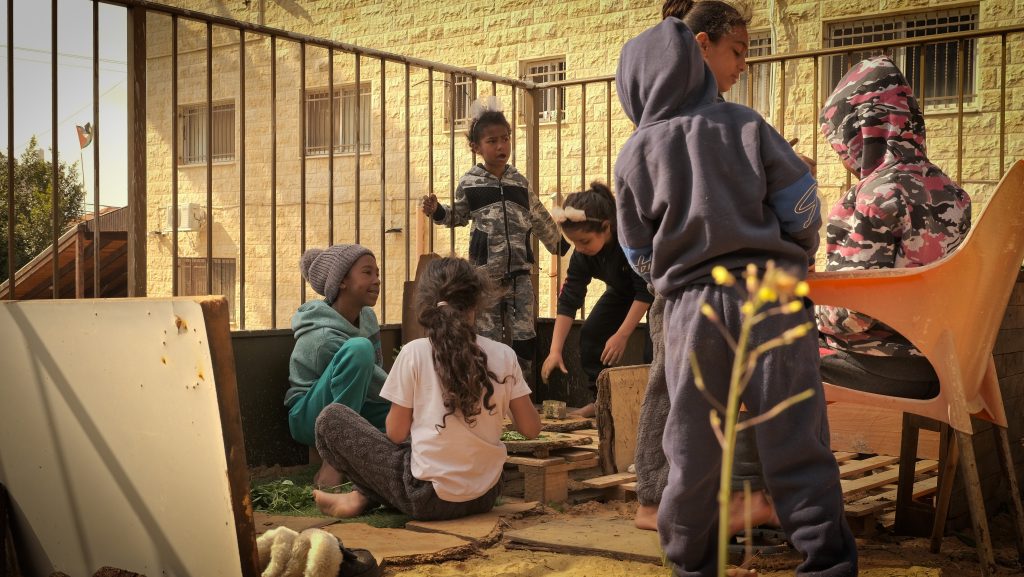
“We are watching television,” said a Palestinian boy to me a week ago in Jenin. No older than five, he and two of his friends of his same age were sitting in the sandy playground of a school-turned-shelter for displaced Palestinians. The children were not looking at a TV screen but at a piece of wood fixed to the ground with stones to stand straight. My colleague, to whom the little game seemed like an exercise of any child’s imagination, moved on taking pictures of the rest of the children, but I stood petrified. I knew exactly that these children were not playing.
When I was seven, my parents had to leave their lives in the diaspora behind and move with their two children, myself and my brother, to my father’s home village in the West Bank. I was forced to cut ties with my school, my friends, my toys, and my house. Our family of four lived for months in an upper room, characteristic of old Palestinian rural houses where my father was born, with no television. One of the things my brother and I did to cope with the pain of losing the life we knew was to stack mattresses against the wall, leave a square hole in the middle, sit in front of it, and pretend we were watching cartoons on television. It was not fun, but painful and traumatic. One day my mother caught us doing that and broke into tears. That trauma never left me, and to this day, I panic every time I have to sleep outside, even if for only a few days.
My parents chose to move to a new place because of financial reasons, but the children in Jenin were forced out of their homes by heavily armed soldiers who came following drone strikes on their community and gigantic D-9 bulldozers that disfigured their neighborhood. They described it all in meticulous detail while playing the game of cooking, sleeping, and laying on what they imagined to be the floor of their homes’ living rooms. They are living in a shelter, but mentally and spiritually, they spend every moment of their existence in their houses back in the refugee camp of Jenin, today empty of residents and turned into a permanent station for Israeli forces.
This is not the first generation of Palestinians that has to live through the trauma of displacement. These children are the fourth generation of families who were forced out of Haifa, Ramleh, and the villages of the lower Galilee in 1948. Displacement and homelessness are everything their families have known for 76 years, and even if they are allowed to go back to the poor, crowded houses of the Jenin refugee camp today, the trauma of displacement has already marked them for life. They will pass it down to the next generation.
It is difficult to understand what it is like to be made homeless. And it is even more difficult to understand what it means for an entire society to be deprived of its own homeland for decades, to the point that something like an old rusty key to the door of a house that probably doesn’t exist anymore becomes a family legacy and a symbol of national identity. But this is not a story taken from the pages of an old Bible or from the magical realism of Gabriel García Márquez in One Hundred Years Of Solitude. This is the real-life story of an entire nation, and it is the collective human experience that has been driving the best part of the history of the Middle East for the past half of a century.
In December 2023, a Palestinian grandmother was walking among the crowds who were fleeing north Gaza on foot under the orders of the Israeli army. She was stopped by a journalist reporting for an Arab sat channel. She had the same facial features as my grandmother and the exact same rural accent. She didn’t scream or utter prayers as Palestinian grandmothers do in similar situations, but rather spoke with a low, tense voice, struggling to contain her tears, and enumerated the times she had to leave everything behind and take to the road. From the first time in 1948 when she and her family were forced out of their village near Yaffa at the age of five, to the 2014 Israeli bombing of Shuja’iyyah. She was already sobbing when she concluded, “I’ve been waiting all my life to see our house in Yaffa once more before I die.”
Last Tuesday, two million Palestinians in Gaza woke up at 2 a.m. to the sound of Israeli warplanes bombing multiple locations across the Gaza Strip. After two months of a fragile ceasefire and the hope of having survived one of the cruelest military assaults on a population in modern history, the war had resumed. Gaza woke up to more than 400 people killed, including 130 children, and over 500 wounded.
But it was not everything. A few hours after the first volley of bombs, Israeli warplanes dropped leaflets on Gaza, ordering the residents of several areas of Gaza City and the north of the strip to pick up the little things they had left and leave.
Over 15 months, hundreds of thousands of Palestinians in Gaza moved from one place to the other, fleeing Israeli bombs. Hundreds of families were forced to flee up to nine times. Today, the horror of displacement is back to haunt Gazans, and Israel and the U.S. are threatening to empty Gaza of its people and replace their homes and communities with a “Riviera.” Although Trump’s declarations regarding his plans for Gaza brought the question of displacement to the forefront of the news, its real meaning was far from the political or the media discussion of the Gaza question. Even when Arab states opposed the displacement proposal, they voiced political reasons, like security, stability, or the two-state solution.
What political actors and public opinion figures fail to see is that at the heart of the entire political chaos of the Middle East, and of Palestine in particular, is not a political issue, but a human one. The wound that displacement burns into the souls of people never heals until they can have their homes back. Palestinians never wanted anything more or less. In the early years of the Nakba in the early 1950s, the first acts of Palestinian resistance were of individuals who snuck back into their villages and “stole” their own crops to bring them back to the refugee camps. Palestinian popular memory saves the stories of refugees who risked their lives crossing back to their villages, just to water trees they had already lost. That was before they discovered that reaching a tree that they or their parents had planted was a transgression against the newly established geopolitical status quo.
Political conflict was never the choice of Palestinians. It was and still is the ocean that separates them from their houses, their trees, and the graves of their elders. An ocean that they suddenly discovered, one refugee camp morning that looked different from the previous ones. They decided to call it “Nakba,” and then began to reorganize.
The children in the shelter in Jenin and the children who survived last Tuesday’s bombings in Gaza haven’t yet discovered the real dimensions of this ocean of complicated political interests. But the political leaders, analysts, and journalists haven’t understood the depths of the wound either, which is already shaping the consciousness of these children — just like it shaped the consciousness of their parents. It is drawing the face of the next generation of Palestinian struggle.
As I woke up from my childhood flashbacks in front of the displaced children pretending to watch television on the sandy playground, my colleague was trying to prepare for our first interview with a grown-up. Bringing me back to our field notes, she asked, “where should we begin?” and went through the different topics we had discussed — the Israeli military offensive, its objectives, the West Bank annexation plans, etc. All I had in mind was the attempt of that little boy to appease the pain he didn’t yet fully understand with the help of a piece of wood that he took for a television. “That’s where the story begins, and that’s where it ends,” I thought to myself. “The rest are details.”


Thank you, Qassam, for this thought-provoking article. It immediately reminded me of our tour guide, Zlata, when I went to Croatia in 2008. She was a toddler during the wars following the break-up of Yugoslavia. She had a wicked sense of humour, having learned a lot of her excellent English from watching BBC sitcoms. But she suffered from claustrophobia, having lived for three years in a cellar with her mother while her father was away fighting.
The trauma of Palestinian kids must be an order of magnitude worse.
The Chinese call Palestinian fighters dandelions and the Chinese government has refused to condemn Hamas
After October 7th, Israel’s embassy in China launched an aggressive campaign to sway public opinion—but it backfired. From spreading misinformation about hostages to enlisting foreign embassies for support, their efforts only fueled stronger pro-Palestinian sentiment online. Chinese netizens quickly exposed false claims, forcing Israeli and Western embassies to shut down their comment sections.
In From Global Anti-Imperialism to the Dandelion Fighters, Zhang Sheng explores why China’s stance on Palestine remains firm and how young people are shaping the conversation.
https://youtu.be/-0fnAud1YIM?si=SHMS_WVerhOWnCkM
A heartbreaking, touching story.
Is there a conceivable way to minimize future trauma to Palestinian children?