
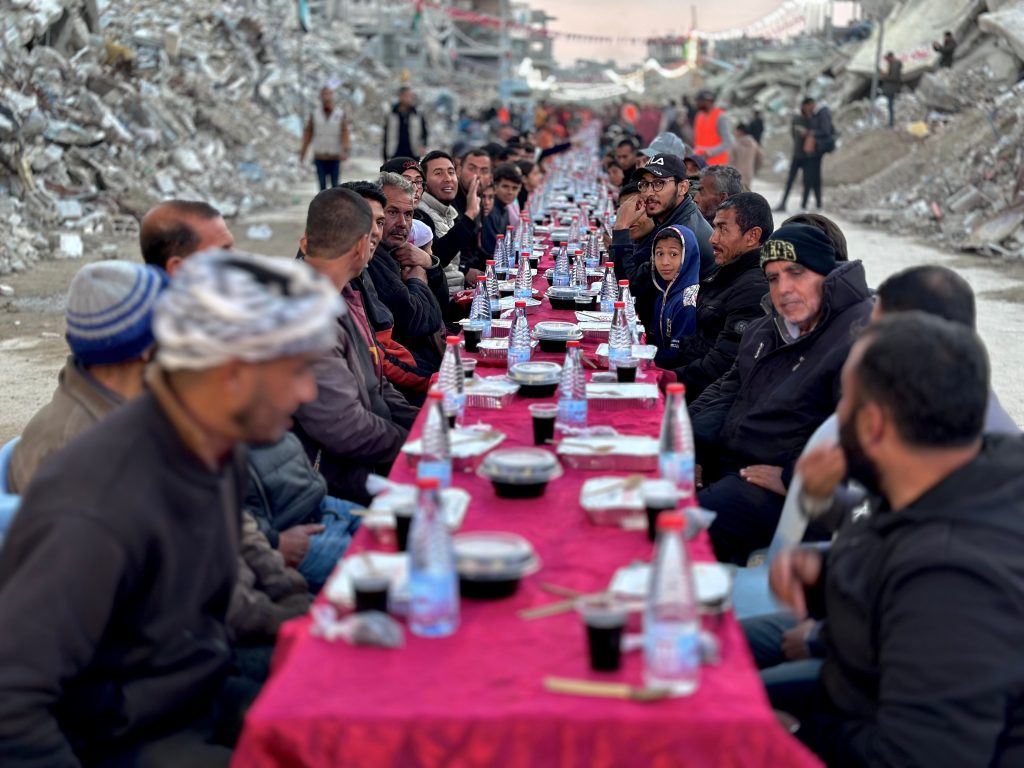
It is one of those moments when I wish I could be with my family amidst the destruction and rubble, to have those warm family feelings that every person living in Gaza has grown accustomed to during the holy month of Ramadan.
At this time, every year, my family would gather daily to share in conversations. I would roam the streets during the day, searching for stories and interviewing those who stand for hours working in the sun to feed their families, and then I would return home, where the children of the family were playing. I was eagerly waiting for my son to be able to join them and enjoy the company of over 10 children in the house, but the war changed everything. It tore my family apart, putting each one in a different place.
This is just one family, but it’s the same story. Everyone is scattered. Some stayed in their destroyed homes, some were bombed and martyred, others went to Egypt for treatment, and some, like me, managed to flee to Egypt and are now experiencing the ache of longing for everything about Gaza.
I watch my country from afar and ask for pictures and videos of my family, my destroyed house, and my neighborhood during the first days of Ramadan. I am eager to know how they spend their time in a now-destroyed house where the whole family used to gather.
Whenever I talk to someone I know and ask them about what Ramadan is like in Gaza this year, they answer that they have lost many things and that they live this month like any other month of deprivation throughout the past year and a half of genocide. My nephew Ahmad, 17, tells me how this year there are no decorative lights to illuminate the streets, there are no lanterns outside of shops, no more mosques for people to go pray — in our residential area, not a single mosque is left standing. He says darkness and sadness loom over most people.
Usually, there are rituals for Ramadan that cannot be ignored. From the first day, the streets are filled with children hours before iftar, bragging to each other about how they fasted all day and talking about the things they have in store for after iftar. The streets are filled with children and adults sitting in front of their homes. People crowd the stores as most men go out before breaking the fast to popular markets to bring home plates of hummus, a common staple at a Ramadan table, and fresh juices and pickles to brighten it and add color.
The iftar meals usually include different types of vegetables, meat, and fresh poultry. With the famine during the war, people break their fast on rations.
In the first days of Ramadan, I asked my family about whether they were observing the same rituals as before. They said that food is scarce and prices are unaffordable for most people. They said that they never lived in conditions like this before the war.
People buy exactly the amount of fresh food they can consume in a short period; the lack of electricity makes refrigeration impossible. Every day, they are surprised by changes in prices and the disappearance of certain goods.
Each family prepares its food individually. They break their fast at sundown and have their final meal during the predawn suhur, all in complete darkness. People roam the markets looking for meat and chicken but cannot buy any. When I talk to one of my family members, I can see how their lives have changed; when I ask to see them, they are surrounded by darkness in every direction — especially when my son sits next to me; I want him to see his family in Gaza, but all we can see is the exhaustion from running for safety.
Now, they sit on one of the sidewalks where they can get an internet connection to keep up with what is going on around them and talk a little with their relatives outside Gaza. They make sure to return home early, but this time, without a family gathering, and without visits from loved ones.

Why NJ Rep. Bonnie Watson Coleman Brought a Doctor Who Worked in Gaza as Her Guest to Trump’s Speech
March 05, 2025
Democracy Now /Amy Goodman
“Trump’s speech to a joint session of Congress discussed the Middle East without any mention of Palestinians. This comes as Trump has called for ethnic cleansing of Gaza and posted an AI-generated video depicting Gaza as a resort town with a golden statue of Trump. Congress member Bonnie Watson Coleman attended the speech with her guest Dr. Adam Hamawy, an Army veteran and reconstructive surgeon who recently volunteered at a Gaza hospital. “The whole issue of Gaza, with the exception of the president wanting to make it a spa for millionaires, was being overlooked at a time when the infrastructure is absolutely devastated, the people are devastated,” says Watson Coleman.”
https://www.democracynow.org/2025/3/5/trump_speech_gaza_palestine_omission
Gazans say ENOUGH with the right to armed resistance (as will Jenin).
https://www.youtube.com/watch?v=R85kR9DgH78