

The burned soil spits out tails of smoke through the thick layer of black ash covering its surface, stretching from the stone crosses dotting the tombs of the village cemetery to the ancient walls of a 4th-century Byzantine church. Israeli settlers were here last Monday, July 7, inside the urban perimeter of the village. They left their mark by setting fire to the surroundings of the historic Church of al-Khader (Saint George), the most sacred site for the people of the village.
Situated northeast of Ramallah, the town of Taybeh is the last remaining predominantly Christian village in Palestine in the occupied West Bank. The attack on the Palestinian village sets a deadly precedent for its residents, but they were not surprised. This eventuality has been decades in the making, ever since Taybeh began to lose its lands to Israeli land grabs and settlement expansion.

On top of a hill facing sunset sits the home of Abdallah Abu Fazaa at the edge of Taybeh. Outside of the town, less than five minutes away from its center, Abu Fazaa continues to live as a Bedouin in a prefabricated home, as he and his family have for generations — or at least he tries. With less than ten sheep in a small stable beside his house, the open space of the hill is barely enough to herd what remains of his small flock.
The meager area he now inhabits is nothing compared to the rolling hills where he and his sons once spent their days herding dozens upon dozens of goats and sheep in the eastern slopes of the Jordan Valley, midway between Taybeh and Jericho. It all changed after October 7, 2023.
Upon a look from his father, Abdallah’s youngest son, Ibrahim, stands up from a floor mattress — characteristic of Bedouin homes — grabs a kettle placed at the center of the visitors’ room, and serves the guest a cup of extra-sweetened tea, also characteristic of Bedouin hospitality, and always with the right hand, as Bedouin rules of propriety have it. His father lights a cigarette and signals with his hand that he does not want to be photographed.
Abdallah Abu Fazaa and his family were expelled by Israeli settlers from the eastern slopes of Taybeh shortly before the Israeli war on Gaza started, along with the rest of the families in his community. Today, he doesn’t dare approach the place he has lived in since his childhood, where Israeli settlers have been installing irrigation lines for more than a year and a half and using their hills to herd cows.
Abu Fazaa fears that he might be harmed or even killed if he returns. Driven to the edges of the town, with the olive groves of the Palestinian families of Taybeh nearby, Abu Fazaa is forced to give up part of his livestock in order to be able to continue his work as a herder and still make a living. Still, he admits, “When you stop being able to move and are forced to stay in one place, you’re not a Bedouin anymore.”
But this is not the first time Abu Fazaa’s family has had to face displacement or limitations on their movement. Throughout the decades, Bedouins have become part of the social fabric of the villages and towns that dot the expanse of land they call home. Taybeh is one of them.
The expulsion of these Bedouin communities from vast swathes of their pastures has been coupled with Israel’s confiscation of these towns’ lands, transforming the lives of Bedouins and villagers alike.

Disrupting a generational social ecosystem
“Before the occupation of 1967, we were all peasants, and we lived off the produce of the land, and Bedouins were part of the yearly cycle of agriculture,” Naameh Abdallah, an 83-year-old Taybeh resident, tells Mondoweiss. “All the lands that are today classified as Area C between Taybeh and Jericho belong to Taybeh families, and they were all farmland.”
“We used to cultivate them with different seasonal crops, so we kept half of the land for wheat from which we made all of our bread, and the other half we cultivated with chickpeas, lentils, sesame, or other grains, according to the season, and the following year, we switched halves,” she continued.
During the summers, Bedouin families would move up from the Jordan Valley and the surroundings of Jericho and make for higher ground to escape the summer heat, Abdallah says. “They installed their encampments on our lands, which they used to graze, and they fertilized the land with their livestock. So we had verbal understandings with them,” she explains. “They paid us for using our land with a baby sheep, for example, or with milk and cheese, and we gave them from our produce as well. This is why we have always had good relations with the Bedouins and considered them — as we do now — a part of the town.”
But these relations began to change with the upheavals caused by the Israeli occupation in 1967, bringing about a drastic transformation that altered the natural evolution of the rural economy of Palestine. One of the casualties of this process was the disruption of Palestinians’ relation to their land — and to each other.
“For us, it was a new episode of the same process that began in 1948,” Abdallah Abu Fazaa points out. “Our family belongs to the Bedouin Kaabnah clan, which has continuous extensions from the northern parts of the Arabian desert in the south of Jordan, through the Naqab desert, and all the way to the hills of Hebron.”
Abu Fazaa’s family has lived in the vast expanse between the South Hebron Hills and the northern Naqab Desert for generations, but they were expelled from those lands in 1948, forced to move north to the Jordan Valley. There, they would continue to maintain their nomadic way of life.
“Before 1967, we moved between the area of al-Auja, just outside of Jericho, and the slopes of Taybeh, some 6 to 8 kilometers down from the town itself,” Abu Fazaa describes. “The people of Taybeh continued to cultivate those lands.”
After the occupation, the lower plains of al-Auja became inaccessible to Abu Fazaa’s family because the Israeli army turned those areas into military training sites. This led to a shift in their seasonal movements, essentially shifting up the slopes. “The hills that used to be our summer encampment became the place where we would winter,” he explains. “And in the summer, we’d go even higher up, much closer to the town, just at the edge of the olive groves. That’s when things became more complicated.”
What followed was a series of social upheavals brought about by the occupation. Taybeh’s agriculture was decimated, as lands that used to be used for farming were confiscated by the Israeli army and later used to build the Israeli settlement of Ofra. “The 1967 occupation put an end to farming as we knew it,” Naameh Abdallah recalls. “I remember that, in the very month of June in 1967, my late father and two of my siblings were harvesting wheat in the western lands of the town, and the Israeli army came and ordered them to leave at once, forcing them to abandon the harvest.”
“That was the last time we had access to that land,” she adds. “Today, the Israeli settlement of Ofra stands in its place.”
Abdallah says that her family used to cultivate more than a hundred dunams (over 10 hectares) of land, “and we barely had enough to live off of and sell, because we were a big family of 12 people.”
When they lost access to large parts of their lands, things changed. “Three of my brothers emigrated to look for work in America, and in my uncle’s family, those who didn’t emigrate began to work in construction, often in Israel,” she said. “It was the only work that earned enough money to live on, unless one had an education. So in one way or another, we were gradually forced to stop being peasants.”

Then came the settlers
In the 1970s, as Israel began to expand its settlement policy in the West Bank, it began to make more land inaccessible to Palestinians. The most common tool used at this time was the creation of “military firing zones” — lands ostensibly reserved for military training that eventually became the locations for new settlements. In 1979, Ariel Sharon, Israel’s then-Minister of Agriculture, told representatives of the World Zionist Organization’s settlements committee that “firing zones” in the West Bank would be used as “land reserves for settlements,” as recently revealed by Israeli outlet +972 Magazine, which reported on the classified minutes of the meeting. The Israeli army continues to use this policy to this day, most recently designating Masafer Yatta in the South Hebron Hills as a “firing zone” and setting up its 2,000 residents for expulsion.
Across the West Bank, this policy made the permanent use of agricultural lands by Palestinians virtually impossible, including most of the areas outside villages’ urban and farming plans. These areas would later be classified under the 1993 Oslo Accords as Area C, comprising over 60 percent of the West Bank’s land over which Israel would maintain direct control.
“In these areas, we couldn’t cultivate as we did before, and with more young people pursuing higher education and looking for jobs with regular salaries, there wasn’t enough labor to continue farming like before,” Naameh Abdallah notes. “So we began to rely more on Bedouin families to maintain these lands.”
It was a continuation of a generations-long symbiotic relationship. Abu Fazaa explains that his father’s generation used to graze these lands for the summer and fertilized them with their sheep, which the people of Taybeh cultivated in the winter. “Those lands became our semi-permanent place of living, where the people of Taybeh didn’t cultivate anymore,” he says. “And our place for the summer moved to just outside town, where my father’s generation didn’t even get close to. That’s where the people of Taybeh cultivated and ploughed their lands all year long.”
“Then came the settlers,” he continues. “And with them, they brought the Israeli army.”
In 1977, Israel established the settlement of Rimonim on a hill that belonged to the families of Taybeh just outside the town. The Bedouin families living in the surrounding farmlands grew used to Israeli settlers and soldiers limiting their grazing practices year after year.
Rimonim’s location wasn’t a coincidence. It is located right beside the Allon Road, which Israel began to plan for and build after the 1967 War. Named after Israeli general Yigal Allon, the road runs across the eastern side of the West Bank from north to south, separating the hill country east of Ramallah and Nablus from the Jordan Valley. When it was built, the road was integrated as part of Allon’s broader plan to impose total Israeli security control over the Jordan Valley “for security reasons,” but which in reality was being used as a pretext for annexation.
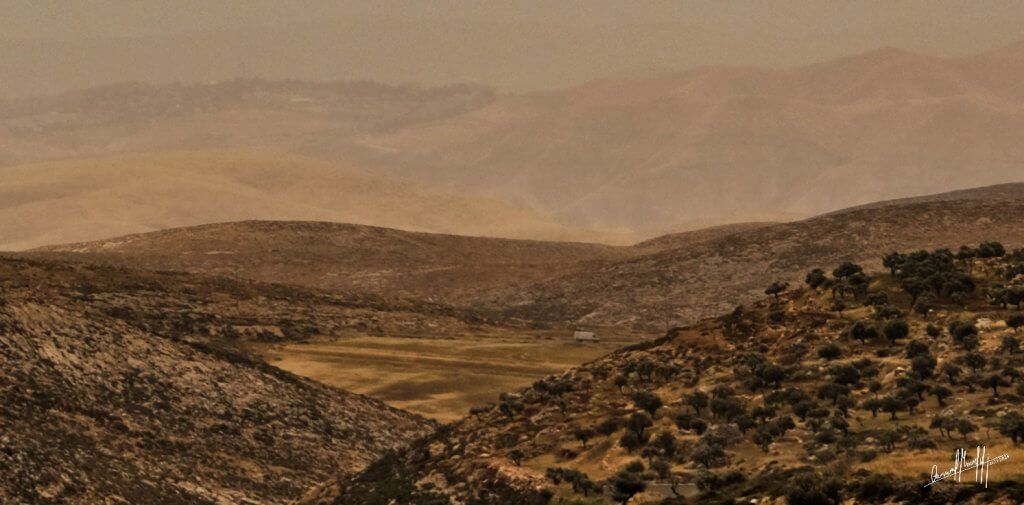
Khalil Tafakji, a leading Palestinian cartographer and expert on Israeli settlements, tells Mondoweiss that “the Allon Plan was drafted under an Israeli Labor government as a security plan, but it became the basis for full Israeli control and settlement of the Jordan Valley in later years, and all lands east of the Allon Road are classified as Area C.”
According to Tafakji, the plan to annex the Jordan Valley that Benjamin Netanyahu proposed in 2019 is nothing but a recycling of the Allon Plan. “But this time, the word ‘annexation’ is explicitly used, making it a distinctly right-wing project,” he explains.
Since 2019, the plan for annexing the West Bank has been picked up and promoted by hardline Israeli Finance Minister Bezalel Smotrich, who is currently part of Netanyahu’s ruling rightwing coalition.
Removing the last line of defense against colonization
Rimonim was one of some 21 settlements that Israel built between the 1970s and 1980s along the Allon Road, making it part of a line of Israeli control along the edge of the West Bank’s eastern hill country. The lands that Palestinians lost in the process of Rimonim’s construction were the farmlands of Taybeh.
For years, the Bedouin communities on the West Bank’s eastern slopes continued to maintain their seasonal way of life. The Bedouin communities were the only Palestinian presence on those lands, becoming the last line of defense against settlement expansion. That began to change in 2020.
“In 2020, Israeli settlers began to become more aggressive, especially down in the slopes,” Abdallah Abu Fazaa says. “First, they began to come close to our houses, harassing our sheep. Then we couldn’t herd the sheep in certain areas. And then they began to come even closer and more frequently.”
After October 7, what was a gradual process of escalation was ramped up beyond anything that was seen before. “They began to attack all the communities in the eastern slopes in large numbers and threatened people into leaving at gunpoint,” Abu Fazaa recalls.
He and his community moved up to the outskirts of Taybeh at the beginning of the summer of 2023. When the war started, it was almost time for them to move back down the slopes. “Instead, there was a stream of more Bedouin families moving up to the outskirts of Taybeh and other neighboring towns in the first week of the war on Gaza, because the settlers had expelled them,” he says.

Later, Abu Fazaa went on his own to his community’s old grazing grounds down the slopes and found that the settlers had taken over the entire area. “They had dismantled our barracks and taken our things. That’s when I understood that we couldn’t go back anymore,” he sighs. “That encampment is where my mother gave birth to me. It’s where I grew up.”
Since October 2023, Israeli settlers have expelled 18 Bedouin communities on the slopes east of Ramallah and Nablus. According to the al-Baidar Organization for the Defense of Bedouin Rights, Israeli settler violence has expelled some 62 Bedouin communities across the West Bank since October 2023, displacing some 12,000 Palestinian Bedouins.
“Bedouins are part of our town’s life, and they are part of our relation to the lands we can no longer access, farm, or build on,” Naameh Abdallah says. “Although many young Bedouins are teachers and doctors, their families continue to graze and live as they always did.”
Abdallah notes that as the land available to both villagers and Bedouins began to shrink, so did the generational symbiosis between the two communities. “Now that they have nowhere left to herd, some of them go herd at the edges of the town, damaging the olive groves,” Abdallah explains. “Then problems arise between the Bedouins and the families of the town.”
Abu Fazaa gives the same account. “Since we were expelled from the lower slopes, disputes between Bedouins and villagers have increased as of late,” he says. “Often the sheep end up inside olive groves, which for the people of towns like Taybeh are as precious as our livestock is to us.”

“In order to avoid this, I sold most of my sheep and reduced the size of my flock down to only ten sheep,” Abu Fazaa continues. “That’s all I can herd on this hill. I used the money from selling my flock to buy this small plot of land I’m living on.”
Abu Fazaa muses on what this means for him and his way of life, marking the beginning of a process of forcible sedentarization. “Now I own a piece of land instead of sheep. The next thing would be to build a concrete house, since I’m not moving anymore, and get rid of the remaining sheep before this hill becomes a residential area,” he says ruefully. “I can’t take that step yet.”
His youngest son, Ibrahim, gets up from the floor mattress and serves another cup of oversweet tea with his right hand.
“I’m still a Bedouin, and I’m not changing my lifestyle out of choice or convenience. It’s by force — the force of the occupation and its settlers,” Abu Fazaa says as he stares out of his prefabricated house at the hill facing Taybeh’s sunset.

Proper words fail me to properly express the contempt and the hatred I feel for israel and the zionists. Already ended relations with the zionist side of my (ex) family.
We are wintnessing the gradual manifestation of structural genocide, accompanied by the eliminatory effects characteristic of settler colonialism. Which,in contrast to classical colonialism, seeks to capture the land while eliminating the presence of its native population through one form of violence or another, rather than merely exploiting resources and labor.
Likely Netanyahu armed the Lion’s Den and the Jenin Brigade.