
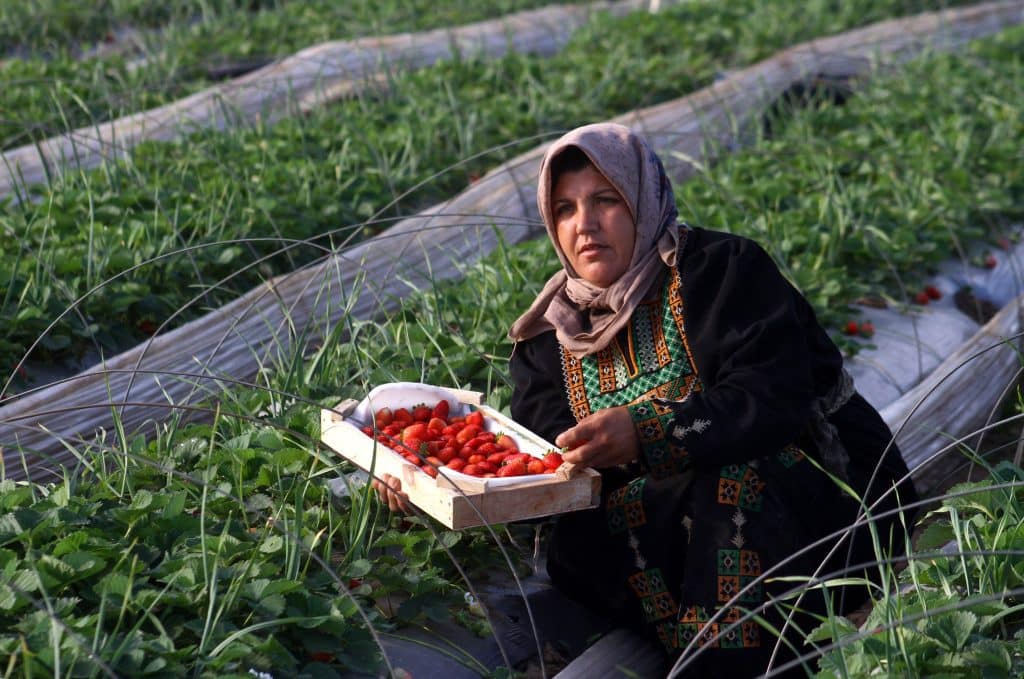
The strawberry season in Palestine, which runs from December through April, has long held a special place in Gaza’s agricultural life. In the northern town of Beit Lahia, strawberries have been both a main source of income and a point of pride, often referred to locally as “red gold.” Since the genocide, Gaza’s northern fields of red gold have gone bare.
Saqer Al-Rahel, a 32-year-old farmer from Beit Lahia specializing in strawberry cultivation, says before the genocide, strawberry cultivation significantly contributed to employment in the area, as they were one of the most valuable agricultural products in the Strip. “Nearly 80% of Beit Lahia’s lands were planted with strawberries. One farm alone employed 16 workers, each supporting a family. It was excellent,” he said.
For decades, however, Gaza’s strawberry farmers have been constrained by Israeli restrictions. Exports were largely blocked, and farmers had to rely on Israeli-controlled crossings, where inspections and delays often damaged their crops. Many were unable to reach external markets at all, leaving strawberries to spoil or be sold locally at heavy losses.

But nothing compares to the damage done over the last two years.
Al-Rahel says the current devastation marks a rupture unlike anything he has experienced before. “We’ve faced difficult seasons before,” he said, “but nothing like this. We will not be able to return to how things were.”
According to the latest assessments by the Food and Agriculture Organization, Gaza’s agricultural landscape has now been pushed to the brink of collapse. Nearly 87% of the Strip’s farmland has been damaged, with destruction only getting worse in 2025. Most of what’s left is barely usable. Only a small portion of land is safe for farming, and even there, just a few hundred hectares can still produce food. Greenhouses lie in ruins, wells are broken, and irrigation systems shattered, leaving fields, orchards, and vegetable plots dry and abandoned. In Beit Lahia specifically, around 95% of homes were destroyed or rendered uninhabitable, leaving almost the entire town’s population without houses.
“Strawberries were my main source of income,” Al-Rahel said. Responsible for ten family members, he added, “Now we are at zero. I’ve lost my house, I can’t reach the land, and all the equipment is gone.”
During the previous ceasefire, from January to March 2025, Saqer Al-Rahel briefly returned to Beit Lahia with his family to inspect what remained of their home. “What we found was massive destruction,” he said. In an attempt to recover, they planted three dunams of zucchini under primitive conditions, trying to create a fragile form of livelihood. When Israel’s genocidal attacks resumed, the effort collapsed. The family was forced to evacuate again to central Gaza, and the crops were destroyed. “We tried to recover,” he said. “But we lost everything again.”
Lina Al-Madhoun, 22, from Beit Lahia and the founder of the Thamra, a project supporting farmers and promoting home-grown food, described how the season was a warm, familiar time for the community.
“Many of us, myself included, used to plan our outings around visiting the farms, having breakfast there, and photographing the red strawberries against the green leaves,” she said.

Now lost for the third consecutive year, the season’s absence carries consequences beyond the financial damage to farmers who once sold and exported tons of strawberries.
“Losing the season is not only a material loss,” Al-Madhoun said. “It is a moral one. We lost a season we used to celebrate together, and we lost a symbol.”
“Losing the season is not only a material loss,” Al-Madhoun said. “It is a moral one. We lost a season we used to celebrate together, and we lost a symbol.”
Displaced from Beit Lahia to Rafah, then to Khan Younis city, Khan Younis al-Mawasi, and finally Deir al-Balah, Saqer Al-Rahel tried to return to his hometown when the ceasefire was announced in October, only to discover that it now falls within the area designated as the yellow line.
He explains, his family survives on aid parcels and sporadic informal work. They are no longer farming. Although he owns 20 dunams of land in Beit Lahia, he is now forced to rent a small plot in Deir al-Balah simply to pitch tents.
“At first, I felt immense happiness to return home,” he said, “only to be shocked that we still aren’t allowed. It is hard. In displacement you feel you are a stranger, even though we are still in Gaza. Beit Lahia means a lot to us.”
The yellow line marks how far Israeli troops pulled back during the first stage of the ceasefire, placing large portions of the Gaza Strip under Israeli control. In the north, it covers significant areas of Beit Hanoun and Beit Lahia, as well as large portions of the Jabaliya refugee camp and several eastern districts of Gaza City, including Shujaiya and Zeitoun. Further south, the line slices through Khan Younis and most of Rafah, effectively barring hundreds of thousands of residents from returning to their homes. Palestinians are strictly forbidden from entering the areas behind the line, and attempts to approach have resulted in deaths.
Lina Al-Madhoun described the yellow line as Thamra’s main obstacle. “One of our biggest challenges is that there simply isn’t enough safe agricultural land,” she said. She added that people are trying to revive Beit Lahia despite the destruction. She recalled receiving a call from residents living near—but technically outside—the yellow line, asking for help cultivating their land. When she went there, she saw an Israeli tank, which terrified her. “But they told me, ‘This happens all the time. The tank always advances, then pulls back.’ It’s a huge risk.”
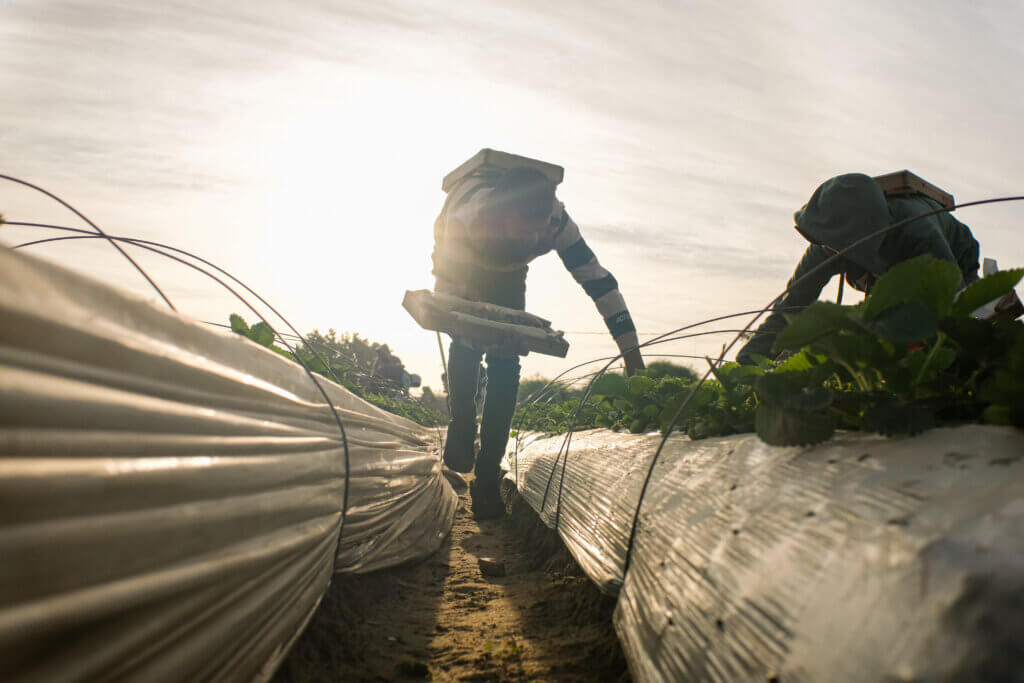
Officially, the yellow line is framed as a temporary measure intended to remain in place only until the next phase of the agreement, when Israeli forces are expected to retreat further and an international authority would take over. However, recently, Eyal Zamir, Chief of the General Staff of the Israeli Army, declared that the yellow line would serve as the new border between the Gaza Strip and Israel.
With Beit Lahia cut off and its farmland inaccessible, Gaza’s red gold remains buried behind a line that keeps moving, swallowing more pieces of land, while residents look toward fields they can no longer reach, fearing the loss may be permanent.
“All the strawberry fields are within the yellow line,” Saqer Al-Rahel says. “They need wide spaces and constant care, which makes growing them in densely populated areas impossible.”

Under the general category of “Making Life Impossible For Palestinians”, the New York Times just published an outstanding photo essay titled “Land Grab: Inside Israel’s Escalating Campaign For Control of the West Bank” – unfortunately it’s only available to subscribers at the moment:
Olive grove by olive grove, sheep pasture by sheep pasture, village by village, the idea of a Palestinian state is withering in the West Bank….Armed Israeli settlers, often protected by soldiers, harass and attack Palestinian villagers daily, with the undisguised goal of driving them out….Over the past two years, Israeli settlers have established a record number of new outposts in the occupied territory. The goal is to win on the ground what might otherwise be lost at a negotiating table….Palestinian communities that for centuries were part of a closely knit landscape, like these three near Ramallah are increasingly on their own, surrounded and isolated.rme
Land Grab: Inside Israel’s Escalating Campaign for Control of the West Bank – The New York Times
I don’t see how this can be called anything else but colonialism and terrorism.
In Dave Chappelle’s latest Netflix special he criticizes Zionist Bill Maher and Israel: See the YouTube Short.
His closing line in the show is: “The fear I have that I need you to protect me from is co-option. What if they make me say the things they want me to say? So just in case we need a code. If I say it you know they got me, and don’t listen to nothing I say after. The code is: I stand with Israel.”
Imagine that, war breaks things. And if the strawberry farmers wish to return to their fields, they should encourage fellow Palestinians to comply with their obligations under the first phase.