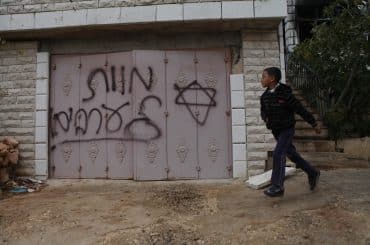
An entire Palestinian neighborhood in occupied Jerusalem is being erased.
Some 40 Palestinian families in the Batn al-Hawa neighborhood of Silwan, a Palestinian town at the foot of Jerusalem’s Old City, have received orders to leave their homes. The order came after an Israeli court gave its final ruling on a decades-long case, giving the land where their homes stand to an Israeli settler organization. Several families have already been expelled from their homes in the past weeks.
The town of Silwan is part of East Jerusalem and is located in the Wadi Hilweh valley, just south of Jerusalem’s Old City walls, with an estimated population of 55,000. Over the years, Silwan has been targeted by Israeli settlement projects, and has seen some 65 locations in the town taken over by Israeli settlers, and a biblical park called ‘the city of David’, run by religious settlers, built in the place of Palestinian homes.
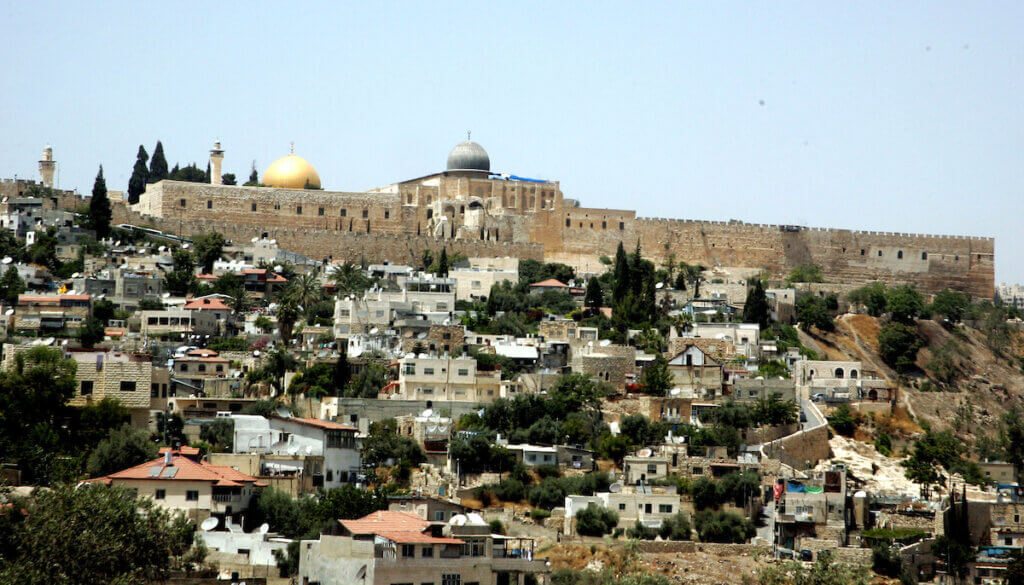
But since December, a particular part of Silwan has been at the center of news in Palestine: the Batn al-Hawa neighborhood, where dozens of Palestinian homes have been the target of Israeli settlers for years. Since 2015, the land in question, where the homes stand, has been claimed in Israeli courts by Ateret Cohanim, an Israeli settler organization dedicated to seizing Palestinian property in Jerusalem. The group is able to claim the property of the land, which is home to Palestinian families, thanks to an Israeli law passed in 1970, which allows Israelis to claim property owned by Jews in Jerusalem any time before 1948. Israeli law does not give Palestinians the same right to claim their homes and property, which they lost in the Nakba in 1948.
The law allows groups like Ateret Cohanim to claim property on behalf of previous Jewish owners, which, in the case of Batn al-Hawa, were Yemenite Jews who moved into Silwan in the 1880s.
“We are talking about a claim that goes back to the Ottoman era,” Ameer Maragha, a resident and youth activist from Silwan told Mondoweiss. “Turkish authorities presented documents from their archives proving that the land was a state property, and that the Yemenite Jewish families were housed there by Ottoman authorities as a social housing case, not as owners, but Ateret Cohanim won the case in the Israeli court anyway,” he pointed out.
The Palestinian families of Silwan appealed, and the legal battle went on and off for a decade, until last December, when the Israeli Supreme Court gave its final ruling in favor of Ateret Cohanim, giving Palestinian families a final notice to evacuate their homes.
Kayed Rajabi, head of one of the families threatened with expulsion, told Mondoweiss that “in this building alone, there are six apartments housing my wife and children, two of my brothers with their wives and children, two of my sisters with their husbands and children, and my son with his pregnant wife. We are 39 people in total, including 20 children.”
The six Rajabi households were notified in early January to evacuate, without a clear deadline, meaning the families live every day unsure if it will be their last day in their homes. Kayed Rajabi expects the Israeli police to enforce the evacuation order in the coming weeks.
“Our family has lived in Silwan since 1967, after Israeli authorities forced us out of our original homes in the Sharaf neighborhood in Jerusalem’s Old City, just a kilometer away, in order to expand the Jewish quarter,” explained Rajabi. “Luckily, my grandfather had bought this piece of land in Silwan’s Batn al-Hawa, and he and his children, including my father, built the first floor of the house, and it was here that I was born,” he continued.
Kayed Rajabi recalled that “it was around 2021 when we first received notice from the Israeli court that Ateret Cohanim was claiming our house, so we went to court and showed our papers and property titles, thinking that at least they would receive some recognition, but the court ruled against us, so we appealed. But now it is over.”
“Now we are looking for apartments to rent, which are not widely available in Jerusalem, and the ones that are available are too expensive and ask for six months of rent to be paid in advance,” he lamented.
Ameer Maragha explained that “Kayed Rajabi and his siblings’ families are only six out of 30 to 40 similar cases, which means an entire part of Silwan that is being uprooted, with claims going back to more than a century ago.”
“The Jewish families who lived here before the Nakba were part of the social fabric, and Palestinian families hold good memories of the times when their Jewish neighbors were present, but the events of the 1948 Nakba forced a segregation where these Jewish families had to leave to the Israeli-controlled side,” detailed Maragha.
“Some of the property that they left was public property, which was later bought by private owners, like the land of the Rajabis, where they have their house, and these properties are being claimed by settler groups by claiming that they were Jewish property in the past,” said Maragha.
“Other properties remained in the hands of the Jordanian state, who annexed the eastern part of Jerusalem after the Nakba, but after Israel occupied Jerusalem in 1967, these properties passed to the ‘absentees’ property custodian’ of the Israeli state, which in some cases transferred the property to settler groups.”
Eventually, Palestinians are removed from their homes, if not by complying with the Israeli court order themselves, then by the force of the Israeli police, which is often the case.
“My neighbors, the Shweiki family, composed of multiple households with 23 people including 15 children were expelled two months ago, and I watched it all,” said Kayed Rajabi.
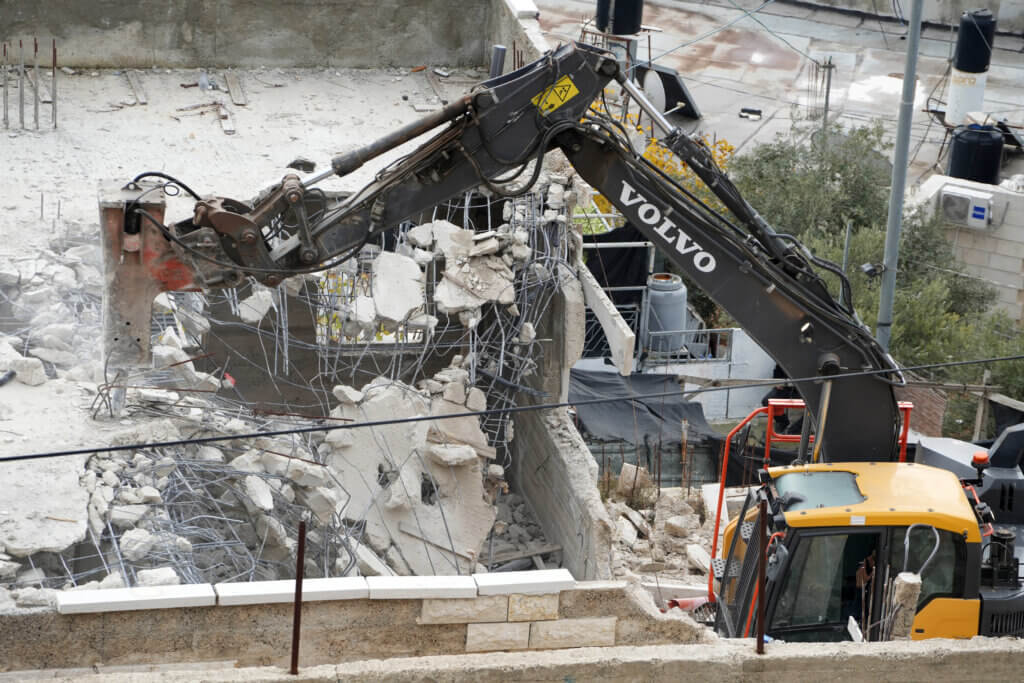
“The police came in the morning, accompanied by settlers from Ateret Cohanim, and they began to take the contents of the house with a crane and throw it all in the street; the furniture, the beds, everything, while the family watched,” he described. “Then the settlers entered the house, locked the doors, and left, and a week later an Israeli settler family moved in.”
Life changed a lot for the Rajabis since their neighbors were replaced. As is typical in Palestinian neighborhoods, families function as a single social unit, often with their homes open to one another. But according to Kayed Rajabi, “Israeli settlers don’t see us as neighbors, but as threats, and they call the police to complain each time they feel disturbed by our presence.”
“My 23-year-old son was arrested for two days, and then was given five days of house arrest, because some settlers complained that he chanted ‘Allahu Akbar’ too loud,” recalled Rajabi. “It is a shrinking freedom of life in our own neighborhood, basically making us feel that we are the strangers,” he added.
It is a feeling shared by Ameer Maragha, who affirmed that “the entire landscape of Silwan is changing to the point it will soon be hard to guess this was a Palestinian town. Police patrols will increase as settler numbers grow, and that means more arrests and raids for us, noted Maragha. “But the hardest part is that we, the people of Silwan, have done all we can to defend our existence here with very little support from anybody,” he added.
“I opened my eyes to the world in this house,” sighed Kayed Rajabi. “My father and my uncles built it with a lot of sacrifices, carrying building material on the back of a donkey for miles, and my siblings and I continued to enlarge it to house us all. It is more than just a house; it’s a family legacy, our history,” he said.
“I have my conscience clear that I did all I could to defend it, and they will have to take my family and me out of it by force, and even then I will not leave Jerusalem even if I have to pay an expensive rent,” he said definitively. “But I can’t stop asking myself: Why are we, Palestinian families in Jerusalem, left to face this displacement alone?”