
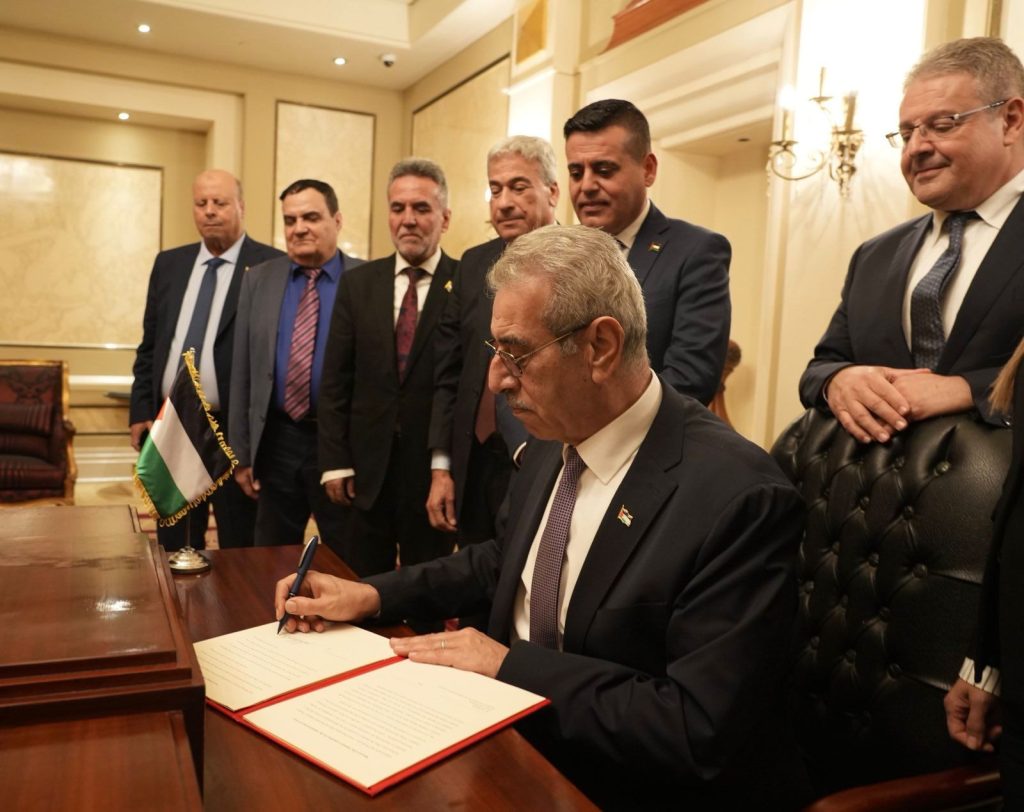
The committee of Palestinian technocrats tasked with running Gaza is about to enter the Strip. Sanctioned by the U.S., the so-called “technocratic committee” will answer to the recently unveiled “Board of Peace” headed by Donald Trump. Palestinian factions had earlier voiced their rejection of the Board, calling it a recycling of the British Mandate era and a new form of colonial rule. But the Palestinian position has since shifted dramatically.
All Palestinian factions now voice their support for the committee. Even Hamas said in a statement that it is ready to cede control of Gaza to the administrative body, despite its subordinate character to Trump’s peace board. The Palestinian acceptance of this new fact, as surprising as it might seem, comes after two years of unprecedented destruction and human loss inflicted on the Palestinian people in Gaza, as well as the systematic theft of land, settler violence, and displacement of tens of thousands of Palestinians from their homes in the West Bank.
Two years that have sent shockwaves through Palestinian society and politics. It has led to a reshuffling of Palestinian priorities from which Palestinians will need years to recover.
The technocratic committee’s announcement followed multiple meetings between representatives of Palestinian factions over its formation. The same factions had previously agreed that such a committee should be formed by a presidential decree from Palestinian Authority (PA) head Mahmoud Abbas, and that it should report to the PA. That vision was cast aside in favor of Israel’s: having neither Hamas nor the PA in charge of the Strip.
The fact that Palestinians have acquiesced to this state of affairs isn’t a coincidence, and it didn’t start with Gaza. Canadian author Naomi Klein calls it “the shock doctrine,” a deliberate strategy perfected over decades around the world in which policies are imposed on societies after they have undergone extreme collective shock, leaving them powerless to resist.
In her book, Klein traces the practice of the “shock doctrine” to the U.S.-backed military coup in Chile in 1973, when the CIA orchestrated the overthrow of democratically elected socialist president, Salvador Allende, imposing a military dictatorship under General Augusto Pinochet.
Pinochet’s military junta presided over a dark period in Chile’s history, carrying out summary executions, torture, and disappearances of people in the country for over 12 years. It was also the period in which Pinochet introduced radical free-market policies that privatized vast industries and eliminated government-subsidized public goods, such as bread and milk at schools. These policies were introduced at the personal advice of U.S. free-market economist Milton Friedman, the theoretician of neoliberal economics, who reportedly described Pinochet’s policies in Chile as a form of “shock treatment.”
Now it’s being applied in Gaza — and later, to the rest of the world.
Meet the technocrats
Dubbed the National Committee for the Administration of Gaza (NCAG), the technocratic body comprises 13 Palestinians, all of them from the Gaza Strip. Each of them is in charge of a particular administrative portfolio, and they are collectively supposed to function as a kind of local government or glorified municipality.
The NCAG is headed by Ali Shaath, a Palestinian engineer and businessman from Khan Younis in southern Gaza who served as the PA’s Deputy Minister of Planning from 1995 to 2004, and later as Deputy Minister of Transportation from 2004 to 2016. He has no public political affiliation, despite his close connections to the PA leadership.
The committee also includes figures with social credentials in Gaza and no public political profile, such as Hana Tarazi, assigned to the women’s affairs portfolio. She is known for being the first female Christian lawyer in Gaza to serve in Islamic Sharia courts, which adjudicate exclusively in family disputes. Other members have an important social role in Gaza, with political affiliations from third parties. One of them is Aed Yaghi, a physician trusted with the health portfolio who has served as head of the Palestinian Medical Relief Society’s Gaza branch, and is a leading figure in the Palestinian National Initiative, a Palestinian center-left party led by Palestinian politician Mustafa Barghouthi.
Other members of the committee come from the business sector, such as Ayed Abu Ramadan, who is responsible for the economy and trade portfolio. Abu Ramadan was director of the Palestinian Islamic Bank and served as head of Gaza’s chamber of commerce, during which he worked to secure World Bank grants for the private sector in Gaza. His profile indicates that his approach to governing Gaza will echo previous neoliberal economic policies introduced by the PA after the Second Intifada.
Other figures on the committee are known to be close to the dissident faction within Fatah, led by the UAE-based Muhammad Dahlan, who was expelled from Fatah by Abbas. Those include Jabr Daour, in charge of education; Husni Mughni, in charge of tribal affairs; and even Ali Shaath himself.
But the most controversial member of Gaza’s technocratic committee is Sami Nasman, who is assigned to the security portfolio.
Nasman is a retired general from the PA’s security forces who left Gaza following Hamas’s takeover of the Strip in 2007. He is a lifelong Fatah member and has been one of the most hardline opponents of Hamas rule in the Strip. Hamas accused him in the past of leading arrest campaigns of its members in the 1990s and of acting against the movement’s rule in the Strip after the Fatah-Hamas split in 2007. The Arabic-speaking newspaper, Asharq al-Awsat, quoted sources close to Nasman denying previous accusations against him, considering them “part of exchanged accusations in the context of Palestinian divisions.”
Despite some independent names with a well-known presence in Gaza, the committee’s composition includes enough controversial names to have made Palestinians — especially Palestinian factions — reject the committee’s current makeup under any other circumstance.
The most controversial aspect of the NCAG, however, is not its membership but the fact that it is subordinated to Trump’s colonial Mandate-style Board of Peace. The board’s executive committee includes Trump’s son-in-law, Jared Kushner, Trump’s Middle East envoy, Steve Witkoff, and U.S. Secretary of State Marco Rubio — all of them explicitly pro-Israel. The other member of the executive committee is former British Prime Minister Tony Blair, responsible for the invasion and destruction of Iraq.
Accepting the unacceptable
The circumstances under which the NCAG came to be give it very little leeway to relieve the catastrophic conditions of Palestinians in Gaza without Israeli cooperation. In effect, this means acquiescing to Israeli conditions.
Yet Israel hasn’t even met its commitments within the current phase of the ceasefire, allowing less than half of the agreed quantity of aid to enter Gaza, according to the World Food Program. Israel has also blocked the entry of construction material and continued deadly strikes across the Strip, and yet Palestinian factions who had previously demanded that the new authority in Gaza be supervised by the UN are now willing to form a committee at the complete mercy of Israel, Trump, and his “Peace” Board.
This change of priorities is a reflection of Palestinians operating in “survival mode,” a state induced by collective shock.
Chile was the first test case, but Klein identified similar processes elsewhere, where unpopular political realities and economic policies were forced upon societies following their exposure to extreme traumatic intervention. Argentina after a similar military coup in 1976. Iraq after the 2003 U.S.-led invasion. Even in the U.S., following the 9/11 attacks.
But what happened in Gaza after October 7 wasn’t just a “shock” — it was the obliteration of an entire society, disfiguring the Palestinian social and political body.
An additional application of the shock doctrine can be found outside of Palestine as well. Israel’s genocide sent shockwaves through the entire global order, opening the door to a new world consecrated today at Davos, which Craig Mokhiber described as “a world on its knees.”
Palestinians find themselves abandoned by the world amid these tectonic shifts, their lives treated as pawns in the hands of the new global players while their own political forces remain fragmented — contained, co-opted, or decimated. The result is that after over a hundred years of resistance to colonialism, Palestinians today have no choice but to accept the unacceptable.


Milton Friedman wrote in Capitalism and Freedom, 1962:
That’s descriptive and strategic, not a doctrine of inducing trauma.
Naomi Klein believed that this idea was first put into practice in Chile. She included a short section on Palestine in The Shock Doctrine but ignored the extremist Zionism of Friedman, who observed the shock of Palestinians, who lost everything when Zionist colonial settler invaders put the long planned never ending Zionist genocide against Palestinians into full operation in Dec 1947.
Zionists like Friedman hoped that Palestinians would never recover from their trauma and give up any hope of reclaiming Palestine from racial supremacist Zionist colonial settler invaders, thieves, impostors, and perpetrators of genocide.