
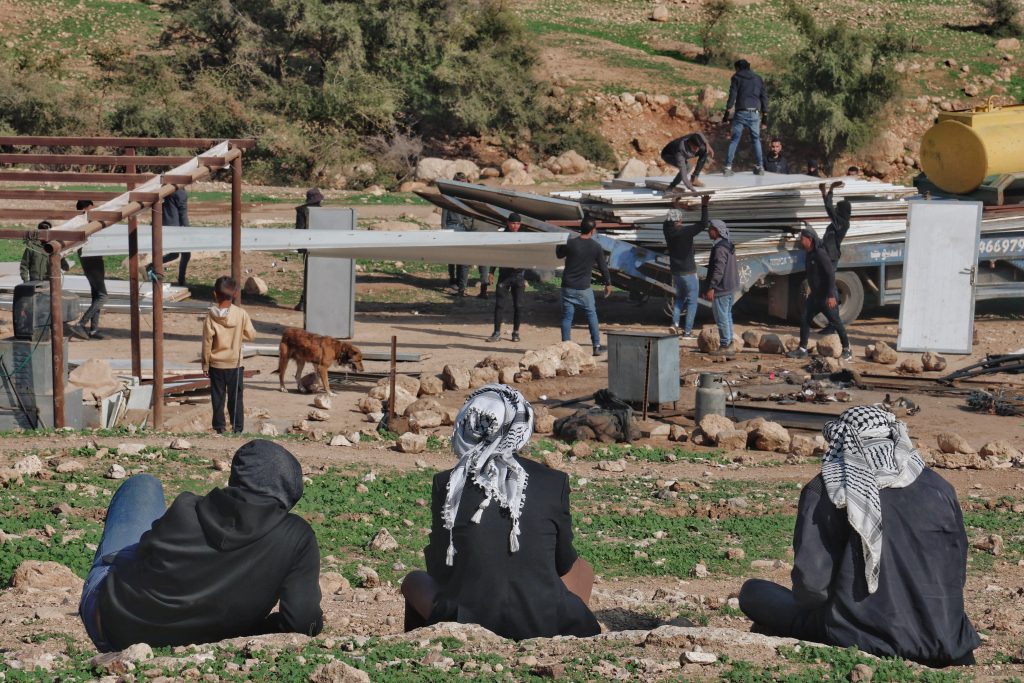
The year 2025 saw the unprecedented displacement of Palestinian rural communities by Israeli settlers, who enjoy the Israeli army’s backing. At least 13 rural Palestinian communities in the West Bank were completely wiped off the map. This impacted at least 190 families and 1,090 individuals.
The wave of settler attacks has continued into 2026, with the displacement of the Ras Ain al-Auja community near Jericho last week.
The dramatic escalation of Israeli settler violence against the Palestinian countryside began after October 7, 2023, and has been particularly devastating to Bedouin communities in the Jordan Valley, the West Bank’s eastern slopes, and the South Hebron Hills. Palestinians from these areas consider their silent displacement a “second Nakba,” and an extension of Israel’s genocide in Gaza.
In 2025, Israeli settlers conducted 892 attacks on Palestinians, killing 14 people in the West Bank.
Last week, the head of the Palestinian Authority’s official Wall and Settlement Resistance Commission, Moayad Shaaban, announced the commission’s findings for the year 2025 at a press conference. According to the report, between January and December 2025, Israeli settlers conducted 892 attacks on Palestinians, killing 14 people in the West Bank. Settler attacks also provoked 434 fires, 127 of which affected farmland, and 307 fires against other Palestinian properties. These attacks concentrated in the areas surrounding Ramallah, Nablus, Hebron, and Tulkarem.
The report also indicated that in 2025, 35,273 trees were destroyed and poisoned, including 26,988 olive trees in the areas of Salfit, Nablus, Ramallah, Bethlehem, and Hebron. This was coupled with a wave of demolitions by the Israeli army, which leveled 1,400 Palestinian structures that year, including 304 inhabited homes, 74 uninhabited houses, 4,900 farming structures, and 270 other livelihood structures. Demolitions, according to the report, concentrated in Ramallah, Nablus, Tubas, Hebron, and Jerusalem.
A year ago, Shaaban told Mondoweiss that settlers’ violence was “an arm of Israel’s annexation policy.” Shaaban also said that his commission had pursued a strategy of establishing a humanitarian presence on the ground to confront these policies, especially through the mobilization of volunteers from local communities. Shaaban explained that the commission worked on “enhancing local steadfastness,” pointing out that volunteers supported Palestinian farmers in accessing their lands in almost 60 percent of the villages threatened by settler violence during the 2024 olive harvest season.
But conditions in the West Bank countryside have deteriorated dramatically since then. The olive harvest season marked a record low this past October, yielding a meager 7,000 tons of olive oil, compared to the 27,000 tons produced last year, according to estimates by the PA Ministry of Agriculture and other Palestinian research centers. The low production totals for 2025 are close to those in 2023, when the events of October 7 coincided with the height of the harvest season and were immediately followed by a dramatic spike in settler violence.
Today, as attention centers on Gaza, Iran, and Lebanon, Israel continues to escalate its clear strategy of de facto annexation in the West Bank, targeting a maximum of Palestinian territories while isolating Palestinian population concentrations. The ongoing displacement of Palestinian communities is coupled with the rapid expansion of settlement construction and the legalization of previously illegal settler outposts under Israeli law.
On Wednesday, the Israeli government announced the legalization of five new settler outposts in the West Bank built on Palestinian land, while last year, Israel advanced this strategy by issuing permits to build 22 new settlements, one of the largest ever settlement expansion plans in decades.
Lives torn apart
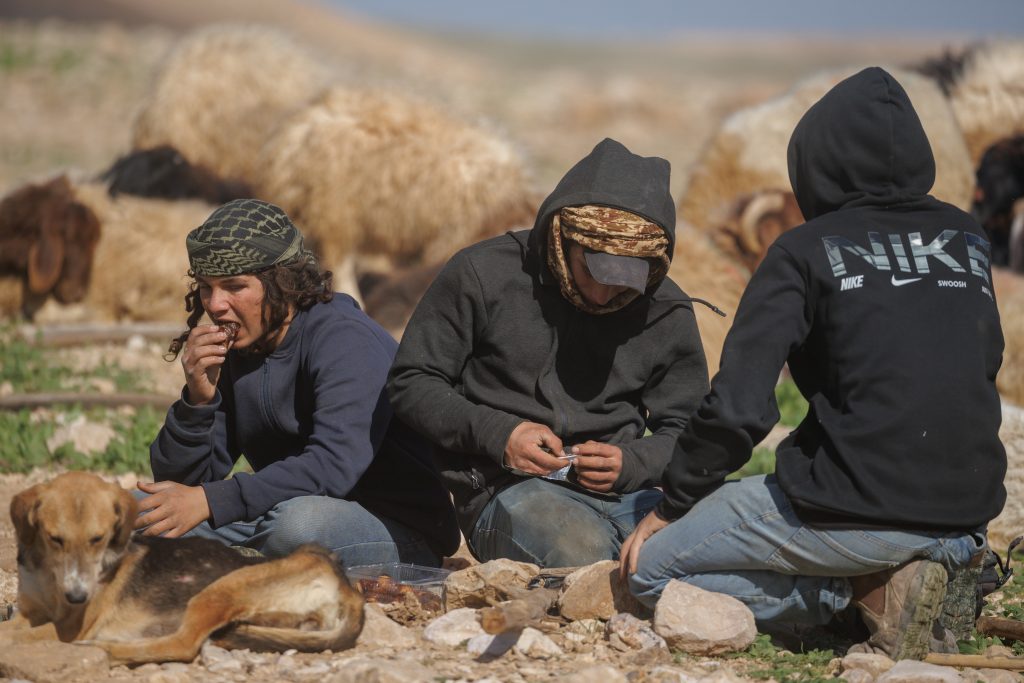
For Palestinians, the impact of this violence and colonization cuts deep into daily life. In rural areas, the social fabric has been disrupted, as Bedouin families are unable to sustain their livelihoods as livestock herders, lose access to grazing lands, and are forced to sell off parts of their herds to survive on the outskirts of villages and towns — areas that have also lost land since October 7.
Yousef Khalayfeh, a Palestinian Bedouin from the Mu’arrajat community, has lived with his family on the edges of the village of Rammoun near Ramallah since being displaced by Israeli settlers from his land in October 2023.
“We lost our herding and grazing pastures, and with them, the capacity to continue to live off our livestock the way we’ve done for generations,” Khalayfeh told Mondoweiss. “After we were displaced, we were forced to sell off a large part of our livestock, because the small space at the periphery of the villages where we had moved to isn’t enough for all our herds.”
“But even after moving here, Israeli settlers continued to attack us where we thought we were safer,” Khalayfeh continued. “They stole our sheep before our eyes, leaving us with very little capital.”
Khalayfeh is now forced to move the little livestock he has even closer to the village. This is creating friction with local villagers, as his small herd has wandered onto their private lands and damaged some of their olive trees, he says.

In the village of Mughayyir, northeast of Ramallah, Israeli settler violence had already made the village’s eastern plain inaccessible to its owners during the harvest season. Then, in August of last year, the Israeli army decided to punish the village, after it accused a youth from Mughayyir of throwing stones at Israeli forces. The punishment? Uprooting and destroying between 8,000 and 10,000 olive trees in the plain, essentially ending the village’s olive production.
Fayez Abu Alia, a Palestinian farmer from Mughayyir, told Mondoweiss that families’ lives as farmers have been destroyed after thousands of olive trees were bulldozed. “My family lost 450 olive trees, and have only three trees left, two of them in my courtyard,” Abu Alia said. “We used to make 95 to 100 tankards [of about 16 kilograms] of olive oil per year. My brothers’ households and my own took our share for consumption, and I still had around 40 tankards to sell, which made some 16,000 shekels [$4,848] — an important part of my family’s income.”

“Last year’s season, in October, I only made two tankards,” Abu Alia said. “Each of my siblings’ households got less than 5 kilograms for our own consumption, and nothing to sell. We’re now forced to buy olive oil, after being producers for generations.”
Abu Alia had been a full-time farmer, and the maintenance of his family’s olive groves formed a central part of his livelihood. Since losing that source of income, he explained, he has been forced to work for others to make ends meet. He added that most farmers in Mughayyir are facing similar conditions, struggling to sustain their families and remain in the village. With much of what once defined their lives now gone, he said, people are no longer planning for the future but focusing simply on staying where they are.
“We’re trying our best to maintain our lives and families in the village,” he said. “We’re just focused on remaining steadfast, even after losing everything.”

The Only Jewish State in the World has invented a new form of terrorism: agricultural terrorism.
Ta’ayush (” a grassroots movement of Arabs and Jews working to break down the walls of racism and segregation by constructing a true Arab-Jewish partnership.” ) has documented it extensively:
December with its rains has passed, January with its rains is here. There will be no plowing this year in the Masafer, the result of effective agricultural terrorism by the army and the settlers. The grazing season has begun, prime time for invasions by settlers with herds, another form of agricultural terrorism. We counted at least 50 such invasions just this week. We have already explained the devastating damage that the settlers’ sheep, cows, and camels wreak on all types of vegetation, often to the point of complete destruction of crops and trees. Recently, these invasions have become particularly massive and brutal, with the army intervening and punishing the attacked Palestinians at the behest of the attacking settlers….
Weekly summary from Masafer Yatta, January 2-8, 2026 « Taayush
When will this genocidal settler colony disarm its genocidal settlers? Oh wait, the answer is already contained in the question