
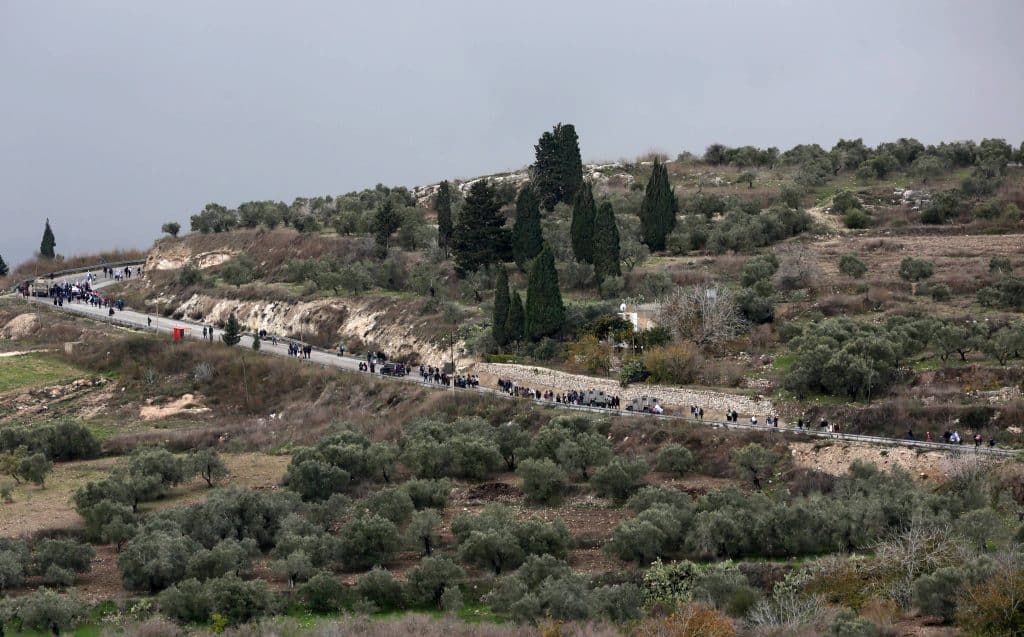
Muhammad Jaradat would never have imagined that 2025 would be the last year he got to visit the hills of the northern West Bank with his hiking group.
“We returned once or twice every year, amazed by the beauty of carob and oak trees,” he said in a quiet grief.
Jaradat, the founder of the Jenin-based Tijawal wa Tirhal group, says that his hiking companions took it upon themselves to tour the rolling plains and forests that dotted the landscape stretching around Jenin. “Our first hike was in the lands of Umm al-Tout nearly 13 years ago,” he told Mondoweiss. “We also used to roam the lands of Jenin, Sanur, and Raba.”
“We don’t hike for leisure alone,” Jaradat said. “We hike to assert our right to these hills. Every carob tree has a name. Every ridge carries a story.”
The areas Jaradat and his group visited used to be illegally occupied by the four Israeli settlements of Ganim, Kadim, Homesh, and Sa-Nur, before Israel unilaterally evacuated them in 2005 following the passing of what was known as the Disengagement Law.
In June, Israel announced plans to build 22 new settlements, including where Sa-Nur and Homesh used to be. The objective is part of Israel’s broader vision to annex large parts of the West Bank.
But these settlements are back, and access to the Palestinian lands around them has been progressively restricted by Israeli authorities ever since 2023, when Israel’s Knesset began the process of re-legalizing the settlements through successive amendments to the 2005 Disengagement Law.
Since then, the Israeli government has retroactively legalized 19 settlement outposts across the West Bank, including the four evacuated settlements in the north. In legal terms, Israel effectively reversed the Disengagement Law after revoking it altogether in July 2024. A year later, Israel announced plans to build 22 new settlements in June, including where Sa-Nur and Homesh used to be.
The objective of this push is part of Israel’s broader vision to annex large parts of the West Bank after forcing its residents off their lands. It plans to do so by making life unbearable for Palestinians in areas targeted for resettlement — until they “voluntarily” leave.
Sanur and Homesh: the hills watching over Nablus and Jenin
The Palestinian village of Sanur, located atop Tal al-Tarsala, has long held strategic significance for the Israeli military. Sitting on elevated terrain in the northern West Bank, it overlooks key routes connecting Jenin and Nablus. The nearby former Israeli settlement of Sa-Nur, which took the name of the Palestinian village, previously benefited from the presence of a major military base that used to control large swathes of the region before the 2005 disengagement.
Following the Israeli government’s most recent decision to re-settle the area, a military platoon has been deployed to the area around Sanur, in preparation for establishing a permanent military base and facilitating the return of settler families.
The move is part of a broader plan to relocate the headquarters of the Menashe Brigade, the Israeli military unit responsible for the northern West Bank, from inside Israel to the occupied territory.
Another part of the preparations involves building the so-called “Silat Bypass,” a road being funded by the Israeli Finance Ministry with roughly 20 million shekels, under the leadership of the Religious Zionism Party’s Bezalel Smotrich.
Last week, Smotrich announced that plans are in motion to build 126 new settlement units as part of the resurrected Sa-Nur colony, describing the move as a “correction of a historical injustice” and “the implementation of a Zionist vision on the ground.” He emphasized that the return to Sa-Nur would not come through slogans, but through “plans, budgets, roads, and concrete steps.”
Another settlement slated for revival is Homesh, established on lands belonging to the Palestinian villages of Burqa, Silat al-Dhahr, and Bazariya. Homesh occupies a similarly strategic hilltop between Jenin and Nablus, and its evacuation in 2005 was fiercely opposed by settlers. Ever since, the site has remained a persistent flashpoint between Palestinians and settlers, often backed by the military.
But today, confrontation with settlers is no longer necessary for Palestinians nearby to feel threatened; simply approaching their farmland is often enough to prompt the arrival of Israeli soldiers.
“They don’t need to expel us all at once. They just make the land impossible to live on.”
Palestinian resident from Burqa
Over recent years, residents of Burqa, Silat al-Dhahr, and Bazariya have documented dozens of incidents in which farmers and shepherds were subjected to verbal and physical attacks.
Ahmad Abu Fahd, a farmer from Silat al-Dhahr, says that access to his land has been heavily restricted in recent years. “Every morning we ask ourselves the same question: will we be allowed to reach our land today, or will the settlers block us again?” he says while scanning the hills overlooking his fields. “Since Homesh returned, every step toward our lands has become a gamble. Sometimes they come with army protection. Sometimes they chase us, throw stones, and force us to leave empty-handed.”
For communities surrounding Homesh, the threat extends beyond physical injury or crop damage. The unpredictability itself — never knowing when land will be accessible, when soldiers will appear, or when violence will erupt — has become a tool of domination.
“They don’t need to expel us all at once,” one resident who preferred to remain anonymous told Mondoweiss. “They just make the land impossible to live on.”
Kadim and Ganim: Jenin’s exposed flank
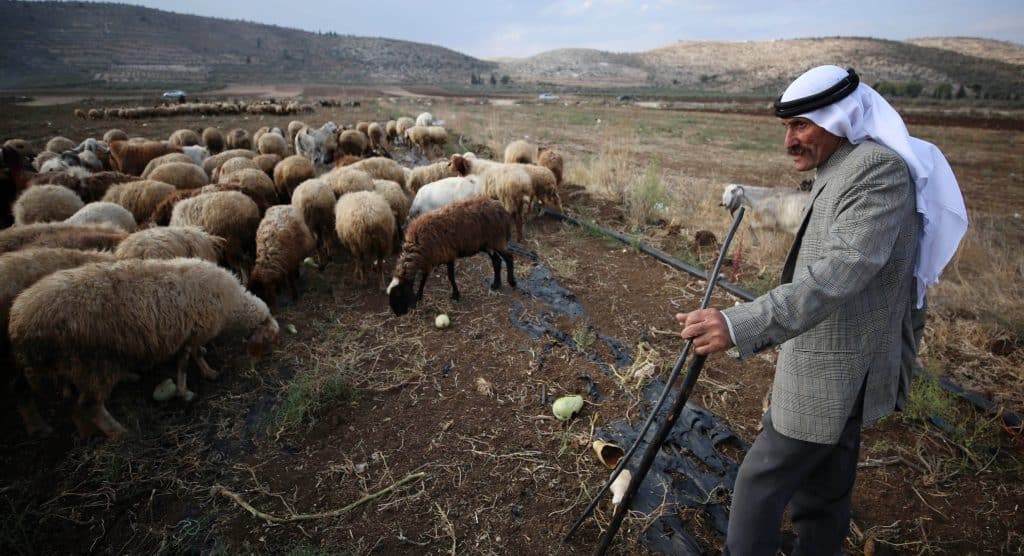
In mid-December, residents of Jenin were startled by bright lights glowing atop the hills of Ganim and Kadim. These were not the temporary encampments settlers had occasionally erected before, but organized celebrations by settler groups marking Jewish religious holidays and openly calling for a renewed Jewish presence there.
The event came only days after Israel’s decision to allow a return to the site, signaling the first step toward re-establishing control over two settlements located just hundreds of meters from Palestinian homes in Jenin’s eastern neighborhoods.
Over the past several weeks, the Jenin area and other parts of the northern West Bank have been subjected to a wide-ranging Israeli military operation aimed at creating a “new security reality” in the area that would allow for the reestablishment of the evacuated settlements. The military campaign drew international condemnation after a particular incident in which Israeli soldiers were caught on camera executing two Palestinian men in Jenin after they had surrendered to the army.
Before 2005, Ganim and Kadim settlements were founded with a combined security-agricultural character, and later gradually evolved into permanent residential communities housing religious-nationalist settler families. The Israeli army provided protection and essential infrastructure, roads, electricity, and water, helping entrench settlement presence as a fact on the ground.
Before the decision to disengage, Palestinian residents of the area recall that military activity in and around these hilltops frequently preceded incursions into Jenin. For them, the settlements were never merely civilian sites, but places where the presence of soldiers often signaled an impending raid.
As direct roads were sealed off, journeys that once spanned just four kilometers were forced into detours stretching dozens of kilometers, in the absence of accessible alternative routes. When the settlements were evacuated in 2005, their prefabricated structures were dismantled and removed, leaving the land cleared, but far from being returned to its Palestinian owners.
Settlers’ attempts to return to Ganim, Kadim, Homesh, and Sanur have followed a deliberate, cumulative strategy. It began with repeated incursions into the evacuated sites, particularly Homesh, where in recent years settlers have camped overnight and erected temporary tents under army protection.

The repeated attempts to reoccupy the hilltop led to the formation of the “Homesh First” settler groups by 2007, which periodically returned to the hilltop with the help of settler networks that supplied food, water, and logistical assistance, allowing a sustained though officially illegal presence to take root.
This presence later expanded through the establishment of religious and educational institutions, most notably the Homesh Yeshiva. What began in tents gradually evolved into caravans, marking a clear shift toward permanent civilian settlement and signaling the transformation of Homesh from a formally evacuated military site into a de facto civilian colony.
According to a report by Yesh Din Volunteers for Human Rights, between 2015 and 2018, settlers were documented in restricted zones more than 40 times, sometimes in groups of dozens or hundreds. Police investigations into settlers’ presence on privately-owned Palestinian land were consistently closed, indicating institutional tolerance for these legal violations.
Between 2017 and 2020, Yesh Din documented 21 violent incidents originating from the Homesh site against Palestinians in Burqa, Silat al-Dhahr, al-Funduqomiya, and Bazariya.
On the ground, new settlement roads were carved out and temporary infrastructure installed across the four sites. Amir Dawud, a researcher with the Palestinian Authority’s Wall and Settlement Resistance Commission, explains that these roads are designed to block farmers’ access to their land, sever geographic continuity in the north, and fragment Palestinian space in preparation for renewed settlement, not only as civilian enclaves, but as military zones.
Popular resistance and continuous return
Despite the bleak reality, Palestinians continue to assert their presence. Muhammad Jaradat recounts youth-led initiatives to replant trees uprooted by settlers and organize cleanup campaigns in evacuated areas before renewed closures.
“Before the decision to re-establish the settlements, we used these lands as our own shared spaces,” Jaradat recalls. “Families would come for picnics, children played football, and the community gathered for small events. We also worked to restore old homes near Ganim and Kadim and organized cultural and sporting activities. It was quiet work, but every step was a deliberate way to assert our presence and connection to the land, even under military restrictions.”
In Homesh, the most volatile of the four sites, landowners from the Palestinian village of Burqa filed a petition with the Israeli High Court of Justice, demanding full and unrestricted access to their privately owned land in the former settlement. The petitioners sought not only the restoration of their property rights but also guarantees for their safety, initiating a protracted series of legal proceedings aimed at securing both access to their land and protection from potential threats.
The legal struggle was a success that now only exists on paper. The seizure order has been revoked, and the area has been removed from the list of localities listed in the regional councils, but in practice, an illegal and unauthorized Israeli presence in the settlement remains.
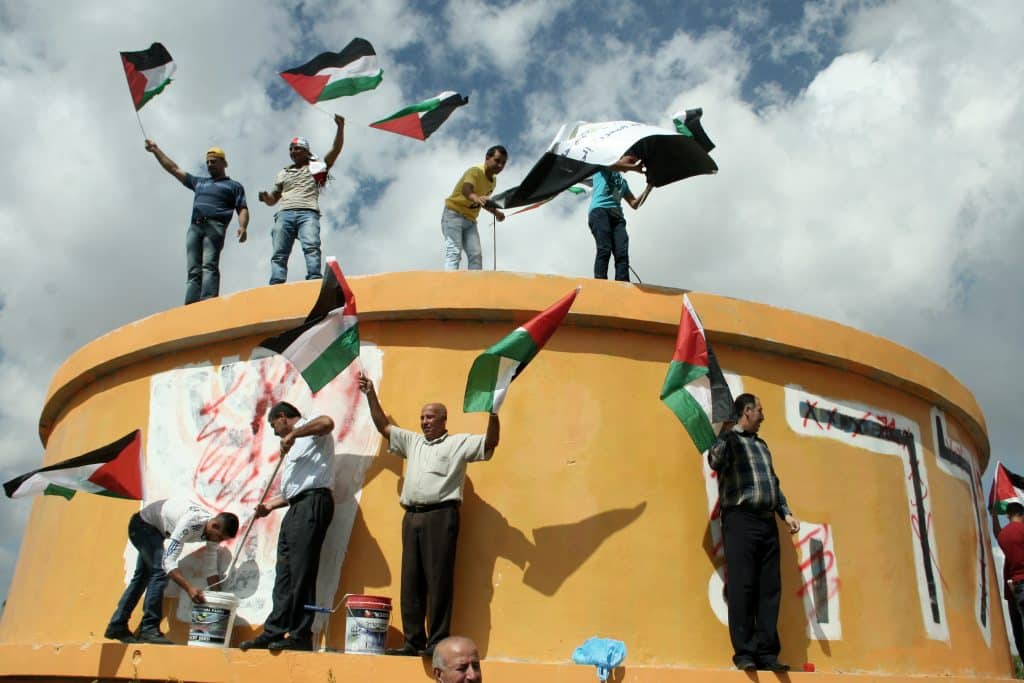
The same is true of the other settlements, creating a de facto settler presence that directly affects Palestinian landowners: around Sanur, farmers attempting to cultivate their land or harvest olives are routinely subjected to complex permit regimes and frequent denial of access.
The re-settlement of Homesh, Sa-Nur, Ganim, and Kadim is a microcosm of Israel’s broader vision for the West Bank, according to Dawud.
“Israel seeks to create isolated cantons surrounded by settlements and military bases,” he explains, adding that this would create a “security belt” that severs the northern and central West Bank and undermines any possibility of Palestinian sovereignty.
Still, farmers continue to return.
“The forests of Umm al-Tout and the hills of Tal al-Tarsala will continue to bear witness to this struggle of wills,” Jaradat said. “They will wait for the day when hiking returns without fear of a sniper’s bullet or a settler’s stone. Then the carob and oak trees will return to their rightful caretakers.”
Majd Jawad
Majd Jawad is a Journalist and researcher from Jenin, Palestine, holding a Master’s degree in Democracy and Human Rights from Birzeit University and a Bachelor’s degree in Journalism.

This might be an appropriate time to watch this 9 minute interview with Yeshayahu Leibowitz:
Yeshayahu Leibowitz – There are Judeo-Nazis
“Since the 6 day war Israel is no longer a democracy…Israel deprives 2 million people of civil and political rights…South Africa was not a democracy either….a Nazi like mentality…also exists in our country…”