
On January 23, 11-year-old Aline Asfour received her third-grade graduation certificate with honors, scoring in the 98th percentile and ranking first in her class. Her family celebrated her academic achievement and excellence. Two days later, Aline began feeling unwell. She started vomiting repeatedly and suffered from severe diarrhea. At first, her family believed she was experiencing a common cold due to the cold weather and living in displacement tents.
That same night, Aline’s temperature rose sharply, and the vomiting continued. By 1:30 a.m., her family called for an ambulance. A few days later, Aline was dead, succumbing to a deadly case of bacterial meningitis.
As of the time of writing, Aline is the first child in Gaza to die from the disease. Health officials in the Strip said at least 15 cases have been recorded so far, with expectations that the outbreak will worsen given the dire medical and living conditions faced by the majority of the population.
Officials also said that bacterial meningitis is often contracted from feces or respiratory droplets, making the displacement camps an ideal environment for spreading the illness. The bacterial infection is far more dangerous than its comparatively mild viral equivalent, and can often be deadly, they added.
When Aline first fell ill, she was rushed from the Mawasi area of Khan Younis to Nasser Medical Complex. At first, doctors only gave her an NSAID injection. “No one really knew what was happening with her,” her father, Hamouda Asfour, told Mondoweiss, saying that they were sent on their way after she received the injection.
Asfour then carried her on foot about 200 meters away from the hospital, deciding to stay the night at a nearby school where relatives were sheltering.

Less than an hour after receiving the injection, Aline’s condition rapidly deteriorated. “She told me she needed to go to the bathroom,” her father recalled. “I held her hand and took her, but on the way, she collapsed and started having convulsions in her limbs.”
Asfour picked her up and ran back to Nasser Hospital. “I was screaming inside the hospital. Aline was screaming, too,” he recounted. “She kept saying her head hurt and that she couldn’t bear the pain.”
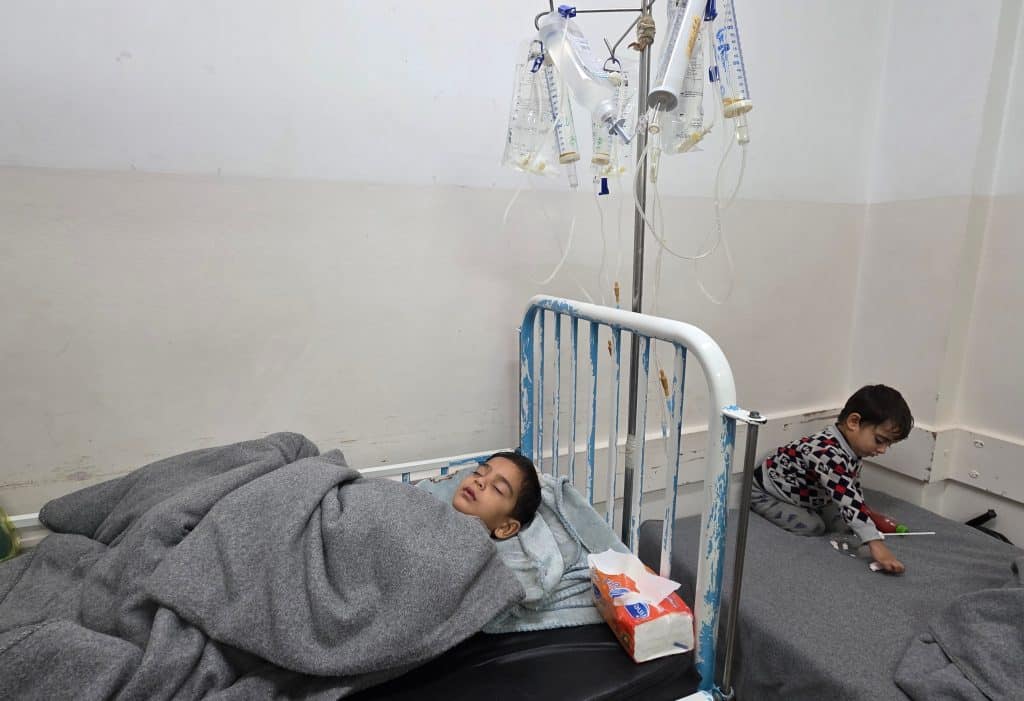
The staff readmitted her immediately, conducted tests, and administered IV fluids and injections throughout the night. The next day, doctors performed a spinal tap. That’s when they discovered the meningitis, telling Aline’s family that their child would have to be quarantined.
Doctors continued to provide her with palliative care as her convulsions intensified. After she began thrashing violently and breaking objects around her, she was administered a sedative. “Aline was completely unconscious,” her father said. Shortly afterward, her body went cold. By the afternoon, she was transferred to the intensive care unit. Her father said he asked the doctors about her condition every hour, every moment.
At some point, they told him that brain scans showed that there were dead cells in her brain. Three days later, Aline passed away.
Crowded living conditions and poor sanitation
Asfour says families live in tightly packed tents in the displacement camps, with sewage water flowing between them and rainwater pooling into muddy, contaminated puddles. Using the camp’s sanitation facilities, he says, is one of the most difficult daily challenges. “More than fifty people use the camp bathroom in a single hour,” he said, adding that he cannot be certain how his daughter contracted the infection. He also noted that Aline attended school in the same camp, with over fifty students cramming into a single tent.
Aline’s mother, Ola Asfour, said her daughter’s illness lasted less than a week. At the hospital, doctors repeatedly asked her about her other children. She told them she had two boys and another girl.
“They told me I have to take care of them,” she told Mondoweiss. “She wasn’t dead yet, but the doctors said there was no hope, that it was only a matter of days before she would give up and die.”
Ola says that the most painful experience she has endured throughout the war us watching her daughter breathe in front of her while waiting, hour after hour, for her death.
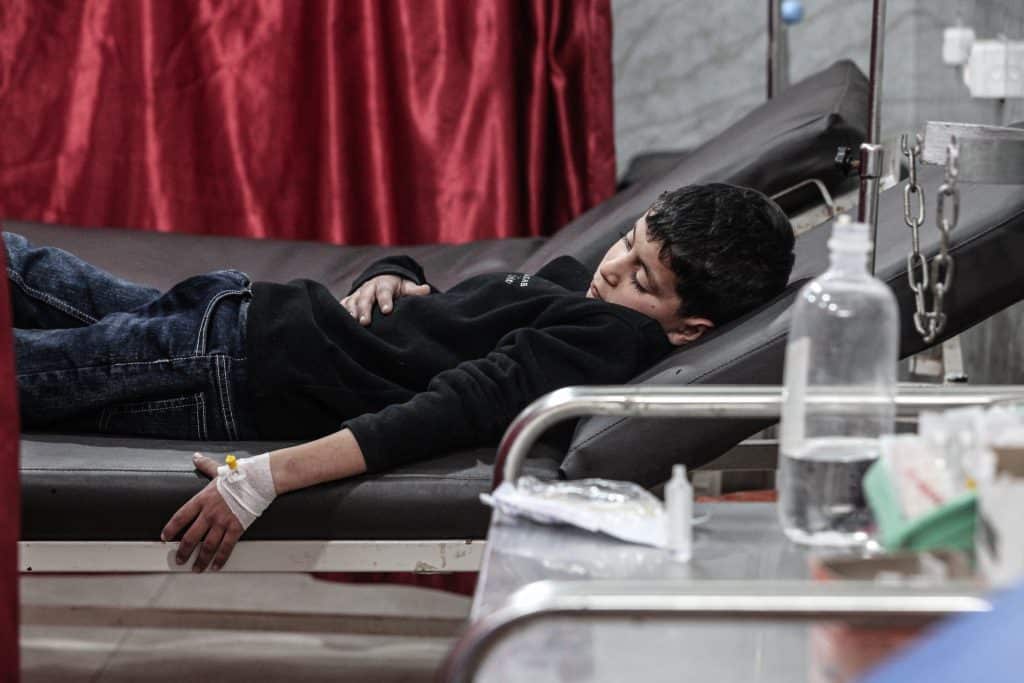
Nine children are currently being treated at Nasser Hospital with meningitis. Other than these confirmed cases, others have been reported at al-Rantisi Children’s Hospital and al-Aqsa Martyrs Hospital. Dr. Ahmad al-Farah, head of the pediatric department at Nasser Hospital, said there is still no official figure for the total number of cases across Gaza, as preventive medicine authorities are expected to announce comprehensive data within the next 48 hours. He tells Mondoweiss that he estimates there are at least 15 cases across the Strip.
Al-Farah notes that the disease itself is not new, but what is alarming about the current wave is that all recorded cases so far are bacterial, which require immediate antibiotic treatments or risk serious complications, including hearing loss, vision loss, paralysis, brain damage, and even death.
According to al-Farah, bacterial meningitis can be treated successfully if diagnosed early, but delayed access to hospitals in Gaza amid the decimation of the health sector threatens to lead to severe complications. He cited the case of Aline, who arrived to the hospital late, by which time fluid had accumulated in the brain, ultimately leading to her death.

The after-effects of Gaza’s famine and continued deprivation
Al-Farah stressed that malnutrition is the primary factor weakening children’s immune systems. Doctors observed that all children diagnosed with meningitis at Nasser Medical Complex were suffering from varying degrees of malnutrition. Their families, he added, are also experiencing food insecurity.
He gave the example of a five-year-old child who should have weighed around 20 kilograms but weighed only 9 upon arrival at the hospital.
Before the start of the ongoing ceasefire in October 2025, famine was declared in Gaza as a result of Israel’s policy of deliberate starvation. According to the world’s foremost famine-monitoring body, the Integrated Food Security Phase Classification (IPC), at least 136,000 children suffered from acute malnutrition at the time. Since the ceasefire took hold, Israel has continued to obstruct the flow of aid into Gaza, falling well short of the agreed-upon daily target of 600 aid trucks per day.
“Vaccinated children still contracted the disease indicates severe immune system weakness, likely linked to widespread malnutrition.”
Dr. Ahmad al-Farah, head of pediatrics at Nasser Medical Complex in Khan Younis.
Of the nine cases treated at Nasser Medical Complex, five were diagnosed with bacterial meningitis caused by Streptococcus, an aggressive strain that requires 10 to 15 days of treatment. “What is particularly concerning,” al-Farah said, “is that children are typically vaccinated against this bacterium. The fact that vaccinated children still contracted the disease indicates severe immune system weakness, likely linked to widespread malnutrition.”
Dr. Darwish Abu al-Kheir, a pediatric specialist at Nasser Hospital who treats the children infected with meningitis, says the wave has also been made worse by the continued ban on the entry of medicines.

This is further compounded by the fact that early detection is often impossible due to the high volume of child patients and the lack of testing capabilities. “Every day, nearly a thousand children come to the emergency department,” Abu al-Kheir says. “Out of a thousand children, how can we know who is infected and who is not?” He notes that this places an enormous burden on the medical staff and rapidly exhausts both personnel and equipment needed for testing.
“The lab’s capacity is almost zero,” he explains.
Under these conditions, he adds, all doctors can do is advise families to wash their hands, practice disinfection, and avoid contact with infected people. But he also acknowledges that it is impossible to ask displaced families to leave the overcrowded camps, as there are no alternatives.


U.N. report from today, Feb 4:
Local health organisations warn that around 11,000 patients are currently deprived of specialised or diagnostic cancer treatment inside Gaza….Some 4,000 patients who received medical referrals to hospitals outside the Strip have been waiting for more than two years to travel….UN News visited Al-Shifa Hospital in Gaza City, documenting the dire conditions inside its oncology department. Patients crowd corridors and wards, waiting for consultations or treatments that are no longer available.
‘We are dying’: Gaza’s cancer patients plead for a way out | UN News
BBC news report on pregnant women and premature babies in Gaza.
https://www.bbc.co.uk/news/videos/c62wpd7wj3ro
Meanwhile in Western societies, dangerous liars spread nonsense that vaccines are killing children or causing autism. We see clearly in Gaza what happens after vaccinations are prevented. Utter shame on the entire State of Israel – its people and government.