

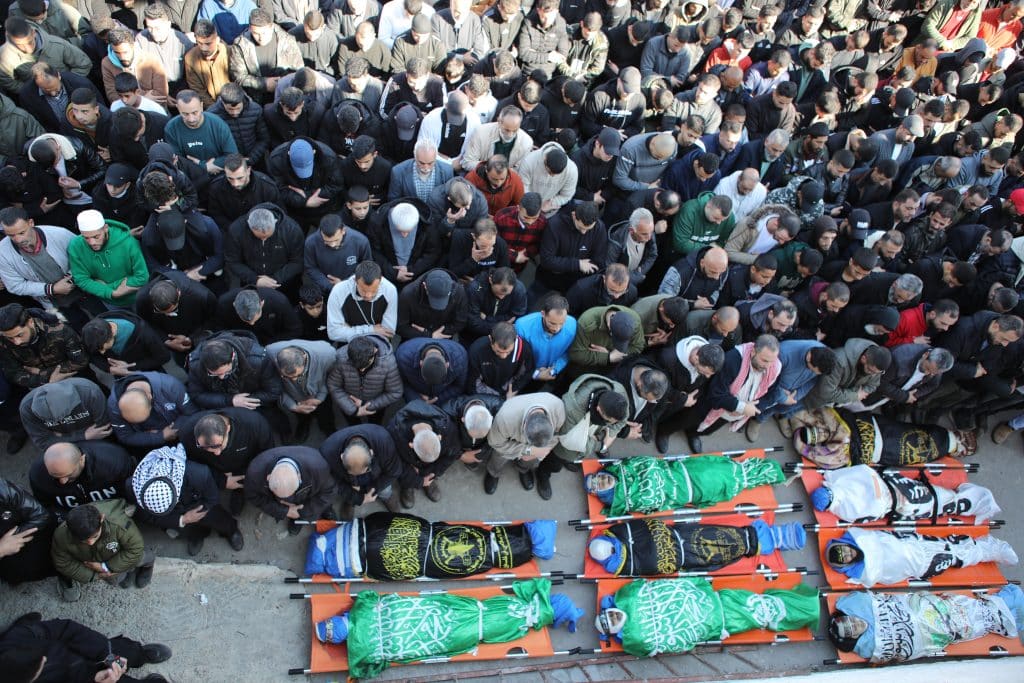
Last week, on an ordinary road in the heart of the village of Tammoun in the northern West Bank, a vehicle carrying Samer Samara and his children was intercepted by members of the Palestinian Authority’s Preventive Security Forces. The unit was masked and heavily armed, moving with the precision of a planned operation. According to the family, they encircled the car and opened fire, unloading rounds through glass and metal with a density that transformed the vehicle into a cage of shrapnel. The windshield splintered inward as bullets tore through seats and bodies. Two children were struck — one killed, the other left in critical condition and on life support. Their father was shot in both legs, immobilized before being dragged from the blood-soaked interior and taken into PA jails and torture chambers.
What remained was a scene of intimate devastation: a little brother collapsing before his sibling’s eyes, a father bleeding beside the bodies of his children, the air thick with cordite and screams.
Samer Samara was not simply a man in a car; he was a wanted man in his eighth year on the run. Why he was wanted is not a matter of public knowledge either, although it apparently made him a target of both Israel and the PA. Yet there was no exchange of fire, the family insists; no weapon was in Samara’s hands at the moment the shots were fired.
Consider what this scene would have produced in Palestinian consciousness before October 7, 2023. Two distinct and powerful registers of feeling would have opened, almost simultaneously.
The first is wonder — at the eight years of being hunted by Israeli security forces across a landscape spatially engineered to deny such duration. It is a rare thing for a fugitive to outlast pursuit in the suffocating topography of the West Bank. The landscape itself conspires against such endurance: watchtowers puncture the horizon, informant networks hum beneath daily life, the PA surveils the streets, and sophisticated Israeli surveillance technologies settle like dust on olive leaves.
To remain “wanted” is not merely a legal designation, but a condition of being suspended between apparition and capture. It would have been a wonder had Samara sustained this condition for months, let alone for years. Samara was a son of Tammoun, a village that presses itself against the hills south of Jenin as though resisting erasure by sheer posture. The town was no stranger to the Israeli security apparatus, and the armed resistance brigades that grew out of the village had unsettled it on more than one occasion, most notably when an improvised explosive device killed an Israeli soldier.
Before October 7, a figure like Samer Samara would have been received with something approaching reverence. People were electrified by far less. Ibrahim Nabulsi, the “Lion of Nablus,” who was killed by Israeli forces in August 2022 after a far shorter period in hiding, became a symbol of Palestinian possibility and gave rise to the Lions’ Den, an armed resistance group in the old city of Nablus. His face filled murals and phone screens across the West Bank and the diaspora. He was mourned and celebrated simultaneously, not only as a fighter but as proof that the grid was not complete, that the script of capture could be delayed, and that a Palestinian body could, for a time, refuse what the occupation insisted was inevitable.
Samara had done this for twice as long. Under other conditions, the eight-year evasion would have been felt as a kind of miracle and a tear in the fabric of total control.
Affective genocide
The second register that would have permeated the Palestinian street before October 7 is shock. What the Palestinian Authority’s Preventive Security did in Tammoun — opening fire into a car carrying children, killing two of them, shooting their father before dragging him away — is the kind of act that would have detonated something. Streets would have filled. The killing of children by Palestinian security forces, in the heart of a Palestinian town, in the service of what can only be understood as coordination with Israeli security interests, would have been received as an outrage that demanded a rupture. The specific betrayal encoded in the scene — children killed not by the occupier’s soldiers but by the Authority that claims to represent and protect Palestinians — would have made it intolerable. It would have demanded a response commensurate with its horror.
Neither of these reactions — the wonder or the shock — crested into anything like what they would once have demanded. And this is the provocation. Not simply that the massacre didn’t elicit the expected response, but that the affective conditions for response had been systematically dismantled.
What explains the flatness? What configuration of authority and political fragmentation would enable this to happen and have it register, in Palestinian public life, as simply another entry in the ledger of catastrophe?
My central claim is that genocide did not take place in Gaza alone — not only in the sense that its violence has literal extensions across the West Bank, but in a more fundamental sense: it has reorganized the affective life of Palestinians everywhere.
What Gaza has produced, in its relentless accumulation of dead children, obliterated neighborhoods, and starved bodies, is not only a humanitarian catastrophe but an assault on the very capacity to be affected.
This affective genocide has entailed the systematic erosion of the nervous system’s ability to register horror as horror, achieved through overwhelming and unceasing atrocity. The wound is not only to bodies, but to the faculty of shock itself. When functioning, it transforms witnessed suffering into demand.
Palestinians, in this context, engage in what might be called disavowal: the knowledge that catastrophe is unfolding, yet that knowledge does not translate into transformative action. But unlike the form of disavowal that relegates impending disaster to a distant horizon — as in the acknowledgment that climate change threatens humanity without compelling structural change — Palestinian disavowal is neither abstract nor deferred. It is desperate and visceral, an immediate coping mechanism for a catastrophe that is already present. Disavowal becomes a kind of anesthesia, a response the nervous system develops when no other means of survival remain. Palestinians in the West Bank, and in the camps of Lebanon and Jordan, did not choose numbness.
Disavowing it all isn’t about lying to oneself; it’s a strategy of survival. One cannot afford to fully inhabit the knowledge of the atrocity without ceasing to function, so it’s held at a slight but decisive remove. Near enough to inform, far enough not to shatter.
This affective condition is not incidental to the brazenness on display in Tammoun. It is its enabling condition. The PA did not only calculate that the international community would look away — a calculation that has, for decades, proven reliable — but it also calculated, correctly, that a Palestinian public metabolizing genocide would lack the affective resources to mount the response that the massacre of children in a car would otherwise demand.
Brazenness of this order requires a guarantor, and that guarantor is exhaustion. This exhaustion isn’t a form of indifference. Palestinians are not indifferent to their dead. Rather, it is the exhaustion of those whose grief has been so continuously overloaded that each new atrocity arrives already partially absorbed, already half-anticipated and folded into the ambient texture of loss.
Outrage requires a certain distance between what is and what should be. Affective genocide closes that distance. It renders the catastrophic ordinary, and the ordinary catastrophic, until the two are no longer distinguishable, and the outrage that would otherwise erupt finds no foothold — and in doing so, it quietly renovates the terms of the Faustian bargain at the heart of PA’s rule.
The disintegration of Palestinian politics
That bargain is not new. It has structured the relationship between the PA and Palestinian society since Oslo — since the Authority first accepted the role of managing occupation in exchange for the semblance of sovereignty. Its essential logic is simple and brutal: the PA may arrest, assassinate, torture, and disappear; it may coordinate with the occupier against its own people; it may operate its security apparatus as a franchise of repression — all of which could be tolerated, even if not openly endorsed — provided it delivers something in return.
That something is not justice or liberation, and not even dignity. But it is order and the appearance of normalcy. Part of the PA’s social contract was the ability to provide a daily life that feels, however falsely, like a life rather than a siege. What affective genocide has done is dramatically expand the terms of what the PA can extract from this bargain.
A second dimension of this shift lies in the diffusion of gang-like modalities of rule, visible in Gaza, in the 1948 territories, and increasingly in the West Bank. The emergence of gangs — and the transformation of segments of the Palestinian Authority into gang-like structures — signals a hollowing out of politics itself.
The gang is instructive not because it is ideological, but because it is emptied of ideology. It represents a crude articulation of marginalization and racialization, where anti-political and fratricidal violence becomes a substitute for collective horizon. In a condition where the colonizer appears undefeatable, the field collapses into a war of all against all.
Violence is not longer emancipatory, instead becoming disciplinary and performative. It becomes a site for the exercise of a masculinity that feels castrated by structural impotence, yet insists on proving its virility through domination.
One might recall the figure of the driver in Men in the Sun. In Ghassan Kanafani’s classic novella, three Palestinian refugees attempt to reach Kuwait in search of work and dignity. They entrust their fate to Abu al-Khayzaran, a former fighter who was emasculated in the 1948 war — literally and symbolically castrated by defeat. He agrees to smuggle them across the desert by hiding them inside an empty water tank mounted on his truck. But in the blistering heat, delayed by bureaucratic trivialities and his own anxious calculations, he leaves them sealed inside too long. By the time he opens the tank, they have suffocated to death. The tragedy culminates in his anguished cry: “Why didn’t they bang against the sides of the tank?” — a question that displaces responsibility onto the dead and masks his own complicity.
Abu al-Khayzaran is not a villain in the conventional sense. His failure is born of impotence — of a masculinity shattered by war and exile, seeking restoration through small acts of cunning and survival. His crime is structured as negligence, as weakness stretched too far under pressure. But what we confront now is a mutation of that figure. The Palestinian Authority is no longer the accidental driver whose miscalculation leads to death.
It has entered a new horizon in which the driver does not merely misjudge the heat of the tank but intentionally seals it. Castration no longer produces tragic hesitation. Instead, the castrated compensates by taking it out on his own. Masculinity, wounded by structural impotence under occupation, seeks redemption through calibrated displays of force. If Kanafani’s driver kills through delay and denial, today’s driver kills through procedure and intention.
The shift marks a transition from tragic complicity to administered suffocation — from accident to design.
The assassination of wonder
But there is something else that was killed in Tammoun, and it is here that the full weight of affective genocide becomes legible. The massacre did not only suppress outrage. It also suppressed wonder.
What Samara’s fugitive endurance carried was the recognition of possibility — the realization that what the system presents as inevitable is, in fact, constructed, and therefore vulnerable.
Shock and wonder are, in this sense, two faces of the same faculty: both require a nervous system still capable of measuring the distance between the world as it is and the world as it might be — one recoiling from what should not have happened, the other exhilarated by what seemed impossible yet did. It is precisely this faculty that the relentless accumulation of atrocity destroys.
When Gaza produces, week after week, images that should be impossible and yet arrive as routine, it trains the nervous system to abandon its faith in the exceptional. The impossible becomes merely the next thing. And when the impossible becomes the next thing, the improbable — the fugitive who outlasted pursuit for eight years — loses its power to inspire. It too simply becomes data, absorbed into the ambient texture of a world where nothing is any longer surprising, because everything is already catastrophic.
This is the deepest political function of affective obliteration of genocide. It does not only suppress our rage at what is being done to us, but our perception of what might be possible. It dismantles not only the capacity for collective anger but the capacity for collective hope — the sense that the architecture of control is contingent, that it contains its own failures, that within its apparent totality there remain spaces of evasion, endurance, refusal.
In Tammoun, two kinds of wonder were extinguished at once.
The first belonged to the children themselves — to whatever remained, in the eyes of boys and girls riding in a car beside their father, of the world’s openness, its as-yet-unwritten quality and the ordinary sense that the future is a place one might still arrive at. That wonder died in the shattered glass, in the space between one moment and the next where a child’s gaze closes and does not reopen.
The second belonged to all of us in Palestine, but also elsewhere: the political faculty, fragile and irreplaceable, that allows a people to believe that the architecture of their subjugation is not final, and that within its apparent totality, there remain spaces of evasion and refusal. This wonder was also killed in Tammoun that day. At least for now.
Abdaljawad Omar
Abdaljawad Omar is a writer and Assistant Professor at Birzeit University, Palestine. Follow him on X @HHamayel2.

“Violence is not longer emancipatory, instead becoming disciplinary and performative. It becomes a site for the exercise of a masculinity that feels castrated by structural impotence, yet insists on proving its virility through domination.”
____________________________________________
Will brains find precedence over hearts?