
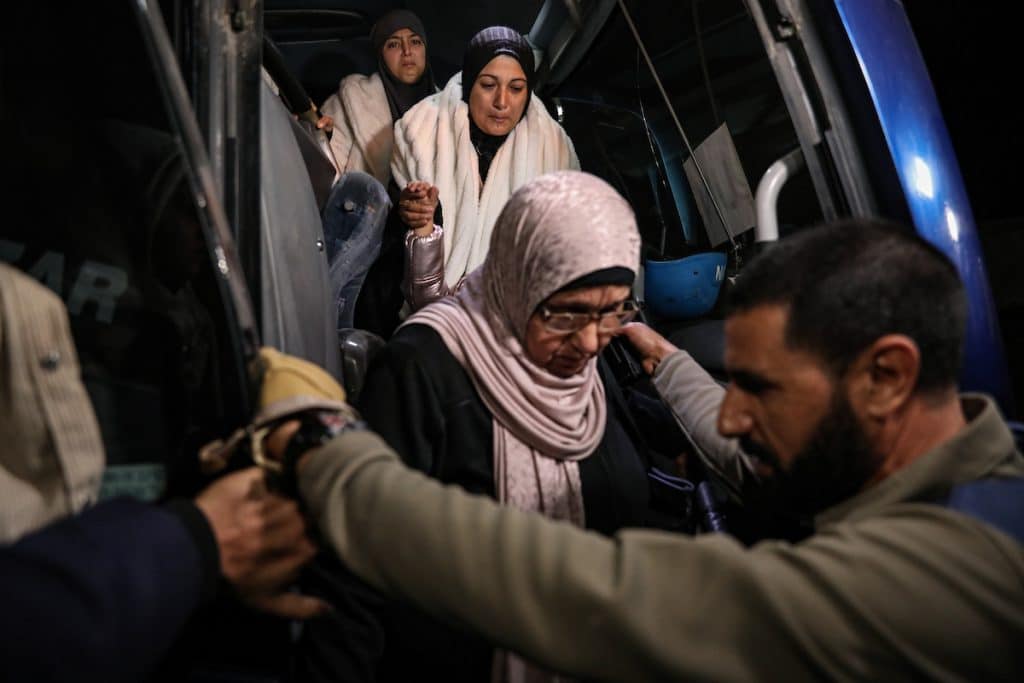
Shackled, interrogated, and humiliated. That is how Intisar al-Ekir, a Palestinian woman from Gaza, described her experience as one of a dozen people who returned back to Gaza from Egypt through the Rafah border crossing this week.
In a widely circulated video on social media, al-Ekir steps off a bus arriving from the Rafah crossing into Gaza, her outstretched hands showing signs of being handcuffed. She describes how she was harshly interrogated for three hours, how she was forced to identify her son among a group of people, and how Israeli investigators kept aggressively asking her about his whereabouts. “I do not know where any of them are,” she says, recounting that the interrogators kept yelling at her and telling her that she was a liar. As an elderly woman, she kept begging them to let her rest.
“They killed me… they killed me while they were hitting me and tying the handcuffs tighter on my hands,” al-Ekir recalled with unstoppable tears. “They put fire inside me, they burned my heart.”
For close to two years, tens of thousands of Palestinians like al-Ekir have been trapped outside Gaza, waiting to return home after leaving the Strip during the genocide. That long-awaited opportunity finally came on February 2nd, when the Rafah crossing with Egypt was opened. Israel had unilaterally shut down the border after attacking and taking control of it in May 2024.
Initial reports estimated, based on Israeli claims, that each day, 50 people would be allowed by Israeli authorities to return to Gaza while 150 people would be allowed to leave the Strip. However, local Palestinian reports confirmed that during the past four days since the crossing opened, a total of 138 Palestinians and their companions left Gaza, while only 77 people were allowed back in.
Rutana Riqb, who accompanied her sick mother to Egypt for medical treatment in March 2024, was part of the first group of Palestinians to return back to Gaza this week. She recounted her return to Mondoweiss, describing degrading treatment by Israeli soldiers at the Rafah crossing.
According to Rutana, the process of returning to Gaza began by registering with the Palestinian embassy in Egypt, where stranded Palestinians must submit their names for pre-approval. Those approved are then informed of their return date to Gaza.
Rutana tells Mondoweiss that on the first day that the crossing reopened, four buses departed from the Egyptian city of al-Arish toward Gaza. But when they got to the border, the Israelis only allowed one bus carrying 13 people through, ordering the other three buses to return to al-Arish. According to Rutana, four of the 13 people were almost not let through, allegedly due to the fact that they were carrying more than the permitted single bag per person.
After completing procedures on the Egyptian side, which Rutana described as “extremely humane,” the travelers dealt with Palestinian staff at the crossing, who also treated them well. They were then informed that after passing the Palestinian checkpoint, the Israeli army would take control until they entered Gaza. From that point on, Rutana says, her suffering began.
Long Israeli interrogations
“We reached the Israeli point without the Red Crescent, no humanitarian organizations, no escorts — only the bus driver and the passengers,” Rutana says. An Israeli military jeep drove in front of the bus, and another followed behind. Upon arrival, Israeli soldiers did not directly take them into custody. Instead, Palestinian personnel wearing uniforms labeled “Counter-Terrorism Unit” — the same name used by the Israeli-backed gangs in Rafah — received them, searched them physically one by one, and then handed them over to the Israeli army.
At the Israeli security check, soldiers handcuffed the passengers, blindfolded them, and led them to interrogation rooms.
“What are you doing in Gaza? Why did you return?” the soldiers repeatedly asked the passengers, Rutana recalls.
Rutana says the questions focused on the reasons for leaving and coming back, along with politically-charged questions, which interrogators insisted on asking over and over again. Passengers were allegedly given limited time to answer, and if their answers did not satisfy the soldiers, they were threatened with detention, prolonged handcuffing, imprisonment, and transfer to Israeli prisons.
“If you don’t answer within the given time, we will arrest you, and you will never see your children again,” Rutana recalls Israeli officers telling her. They also said: “You will never enter Gaza. Gaza belongs to us now.”
One interrogator told her, “What if we bring your children from Gaza right now, you take them and leave Gaza forever, and never return?”
Rutana says she understood this as an attempt to force Palestinians off their land. “They don’t care who comes back or who leaves. They want all of Gaza. They want the land without its people,” she says. One interrogator repeatedly told her, “Even if [it takes] thirty years, we will take all of Gaza.”
She describes being taken from one place to another, hands painfully bound, eyes repeatedly covered and uncovered, guns pointed at their heads as they were asked questions to which they had no answers. “They used the worst methods of interrogation and humiliation,” she says. “Their main goal was to push us to leave Gaza again — but they failed.”
Speaking about the crossing itself, Rutana says Rafah no longer looks like the border terminal it once was. “It is just a fenced corridor with high barriers on both sides,” she explains. “The rest of the crossing is completely burned.” She adds that returnees pass through three different Israeli gates, where facial scans are conducted before being taken for interrogation.
In another testimony, Huda Abu Abed, an elderly woman, describes a similar experience. She says all returnees went through nearly identical conditions. While on the bus, she saw Israeli military jeeps driving behind them and ahead of them. When she asked the bus driver where they were going,he replied saying “To the unknown.”
Huda says she believed the journey was over after being searched on both the Egyptian and Palestinian sides. She expected to return directly to her family in Gaza. Instead, passengers were taken off the bus and divided into small groups. Her name was called, and soldiers pointed at her saying, “Bring that old woman.” A Palestinian man from the ‘counter-terrorism unit’ took her by the hand and handed her over to soldiers.
“I am an elderly, sick woman,” Huda says. “Is there no humanity, no dignity, in taking me by the hand and delivering me to armed soldiers?” She adds that she has severe vision loss and should have been treated with care, not dragged into interrogation rooms, handcuffed, and blindfolded.
Why are you returning to Gaza? What do you have there? Who told you to return?
The questions were all familiar. She explained she was returning with her daughter, who had left her children behind in Gaza in order to accompany her mother for treatment in Egypt, and wanted to reunite with her children. After more than two hours of interrogation, soldiers told her to deliver a message: the people of Gaza should pack their belongings and leave at the first opportunity.
Huda says that under pressure, she began to panic and started screaming for her daughter, who helps her walk due to her poor eyesight. Soldiers told her her daughter was on the bus, but she later realized they were lying. Her daughter was also being interrogated. After some time, they were finally released and taken back to the bus, before finally being let through to Gaza.
“We will not leave.” This became the defining message that Palestinians returning to Gaza insisted on repeating, no matter how destroyed or scarred by war it is. Huda told Mondoweiss that all Palestinians must stay on their land, urging those who left Gaza to return as soon as possible.
‘We will not leave our country’
Rutana explains that many left Gaza alone, not with their families, because only limited people were allowed to accompany sick relatives. She herself left with her mother, but left behind her husband and children living in displacement camps in Gaza. “The main reason I returned is my family,” she says. “This is my country. I missed my family deeply, and I wanted to reunite with my children, whom I hadn’t seen for more than a year.”
Most of the testimonies collected from Palestinians returning from Egypt say the same; the overwhelming reason was family. Despite knowing that their homes had been destroyed, that their relatives were displaced, and that many were now living in worn tents, they returned without hesitation.
“When I left Gaza, my family was still living in our home in Khan Younis,” Rutana says. “When I returned, I found that the house had been bombed while my family was inside. My husband was seriously injured and is now unable to move. They are living in a tent instead of a home. I didn’t even know what life in a tent meant until I lived it myself.”
Despite everything, she insists on her decision. “Even if I were given the choice again, I would return to Gaza,” she says. “Life in Egypt, despite the warmth and care shown to Palestinians, is exile. Gaza is our homeland, and our family is there. We do not want to be separated from them.”
“I didn’t see my children for an entire year,” Rutana adds. “Every day I was torn apart as I followed the news, watching the bombing and destruction, asking myself: who is holding my children, who is comforting them when they are afraid? Now I have returned to them. I will stay with them. I will not leave them, and I will not leave Gaza.”
Huda echoed the sentiment, recalling suffering a severe health crisis in Egypt that put her in intensive care. She says she felt close to death, and at that moment, she had only one wish: to return to Gaza and die there.
“There is nothing that compares to being in your homeland,” she says. “No matter how comfortable, stable, or safe exile may be, home is more beautiful than anything else.”
“We were born in Gaza,” she adds. “Everything here is blessed. We will not leave our country. We will do everything we can to return to it, to live in it, to die in it, and to be buried in its earth.”

And those shilling for the genocidal Apartheid country wonder why people despise Israel. The hatred isn’t because they claim to be Jewish—Israel is the farthest thing from Judaism’s humanistic traditions—it’s because of their barbarism and sadism toward the indigenous people of Palestine that now stretches eight decades. In many ways, Israel represents the values of the Epstein Class: abusive, lacking empathy and humanity. Neanderthals.
So much of the torment heaped upon Palestinians by Israelis is pure sadism. As CT says, Israeli society has nothing to do with Judaism’s long tradition of moral inquiry and debate. All power tends to corrupt and absolute power corrupts absolutely, as Lord Acton said (although he was thinking primarily of the Catholic doctrine of Papal infallibility). Give someone a licence to kill and they will kill – whether it’s in Gaza or Minneapolis or Tehran. And they will feel no guilt.
“Rutana says she understood this as an attempt to force Palestinians off their land.”
This might be a good time to examine the issue of ethnic cleansing – what else can we call it? – by Israel. There’s been some recent media attention on a recording of an Ehud Barak – Jeffery Epstein conversation:
Former PM had told late sex offender that Israel could ‘easily absorb another million’ Russian immigrants to offset Palestinian population and lessen religious Jews’ influence.…Audio of the former Israeli Prime Minister Ehud Barak speaking to Jeffrey Epstein, the now deceased convicted sex offender, has shone a light on Israel’s efforts to alter demographics by diluting the Palestinian population it occupies and also revealed ingrained racism within Jewish circles….Barak told Epstein that he had told Russian President Vladimir Putin that Israel needs one million Russian-speaking immigrants to absorb, as the authorities can be more “selective” and “can control the quality much more effectively” compared to the past….The recording was released last week in a huge tranche of files by the United States Department of Justice….
What Barak-Epstein audio says about Israeli controlling demographics | Israel-Palestine conflict News | Al Jazeera
Barak wanted Russian immigration to offset Arab population growth, Epstein files show
Barak wanted Russian immigration to offset Arab population growth, Epstein files show | The Times of Israel
Demographic engineering at its finest!
In Australia The Police Beat You Up For Opposing Genocide
Caitlin Johnstone
Feb 09, 2026
“Australian authorities were fully aware that inviting Israel’s president for a visit was going to ignite unrest and furious opposition. They invited him anyway, and sent in the police to assault the protesters.
I saw a video of two cops pinning a kid in a keffiyeh face down on the ground and proceeding to punch him over and over again long after he’d been subdued.
I saw another video of police repeatedly punching a middle-aged man who was holding his hands in the air until he fell to the ground.
I saw another video of police repeatedly pepper spraying a demonstrator directly in the face as he was visibly complying with their demands to move and providing no resistance whatsoever.
I saw another video of police manhandling Muslim men who were literally on their knees praying, presenting no possible threat of any kind.
That’s right kids, welcome to Australia, where the government invites the head of a genocidal apartheid state for a happy cuddle party and then beats the shit out of anyone who opposes this.
It’s a testament to the courage and vitality of the pro-Palestine movement in Australia that people keep showing up to anti-genocide protests even as authorities do everything they can to create a chilling effect on them.
After all, this happens as the state of Queensland moves to make it illegal to utter the pro-Palestine phrases “from the river to the sea” or “globalise the intifada”, with violations punishable by two years in prison. This is easily the single most bat shit insane speech suppression legislation in Australian history, and that’s an extremely high bar.”
https://www.caitlinjohnst.one/p/in-australia-the-police-beat-you
Trump only has 7 billion of the 70 billion needed to begin rebuilding Gaza. He only has Muslim majority countries signed on for his International Peacekeeping Force. It is supposed to start with Rafah and it needs to kick out the IDF, IAF, and INF. It needs to secure the border crossing, rebuild the airport, and sea port and allow the Palestinians to control fishing in territorial waters, & etc.
Hamas has agreed to turn over heavy weapons to the Technocrats. The notion that Israel will restart the war in March with an international force in place is unlikely. They haven’t defeated Hamas to date, and have no prospects of doing a better job in the future. Likewise, the annexation of the West Bank will kill Trumps BOP and dispose of the two state illusion. Israel is shooting itself in the foot and forcing the Palestinians to demand equal rights and the vote in their own homeland and the end of the Zionist apartheid security state.