
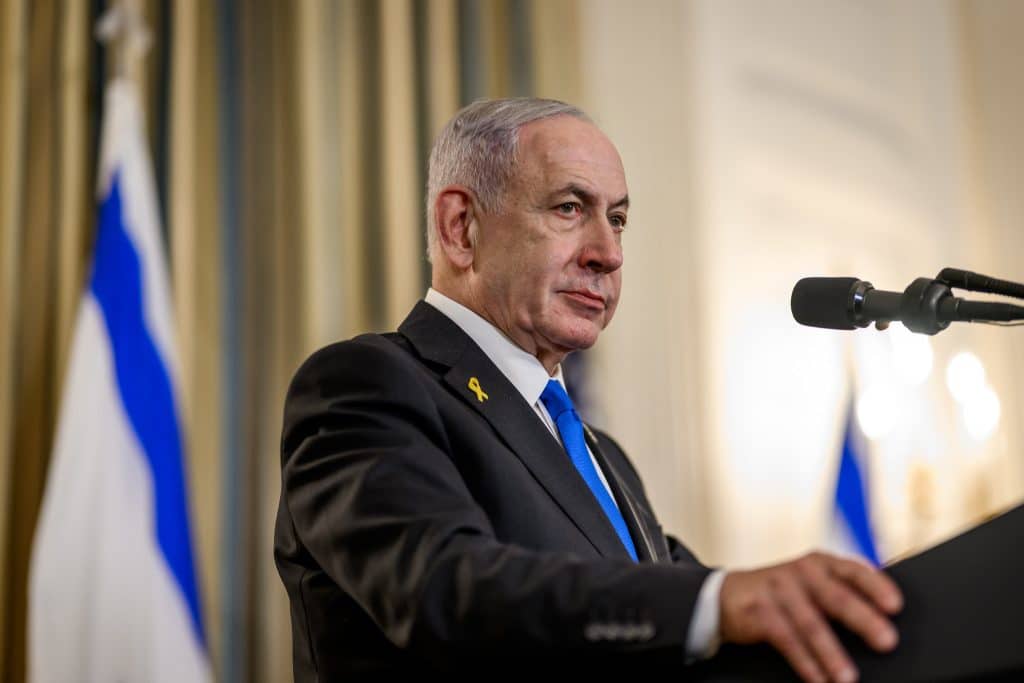
Israeli Prime Minister Benjamin Netanyahu made a hasty trip to Washington this week. He met with U.S. President Donald Trump on Wednesday, and the main topic of discussion was a potential war with Iran.
In an unusual, though not unique, turn of events, very little about the meeting was made public. There was no press conference, no major statement, not even a readout from either the American or Israeli side.
Aside from Iran, the only other topic mentioned specifically was Gaza, and this tells us something. Given the major developments in the West Bank earlier this week and the response those developments have gotten from Europe and some Arab and Muslim states, the fact that there was no specific mention of the West Bank is significant.
Iran
Since all we have to go on about the meeting are a few shallow comments from Netanyahu and Trump—two highly unreliable sources—we can’t know for certain whether Netanyahu succeeded in dissuading Trump from pursuing a diplomatic resolution with Iran.
Trump claimed that he insisted to Netanyahu that he would prefer a diplomatic resolution to the standoff, but he is also considering sending a second aircraft carrier group to the Persian Gulf to intimidate Iran. And we can be certain that Tehran has not forgotten that the U.S. attacked last June, even while negotiations were ongoing.
Still, the tone of the comments from both Trump and Netanyahu suggests that the Israeli leader’s trip was a failure in this regard. According to Netanyahu, Trump wants to reach a deal with Iran without an attack.
“I will not hide from you that I expressed general skepticism about any agreement with Iran, but I said that if an agreement is reached, it must include the elements that are important to Israel: not only the nuclear program, but also the ballistic missiles, and also the Iranian proxies,” he said.
It’s important to note that Netanyahu didn’t say Trump agreed to those conditions. Trump’s public statements have focused almost entirely on Iran’s nuclear capabilities and have generally lacked any kind of specificity.
But Netanyahu has a strong ally in Secretary of State and National Security Adviser Marco Rubio. According to Rubio, talks with Iran must include the question of ballistic missiles and Iranian support for militias around the region.
Netanyahu and Rubio both know very well that these are non-starters for Iran. Not only has Tehran publicly stated that it will not discuss either the issue of its ballistic missile program or its support for allied groups, but it would be suicide for them to do so.
The missiles and the militias are the only reasons Israel, and likely the United States, have not attacked Iran already. Without them, Iran would be entirely vulnerable to virtually unlimited air strikes. Its army can hold its own against a ground invasion, but any other attack—which are the kinds both Israel and the U.S. prefer and are very good at—would face neither resistance nor reprisal without Iran’s allies and ballistic missiles.
If Trump understands all of this—and that is far from certain—then when he says he believes a deal can be reached with Iran, he is indicating a willingness to focus on the nuclear issue.
A compromise on the nuclear issue is clearly attainable if both sides are serious about reaching one. Iran hasn’t pursued a nuclear weapon since at least 2003, and it’s unclear if it ever really intended to attain one. They can give Trump a win by agreeing to limit enrichment to levels needed only for civilian power and medical research, and sweeten the deal by handing over whatever enriched uranium they still have that exceeds that level.
But if Trump does pursue the issues of missiles and proxies, then a U.S. and/or Israeli attack is inevitable and will likely be both more devastating to Iran and provoke a much stronger response than what we saw in June 2025.
Still, that means we’re in the same position that we were prior to Netanyahu’s visit this week. It is therefore likely that his trip was a failure on this point.
Gaza
Just before he met with Trump, Netanyahu formally accepted Trump’s invitation for Israel to join the “Board of Peace.” It joins a list of 21 other states, all of which are authoritarian, Trump partners in corruption and far-right populism, or both.
While a country whose prime minister is wanted for war crimes by the International Criminal Court joining a “Board of Peace” generates its own absurd jokes, it will change very little on the ground, in Gaza or elsewhere.
Although Trump has declared that Phase II of his Gaza plan for “peace” has begun, there is no change on the ground. Israel continues to kill Palestinian civilians, continues to block most of the materials needed for basic survival in the devastated Strip, and continues to support its own mercenaries in Gaza to terrorize the population.
The U.S. seems to be seeking ways to reckon with Trump’s poorly conceived “peace plan.” The latest draft plan leaked for Hamas’ “disarmament” would have an agreement whereby Hamas could keep small arms, at least for a while. This is an apparent recognition of the reality that surrendering personal arms would be suicide for Hamas fighters, given the ongoing activity of Israeli-backed Palestinian gangs of bandits in Gaza.
It also moves closer to the sort of agreement that Hamas has floated since before the pseudo-“ceasefire” began in October, where they have proposed decommissioning their weapons and submitting to a Palestinian security force that would enforce the absence of weaponry.
None of this will sit well with Netanyahu, who continues to prepare Israel’s military for a renewed offensive in Gaza. Trump is resistant to this, as it will undermine his false claim to have “brought peace to the Middle East.” It is likely that this renewed attempt to find an agreement with Hamas is Trump attempting to forestall an Israeli attack.
Trump could, of course, simply tell Netanyahu not to launch a new offensive in Gaza. But given his political difficulties, and especially with midterm elections just beginning to ramp up, he likely would not want to be seen by his base as clashing with Netanyahu on a matter that they would perceive as fundamentally a concern of Israeli security.
Again, the lack of specificity in the remarks after the Wednesday Trump-Netanyahu meeting is probably an indication that things remain as before. And that means we are still heading toward a large-scale Israeli attack in Gaza in the coming weeks.
The West Bank
“The UK strongly condemns the Israeli Security Cabinet’s decision yesterday to expand Israeli control over the West Bank. The major changes to land, enforcement, and administrative powers proposed in the West Bank will harm efforts to advance peace and stability. The UK has been clear: any unilateral attempt to alter the geographic or demographic make-up of Palestine is wholly unacceptable and would be inconsistent with international law. We call on Israel to reverse these decisions immediately.”
That was the United Kingdom’s official response to Israel’s decisions on Sunday to change the rules on the West Bank.
Those changes will make it easier for settlers to buy Palestinian land, and to do so without the permits that, until now, were an obstacle to fraud in those purchases; they will also allow the military commander to essentially rewrite laws in the West Bank and enable more purchases by settlers and foreign speculators.
Israel will now also be empowered to enforce more regulations in Areas A and B, meaning Israel can now demolish homes and assert authority over important religious sites in those areas. More than this, it gives Israel even more power than it already had to limit and even completely halt Palestinian development in all areas of the West Bank.
These changes, and others which were included in this round of Israeli decisions, effectively expand the legal mechanisms of Israeli rule over the West Bank. They are correctly seen as another step in the annexation of the West Bank.
Of course, annexation of the West Bank has been underway in a gradual manner since 1967, and has accelerated greatly under the Netanyahu government. In practice, the West Bank has already been annexed, and that was made clear when the authority over the territory was transferred to civilian Israeli control, under the tender care of Finance Minister Bezalel Smotrich three years ago.
Still, this brazen exertion of Israeli control angered the UK. It also brought a rare joint condemnation from eight Arab and Muslim states—Egypt, Indonesia, Jordan, Pakistan, Qatar, Saudi Arabia, Türkiye, and the United Arab Emirates—who came together to denounce “the continued expansionist Israeli policies and illegal measures pursued by the Israeli government in the occupied West Bank, which fuel violence and conflict in the region.” Others also condemned the moves.
Yet Trump’s response to all of this was simply to say he opposes annexation. Indeed, he himself said nothing, while a White House official stated that the president “has clearly stated that he does not support Israel annexing the West Bank. A stable West Bank keeps Israel secure and is in line with this administration’s goal to achieve peace in the region.”
That’s a long way from a demand that Israel reverse these decisions. What Netanyahu and Smotrich hear when the White House makes this statement is, “Don’t officially annex the West Bank.” So, they just keep passing these rules, which seem obscure to most observers, tightening their hold on territory already completely under their control.
The fact that the West Bank was not even mentioned in any of the comments from Netanyahu and Trump after their meeting indicates that it was either not on the agenda or given very little space in their talks. For all practical purposes, that’s a U.S. rubber stamp on the decisions.
The only significant statement Trump made since the meeting was to berate Israeli President Isaac Herzog for not having pardoned Netanyahu. While these two highly slippery and dishonest men might have made any number of secret understandings in their meeting, the indications are that Netanyahu’s trip was a failure, and Trump’s thinking, such as it is, remains where it was before Wednesday.
In other words, things are still very grim. Iran is likely to be attacked. Israel is likely to renew its offensive against the people of Gaza. And West Bank annexation will continue apace. It could have been worse, but things got no better.

Used to be able to hear former CIA middle east analyst Flynt and Hillary Mann Leverett, Former head IAEA weapons inspector Scott Ritter etc on NPR, a few MSNBC programs years ago (Melissa Harris Perry) Charlie Rose’s program, Cspan. Could hear those experts on some of the main stream news programs discussing the U.S.’s history with Iran. Discussing their books. No longer.
Almost all outlets even Amanpour and Company pushing the “attack Iran” Israeli plan for decades. Bianna on Amanpour totally pushing guest who support and attack on Iran. Hoping Christianne Amanpour does not turn that program over to Bianna. She is so pro Israel no matter how many war crimes they commit she can barely see straight.
Where are those who would likely oppose an attack on Iran? Where are those who would bring up Israel’s unwillingness to sign the IAEA’s NPTreaty. That Iran signed long ago?
https://www.youtube.com/watch?v=8Mlk7sXRsPc
Scott Ritter on Iran and other issues:
https://www.c-span.org/person/scott-ritter/56771/
Main stream media not having any guest on their programs pushing back against Israel’s continued efforts to attack Iran….again
Here’s a reminder that the issue of genocide isn’t going to go away for the next 20 years:
Wes Streeting [ British Secretary of State for Health and Social Care ] told Peter Mandelson that Israel was “committing war crimes before our eyes” in Gaza, private WhatsApp messages have revealed….The health secretary’s views put him at odds with the government’s official position on the conflict….In one sent in July last year, he said: “Israel is committing war crimes before our eyes. Their government talks the language of ethnic cleansing and I have met with our own medics out there who describe the most chilling and distressing scenes of calculated brutality against women and children.”
Wes Streeting believes Israel committed ‘war crimes’ in Gaza, messages to Mandelson reveal
Re the death toll in Gaza, we won’t know for sure until Israel lets in the press and the scientific community, but recently the figure of 200,000 has been floated:
In what is considered one of the most serious estimates since the outbreak of war in October 2023, the Geneva Academy of International Humanitarian Law and Human Rights has suggested that Palestinian deaths in Gaza may have exceeded 200,000. The estimate is based on data indicating a population decline of more than 10% in recent months.
Gaza population drop of 10% could mean 200,000 deaths
Here’s Seymour Hersh’s essay from a year ago – I predict we will hear from him re Gaza later in the year:
The IDF recruiting pattern explains the growing violence against Palestinian men, women, and children in the war. I was told that 40 to 45 percent of today’s higher officers in the IDF come from settler families in the West Bank who combine “deep religiosity with Netanyahu’s political fervor.’’ The Israeli veteran told me of watching in horror, with colleagues, as Israeli bombings and earth-moving machinery were continuing to, as he put it, “level” north Gaza and turn it into a dead zone. He said that there “have been more and more reports of colonels and even generals issuing orders to kill every Palestinian you see and destroy every building still standing. Israel’s war in Gaza has become fanatical. It’s apocalypse now. Killing for killing’s sake. It is corruption like never before.”
Killing for killing’s sake in Gaza | Pearls and Irritations
Iran serves as a distraction from what the genocidal Apartheid regime is doing in Gaza, the WB, East Jerusalem, Syria and Lebanon: stealing more territory, ethnically cleansing more indigenous peoples and chemically poisoning the soil to prevent people who haven’t yet been violently removed from growing crops for survival.
Re: Iran
Given a well-documented history, a false flag is in the offing which will serve as the impetus to attack Iran and the expulsion of the remaining Palestinians from their ancestral lands. In the event, Israel may succeed in its complete domination of the region or—plausibly—suffer the greatest military loss in its inglorious history. With it, may result the destruction of the vile, authoritarian monarchies and families that rule the statelets in the Persian gulf region, and who are openly and tacitly allied with the Apartheid regime’s ambitions.
Smotrich says he would tell his daughter not to enlist in the IDF – The Times of Israel
“Given the major developments in the West Bank earlier this week and the response those developments have gotten from Europe and some Arab and Muslim states, the fact that there was no specific mention of the West Bank is significant. “
What has and continues to take place in the West Bank has been COMPLETELY ignored by almost all main stream media outlets for decades. Including NPR, BBC, PBS, AMANPOUR. A tiny bit of a shift the past year.
“The missiles and the militias are the only reasons Israel, and likely the United States, have not attacked Iran already. Without them, Iran would be entirely vulnerable to virtually unlimited air strikes. Its army can hold its own against a ground invasion, but any other attack—which are the kinds both Israel and the U.S. prefer and are very good at—would face neither resistance nor reprisal without Iran’s allies and ballistic missiles.”
Why would thinking leaders who are in the bullseye of Israel and the U.S. ever give up ballistic missiles that could reach Israel? All one has to do is look at Iraq, Afghanistan, Gaza, West Bank and know what Israel and the U.S. are and would continue to do.
No one NO ONE in the main stream, not Amanpour, not PBS, etc etc. Of course not Rachel Maddow, Chris Hayes, Jake Tapper, Dana Bash have or would ever bring up how Israel’s unwillingness to sign the IAEA’s Non Proliferation Treaty for decades. How Israel’s nuclear weapons threats in the middle east have been a major issue in that part of the world for decades. No way Trump and team and any other U.S. administration (since assassinated Pres John Kennedy challenged Israel) will bring up Israel’s defiance of the NPT and complete unwillingness to play the the same rules Israel demands Iran play by. No way has Israel ever been forced to open up their nuclear weapons facilities to the international community.
We know last President to really challenge Israel’s nuclear weapons development was President Kennedy.
https://nsarchive.gwu.edu/briefing-book/nuclear-vault/2019-05-02/battle-letters-1963-john-f-kennedy-david-ben-gurion-levi-eshkol-us-inspections-dimona
https://www.wilsoncenter.org/publication/kennedy-dimona-and-the-nuclear-proliferation-problem-1961-1962
How many nations have complained about Israel’s nuclear capabilities and threat to that part of the world
https://www.wilsoncenter.org/publication/kennedy-dimona-and-the-nuclear-proliferation-problem-1961-1962