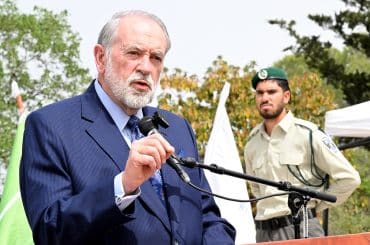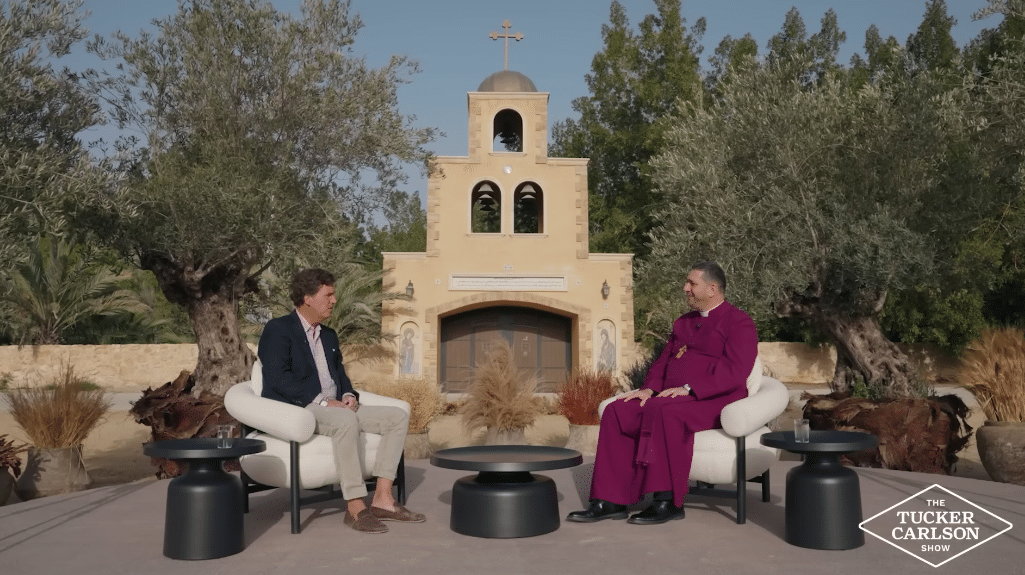
It isn’t often that a podcast episode sets off a minor diplomatic incident, but Tucker Carlson’s interview with U.S. Ambassador to Israel Mike Huckabee last week was one of them. The cause of the controversy was Huckabee’s comment to Carlson that it would be “fine” if Israel took over all of Palestine, Syria, Lebanon, and Jordan, as well as parts of Saudi Arabia, Iraq, Kuwait, and Egypt, because God promised that land to Abraham and his descendants. Over a dozen officials from Arab and Muslim states roundly condemned Huckabee’s statement, prompting Washington to note that the ambassador’s words had been “taken out of context.”
The views that Huckabee has espoused reflect what Israelis call the idea of “Greater Israel,” a vision for the expansion of Israel’s borders to encompass the vast swath of land between the Nile and the Euphrates. Christians who also support this vision, often evangelicals in the U.S., are called Christian Zionists.
But Arab and Muslim officials weren’t the only ones enraged by Huckabee’s avowed Christian Zionism. A growing part of the American right is becoming increasingly critical of Israel, including media personalities like Tucker Carlson, who takes issue with the theology underlying Evangelicals’ support for the state.
Carlson has also increasingly protested Israel’s treatment of Palestinian Christians — often dropping their identifier as Palestinians and referring to them generally and abstractly as “Christians in Israel.” In April 2024, he interviewed Palestinian pastor and theologian Munther Isaac, garnering 848,000 views on YouTube and sparking outrage among Christian Zionists in the U.S. Most recently, Carlson conducted a series of interviews in Palestine and Jordan, largely focusing on Israel’s treatment of Christians, and just last week, he interviewed Rev Dr. Fares Abraham, a Palestinian-American minister from Beit Sahour, near Bethlehem.
But Carlson’s criticisms miss the main point: the centrality of the Palestine question to the persecution of all Palestinians, regardless of their faith. When he pressed Huckabee on Israel’s treatment of Palestinian Christians, the violations he listed were the same indignities that Israel has routinely practiced against all Palestinians.
Focusing only on Christians isn’t a new approach. For decades, Christians in the West have used “the Christian presence in the Holy Land” as a main vehicle of engaging with what is happening in Palestine. It almost always ends up avoiding addressing the root cause of it all — the denial of the Palestinian right to self-determination
But as renowned Palestinian theologian Rafiq Khoury tells Mondoweiss, “there is no way to take interest in Palestinian Christians without taking interest in the Palestinian cause.”
A quintessentially theological concern
Rafiq Khoury is the forefather of modern Palestinian Christian theology, which he pioneered as a Catholic priest in the mid-1980s. Khoury has authored more than 20 books, including some foundational reference works on Palestinian Christian thought, such as The Inculturation of the Eastern Churches in the Arab World and The Palestinian Local Theology. Today, he is regarded as the father of Palestinian theologians from all Christian denominations.
“Western Christians often tend to believe that showing concern for Palestinian Christians as an isolated community is a form of solidarity. This isn’t only wrong — it’s dangerous,” Rafiq Khoury told Mondoweiss.
“Christians in Palestine didn’t fall from the sky in parachutes. We are an essential part of the people and the culture of Palestine, and by extension, we are part of the political context of our country in every sense of the word,” he stressed. “Isolating us leaves us without an identity, without a context. Contrary to what many Christians in the West might believe, this jeopardizes our existence and future on our land.”
But Palestine isn’t only the context and identity of Palestinian Christians. For Rafiq Khoury, “the Palestinian people and the Palestinian cause are a quintessential theological concern.”
The reasoning is simple. The Palestinian people are part of this land’s history, “and if the land of Palestine is a theological concern, then the people of this land are as well,” Khoury says. “The Palestinian people have been living through a long story of suffering under injustice, and this is a central issue in the Bible.”
Father Rafiq takes it a step further, believing that anyone who calls themselves Christian must be in solidarity with the cause of the Palestinian people — all Palestinian people — because it is a “Christian moral perspective,” which is “bigger than any political calculations.”
Palestinian Christians also concieve of their own struggle against the occupation as a component of their faith, Khoury says. “We as Palestinian Christians ground our experiences of suffering and longing for justice in our faith.”
More importantly, their sense of justice is intimately tied to their land and culture, Khoury emphasizes. “If anybody wants to show solidarity with us, they need to make it a priority to also learn how we perceive our reality, how our story is part of that of our people and our country.”
Respecting Palestinian Christianity
If Christians in the U.S. aren’t aware of this story, it’s not because it’s difficult to find. Palestinian Christians have been articulating this narrative for years, and today, Palestinian theologians have multiplied. They’ve published manifestos, written books, and organized conferences, all to insist on the Palestinian nature of Christianity in the Holy Land. They don’t point to themselves as a community, but to Palestine as the moral issue of our time.
Yet every time the mainstream media in the West takes an interest in Palestinian Christians, it’s usually just to marvel at the fact that they exist. And perhaps to wonder whether they’re mistreated.
“Our voice hasn’t reached most of the Western world, including Christians in the West,” Khoury said. “Maybe it’s from a lack of interest in our thoughts and perspectives. But showing interest is a basic sign of respect.”
“You can’t show solidarity with someone without respecting them,” Khoury explained. “And you can’t respect Palestinian Christians without taking an interest in their identity, the people to which they belong, and the cause that shapes their present and their future.”
The fact that Carlson had on Rev. Fares Abraham last week, who spoke about his hometown of Beit Sahour and how it was threatened with erasure by a recently established settler outpost, shows that Christians in the West have begun to show some interest. But they have a long way to go.