

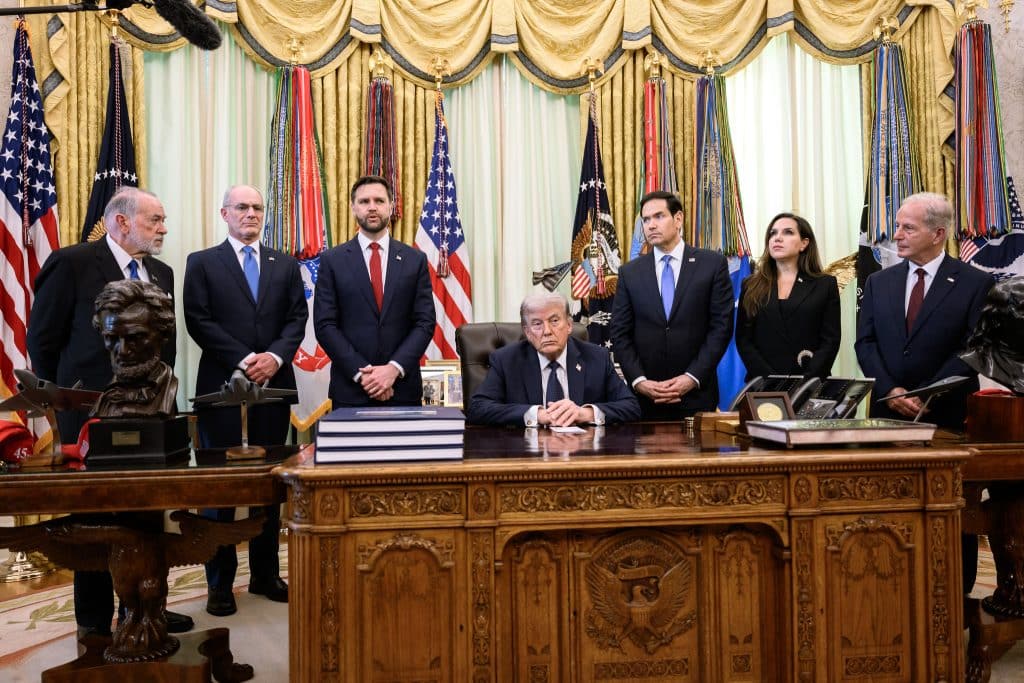
A brittle ceasefire currently exists United States and Iran, but any hope of a longterm agreement has stalled.
In comments to reporters and social media posts, President Donald Trump has claimed that Iran military has been defeated and that the country has been weakened as a result of the U.S./Israeli bombings. However, these assertions are not backed up by reality and it’s the United States that seemingly faces longterm risks.
“An entire nation is being humiliated by the Iranian leadership,” German Chancellor Friedrich Merz recently observed, referring to the U.S.
Mondoweiss U.S. correspondent Michael Arria spoke with Center for International Policy Senior Fellow Sina Toossi about Trump’s claims, why Iran doesn’t feel compelled to compromise, and more.
Trump had a Truth Social post the other day claiming that Iran is losing 500 million dollars a day, military and police are complaining that they are not getting paid, and that the country is basically falling apart. Is there any truth to this Trump claim, and why does Iran feel they don’t have to compromise?
I have a new piece in The Guardian where I argue that Iran believes time is on its side and wants a stronger deal for itself. They ultimately want some deal, but one that gives them an economic horizon that ties their development to the Persian Gulf’s and, by extension, the global economy’s development. Using the Hormuz Strait leverage, they have to come out of this stronger.
Regarding Trump’s remarks, the U.S. blockade has many holes in it. We know this; there’s been a lot of reporting. They have intercepted ships. They’ve seized a couple ships. They fired on this ship last weekend, but Iran is continuing to have quite a significant number of tankers that are going past this blockade and circumventing it.
When it comes to their ability to withstand it and why they believe time is on their side, the Iranian economy has, for decades, been built around the idea of self-sufficiency in key industries,, from food security to medicines. During the last decade of maximum pressure sanctions, Iran has developed alternative routes that nullify the impact of sanctions, that allow them to export goods, including non-oil exports, and diversify their economy.
So, they’ve taken major blows, but their economy is not as vulnerable as a result of these moves. Their political economy model is more resilient, and more able to withstand these shocks. That’s not to say that the status quo and equilibrium in Iran has been a good one, but the core state functions, the core welfare and subsidy systems, these have all held.
[Iran knows] the accumulating costs of the Strait of Hormuz closure for the global economy, and for the U.S. economy is going to be more unbearable. Their calculation is that Trump will eventually have to fold.
The big claim now is that the country massively fractured and that’s their hangup in these negotiations is. My read is that, no, this is Trump’s diplomatic cover. This is Trump trying to position himself as creating some leverage for himself and position himself as the one with the upper hand. This is why he’s extended the ceasefires. He says it’s because Iranians are paralyzed by this blockade and they’re deeply fractured, but there’s very little evidence of all of these things.
Trump has been contradicting himself severely. The Iranians have followed a much more coherent and consistent path during this war and they gained this rate of Hormuz leverage. Trump actualized this for them because they weren’t going to meet these maximalist U.S. demands. It’s largely been the same negotiating posture that they had when Khamenei was still alive. They’ve had a consistent line, across their government, that they can withstand this blockade.
They know the accumulating costs of the Strait of Hormuz closure for the global economy, and for the U.S. economy is going to be more unbearable. Their calculation is that Trump will eventually have to fold. So that is their calculation. Trump is trying to create leverage for himself and present himself as tough, but that’s just political optics. In reality, if we’re going to have a lasting peaceful settlement there needs to be a middle ground solution where both sides back off maximalist rhetoric and aims.
I know it can be hard to decipher whether Trump’s public comments represent actual policy, or are just him randomly riffing at any given moment, but yesterday, in response to a question about how long this will last, he invoked the Vietnam War and told a reporter that the U.S. spent 18 years there. What did you make of these comments and could you see the U.S. dragging this out for years?
He’s been saying similar stuff since the beginning of the war. I remember in the initial days, he said, this shouldn’t take more than a couple weeks, but it could be years and I’m ready for that.
He’s a man of grandstanding brinkmanship with this rhetorical flourishing that is aimed at portraying himself as tough. There’s obviously a distinction between what he says and what he does and he’s saying many different things and I think both sides are trying to regroup, rearm, position themselves, and show that it’s willing to fight.
[Trump is] grandstanding and saying he’s not going to back down and that he’s in it for the long haul, but I think that’s betrayed by the reality of this conflict.
I don’t think the U.S. is going to be there for 18 years, but I think Trump is egomaniacal and impulsive and surrounded by sycophants and the Israel lobby, who want him to get deeper and deeper into this quagmire. He does have business instincts as well, and on some level this is a cost benefit analysis. I don’t think he wanted to do a ground incursion. If he puts more U.S. soldiers in harms way and there’s prospect of U.S. casualties, the political costs go up.
There’s timelines. He has the World Cup coming to the U.S. in June and the midterm elections. He has high energy prices as the summer is coming. There’s countries that are heavily dependent on the Strait and their reserves are going to run out in a couple of months. These accumulating pressures ultimately create more pressure for Trump, or at least weaken his policy.
Iran is also trying to leverage the Hormuz control, to have tolls and preferred route way, and generate a lot of income. That’s going to have the impact of nullifying U.S. pressure and strengthening Iran’s hand over time, dividing America from its partners, and weakening its strategic position.
I think these are all factors that kind of play against Trump. He’s grandstanding and saying he’s not going to back down and that he’s in it for the long haul, but I think that’s betrayed by the reality of this conflict.
Can you talk about the current state of negotiations? What is Iran looking for, what is the U.S. looking for, and where do these talks stand?
Iran has had been this political football in American politics for decades, an easily demonized adversary. There’s this consistent hawkish rhetoric, where now you’re seeing some Democrats criticize Trump, and try to out-hawk him. We saw some of that rhetoric from them after he lifted the sanctions on oil at sea, for example.
It’s often framed like Iran can’t come to diplomatic settlement, and there needs to be various forms of escalation and pressure. The fact this was has been counterproductive, so costly for the region, and for the global economy, just shows that “military solutions” haven’t been actual solutions, not even for things that the U.S. says are problems, like Iran’s nuclear program.
The Iranians have basically always wanted strategic accommodation, and the U.S. and Israel have more or less pursued various forms of regime change strategies against this government for decades. Iran wants to come out from under that isolation, that pressure, and gives them a lasting exit from sanctions.
So, even if you look at their nuclear program. It wasn’t a nuclear program that was aimed at having a covert pathway to a bomb. They declared that goal was to provide their own nuclear fuel through their own enrichment capability for their facilities. There’s been no evidence that they have done any kind weaponization work, according to U.S. intelligence since 2003.
For Khamenei, I think the program was a bargaining chip. I think internally in Iran, that was the broader strategic objective to get out from under these sanctions and to have a new kind of equilibrium in their foreign policy. You saw that with [the Joint Comprehensive Plan of Action], but Trump obviously reversed course on that, went full on on regime change, maximum pressure, and now this war.
At this juncture, the Iranians want to maximize their national security. They’ve had this strategy based on their threat perceptions and regional strategic debt, but their overall goal is to have sustainable development and have sustainable security. This is what keeps a deal likely. But it requires the U.S. and Iran to come to a negotiating table.
The key obstacle [to the negotiations] has been the maximalist demands from the U.S. that have been, implicitly or explicitly, regime-change goals. It’s been at the behest of Israel, which has always wanted that.
The U.S. doesn’t want nuclear weapon in Iran because that would have regional cascading effects, perhaps from the Saudis, the Egyptians, the Turks. However, at the same time, Iran has been willing to give concessions that ensure the peaceful nature of its nuclear program, like the JCPOA, the contours of which I think will have to be the basis for a new deal. They don’t want to give up their nuclear, their missile program. They don’t want to give up their regional strategic depth, or their alliance network.
They want sanctions relief, something that is more enshrined in international mechanisms like the U.N. Security Council. In the short term, the U.S. could release their assets. That may be enough of a confidence-building measure to get the diplomatic ball of rolling, get a framework deal in place that could lead to a broader strategic settlement.
I think that, at the end of the day, the key obstacle has been the maximalist demands from the U.S. that have been, implicitly or explicitly, regime-change goals. It’s been at the behest of Israel, which has always wanted that. We’re going to have to see what strategic settlement comes out of this war or what strategic outcome comes out of this war. Is the U.S. going to budge in that direction? Is Trump going to be the one who makes a big deal with Iran that meets the bottom line of both sides, or is he going to continue on this quest of relentless pressure, escalation and getting dragged deeper into this escalation trap, in the hopes of creating regime change?
Senate Republicans have now defeated a War Powers resolution five times. It’s unlikely that Congress can actually reel the Trump administration in. But JD Vance’s camp is leaking these stories about how he’s opposed to what’s happening, which feels like a clear attempt to save some face going into his probable presidential campaign. What do you think the domestic implications of this could be on the midterms or the 2028 presidential race?
That is very interesting because JD Vance, who obviously has grander political ambitions and wants to run for president in 2028, his political persona has been that he’s against these reckless wars that have become quagmires in the Middle East.
These leaks have created a good narrative for him, which is that he has been the lone skeptic in the administration, but this war has gone south and it hurts his political prospects. A general rule of thumb has been that foreign policy is not that important of an issue to the average American voter, but it can move the needle when it’s a big conflict and quagmire. The authorization for the Iraq War war haunted many politicians for years and resulted in Obama beating Clinton in the 2008 primary.
A politician like Vance is worried about that. That is part of their calculation. Vance has now been positioned to lead these ceasefire negotiations and negotiations with Iran. That may be his calculation for how he comes out of this. He can be the guy who helped negotiate diplomacy and saved the day. However, that’s a gamble for him because if it goes south he’s going to be tied to it falling apart.
Going into the midterms, a number of things will be important. If the Strait of Hormuz remains closed, the costs will keep accumulating. There’s already hundreds of billions of barrels of oil sitting there that haven’t been exported. Every day that goes by is resulting in more shortages internationally. You have the fertilizer issue, you have sulfur, you have aluminum, you have helium, all these critical chemicals that are very important for industries in the U S and elsewhere.
You just saw the other day, Senator John Thune, a Republican from South Dakota, talking about the fertilizer issue and the farmers in his state. The cost of fertilizers is going up as they are entering planting season. He says we need an exit strategy from this war.
These costs are coupled with the affordability crisis. Trump is trying to get interest rates down. Now they’re going up again. The Fed is going to be more cautious about lowering interest rates. So these are all costs and if this drags on I think you’re going to have effects on the U.S. economy as well. The average price of gas is $4 a gallon right now and it’s even worse for diesel.
Unlike other wars in modern American history, this is an actor that’s been able to hit back in a material way, both on U.S. military bases and critical infrastructure, but also creating real economic costs.
It’s impossible to know what Iran will look like coming out of this, but the country has been viewed as one of the only places that has consistently stood up to U.S. imperialism and it’s regarded as the leader of, what’s sometimes referred to as “the Axis of Resistance.” It’s stood up to U.S. and Israeli aggression and backed groups like Hezbollah, Hamas, the Houthis, militias in Iraq, etc.
Do you foresee Iran continuing to inhabit that role? Does this war recalibrate their ability to inhabit that role?
This is another thing I tried to get across in my Guardian piece. One of the core aspects of Iran’s national security strategy, of its deterrence, is its support for regional allies. The Iranian aspiration was always to have this unity of fronts and allies in the region.
After October 7, one by one, Israel was going after Hezbollah, Hamas, then hitting the Houthis and Syria. The Iraqi militias were under a lot of pressure. Iran was not going all in. It was a seemingly tenuous situation for them.
In this war, Hezbollah came in, it had reconstituted itself in a way that exceeded a lot of expectations, especially based on what the Israelis had been claiming. The Houthis came in.
The Iraqi militias came in in a big way in this war.
So, Iran’s demand during the ceasefire was that it had to be an all-or-nothing, region-wide ceasefire. When the ceasefire first came into effect, the Iranian foreign minister told the Pakistani mediator was that Iran will allow the Strait of Hormuz to open up if it’s a region-wide ceasefire.
The Pakistani mediators said, yes, it is a region-wide ceasefire. Israel did not abide by that. They hit Beirut incredibly severely and barbarically. The Iranians did not close the Strait of Hormuz. They maintained that pressure,, and they got that ceasefire a week later in Lebanon, however tenuous. So in their mind, they are reinforcing this unity of fronts and they managed to get Israel to back down from its war in Lebanon, at least from where it was.
Through negotiations over decades, if you go back Iran-Iraq War era, Iran-Contra, Akbar, Hashemi, Rafsanjani, Khomeini, Ahmadinejad and various efforts in negotiation, the Iranians have wanted accommodation. This is a history that’s not really discussed in Washington nearly as much as it should be. Throughout these different eras Iran has sought detente. It wanted a strategic settlement. This idea that it was main intransigent actor is really baseless.
They have wanted to preserve their core national security and keep being an independent security actor that provides for their own security, and they don’t want to lose the ballistic missile programs, which is their means of supporting these other constituencies in the region that, like the Palestinians, like the Lebanese, like the Iraqi Shia, like the Houthis.
They’re not going to give up these core levers. They’re not going to give up these core means of their national security strategy, their strategic depth. They’re not showing any signs that those concessions will on the bargaining table. What they are signaling, and what they have signaled before this war and for many years now, is that strategic inclusion. If there is a deal, they’re not going to abandon support for Hezbollah or Palestinian groups that they have been supporting.
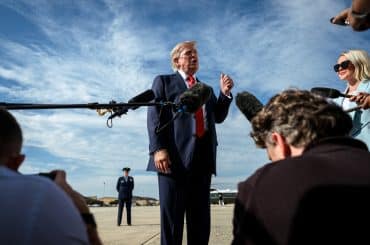
“he invoked the Vietnam War and told a reporter that the U.S. spent 18 years there”
Has Trump forgotten how the Vietnam War ended?
It’s interesting that we can believe what the Iranians say, but we cannot believe a word that the president of the United States says.
Latest from Max Blumenthal over at Judge Napoltino’s “Judging Freedom.” I always fact check from numerous generally credible sources when I am listening to someone live. Max so often accesses information I have not heard or read. He is almost always spot on.
What a resource.
https://www.youtube.com/watch?v=NeFvK1dldV4
“…yesterday, in response to a question about how long this will last, he invoked the Vietnam War and told a reporter that the U.S. spent 18 years there.”
There’s a connection between Vietnam and Iran: if you’ve followed the conversation on Iran at all then you’ve probably heard the word proxy, as in “Iran’s proxies do some nasty things.”
It drives me nuts that Americans have a hard time understanding that we have proxies too, and our proxies make their proxies look like apprentices. From the time the French left Vietnam to the time the Americans left the entire psuedo-country of South Vietnam** was an American proxy. How many people did we and our proxies kill in that completely pointless war?
A good case can be made that Israel is our proxy.
**
South Vietnam – Wikipedia
South Vietnam, officially the Republic of Vietnam (RVN; Vietnamese: Việt Nam Cộng hòa, VNCH), was a country in Southeast Asia that existed from 1955 to 1975.
Nearly all people in the world are today somewhat poorer. Humanity needs workable concepts for peaceful co-existence in the Holy Land to head off the death of millions.