

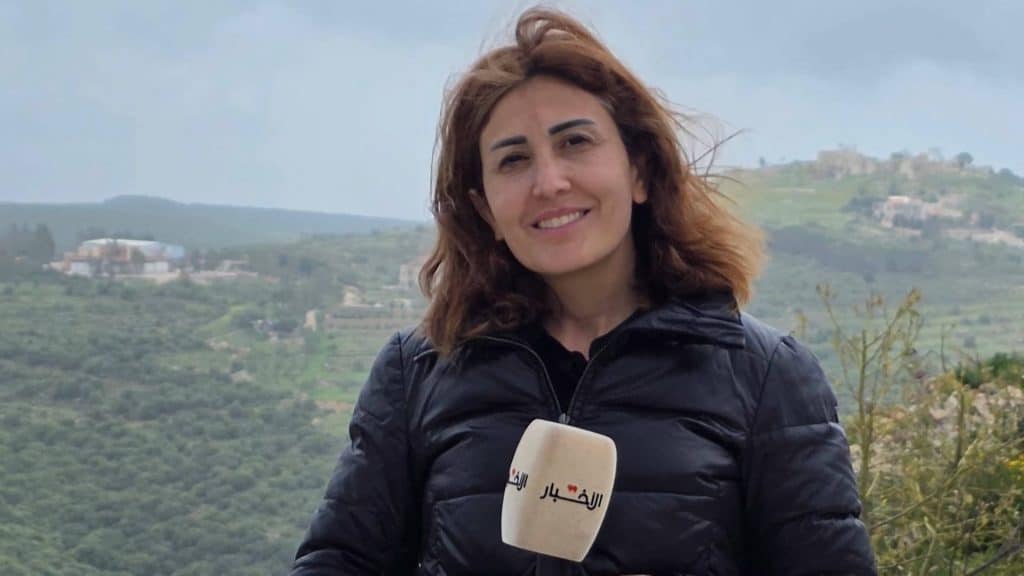
Amal Khalil was a brave Lebanese reporter who for the past two decades has reported from the often dangerous southern part of her country for the Al-Akhbar daily newspaper. On April 22, while doing her job, she died in agony — and there is compelling evidence that the Israeli military murdered her. She was 43 years old.
But once again, the mainstream U.S. media is guilty of sickening malpractice. Journalists are supposed to make special efforts to follow the story when their colleagues are killed in action, but the leading American cable news networks, so far, have mostly not reported her death at all. On MS NOW, the more progressive outlet, nothing on air. Ditto for CNN, (although the network’s “CNN International” subdivision did air a 2:16 report — which most American subscribers will have missed). Neither did the major legacy TV networks cover the story: nothing on ABC, NBC, or CBS.
(There was one honorable exception, on the PBS News Hour. Geoff Bennett raised the killing of Amal Khalil in an interview with Israel’s ambassador to the U.N., Danny Danon, and pressed Danon hard.)
Here’s what actually happened. Back in 2024, Amal Khalil had already received death threats from an Israeli media commentator with close ties to the military, who warned her to leave southern Lebanon. On April 22, 2026 she was reporting near the village of al-Tiri when an Israeli air strike hit the vehicle in front of her. As usual, she had been wearing protective equipment that clearly identified her as a journalist. She and a fellow reporter took refuge in a nearby home. That reporter, Zeinab Faraj, told the Associated Press “Amal was crawling, she was wounded — her nose and head and shoulder and leg.” Both women were able to speak by phone to family and other colleagues.
Then, a second Israeli air strike hit their refuge. Rescue workers got to her colleague, but the Union of Journalists in Lebanon charges that Israeli forces used stun grenades to prevent further efforts to free Amal. She continued to lay in that rubble for hours, surely in pain. Six hours later, the rescuers finally got through. But she had already died.
Back to the mainstream U.S. media. Unlike television news, newspapers did not entirely ignore the killing of Amal Khalil, but their coverage was mostly minimal, with — so far — little or no follow-up. One New York Times report especially stood out for its grotesque contortions to try and hide the compelling evidence that the Israeli military had prevented her rescuers from saving her.
The sub-headline to Max Bearak’s April 23 report telegraphed the paper’s concealment strategy. “Mourners paid respects to Amal Khalil, who remained trapped under rubble for hours before emergency medics recovered her body.” You had to read all the way down to the 7th paragraph to learn who had actually “trapped” her, and was stopping those “emergency medics.” And, astonishingly, here was the explanatory sentence: “The Israeli military denied in a statement that it had prevented rescuers from reaching the injured journalists, and said the incident was under investigation.”
This is quite extraordinary. The New York Times is reporting Israel’s denial before it even bothers to tell you what the charge is.
Let’s quickly contrast Times with an article the exact same day in the Guardian, Britain’s flagship legacy newspaper. Here’s the headline to Peter Beaumont’s report: “Israeli killing of Lebanese journalist draws international condemnation.” And the sub-head: “Lebanese PM calls attack that killed Amal Khalil a ‘war crime,’ with rescuers attempting to free her also targeted.”
In fairness, not all U.S. papers tried to downplay Israel’s complicity. Los Angeles Times reporter Nabih Bulos was actually on the scene in southern Lebanon at Amal Khalil’s funeral, and he did a fair and honest report. He quoted Mohammed Zanaty, a journalist friend of Khalil’s, who said: “This was an assassination; this wasn’t by mistake. The Israeli military knew who she was, and they killed her.”
Meanwhile, the New York Times opinion writer Nicholas Kristof posted on X/Twitter about Amal Khalil:“Journalists worldwide should stand up for colleagues who are murdered.” Kristof is right, of course. But it was revealing that he didn’t link to the reports in his own newspaper about Amal Khalil. Instead, he cited an article from the Associated Press.

Some actions of a mainstream media organization make the mainstream media organization seem at least an accomplice after the fact of genocide, war crimes, or a violation of international humanitarian law.
Here is the legal logic in lay language:
The preceding would have to be rendered more precise for a complaint, a brief, or a legal memorandum.