

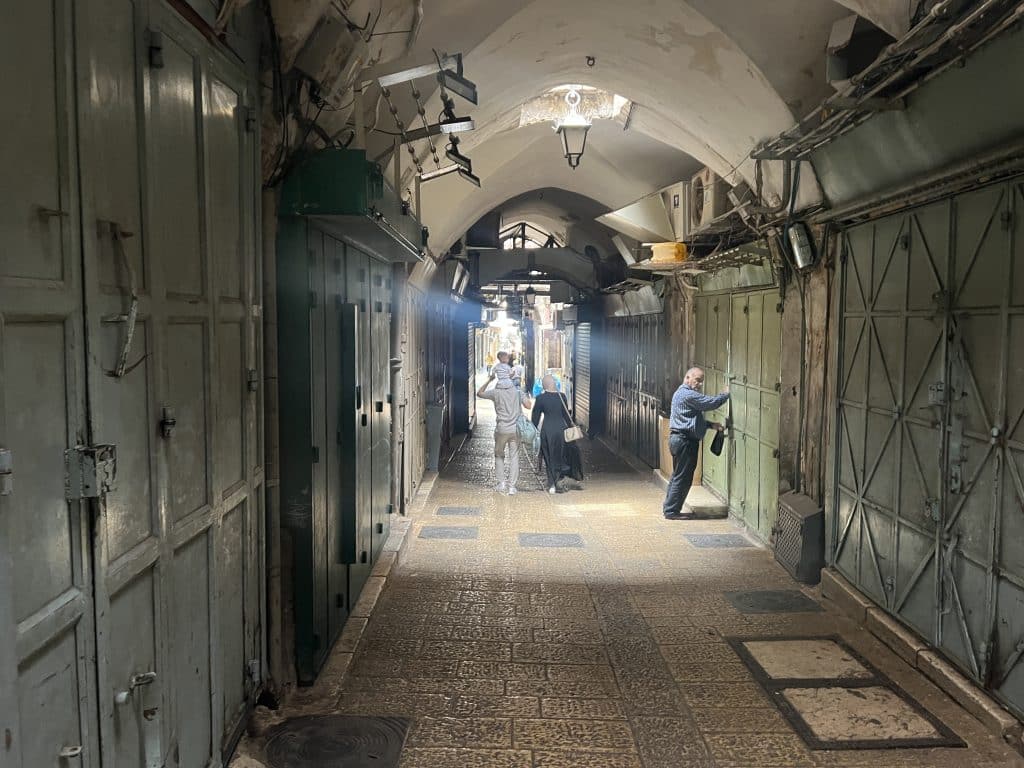
Before Jerusalem Day festivities even began, a palpable tension could be felt in the streets of the Old City. By late morning, the normally bustling Muslim quarter had fallen silent, with shopkeepers closing up after only a few hours of work.
“The past ten years have been particularly bad,” said Khemis, a 63-year-old who has worked in the Old City since he was a teenager. “Jews, Muslims, Christians, we all live in peace in the Old City, but on this day, people are too afraid to even walk around,” he added, as he packed up his belongings and headed home.
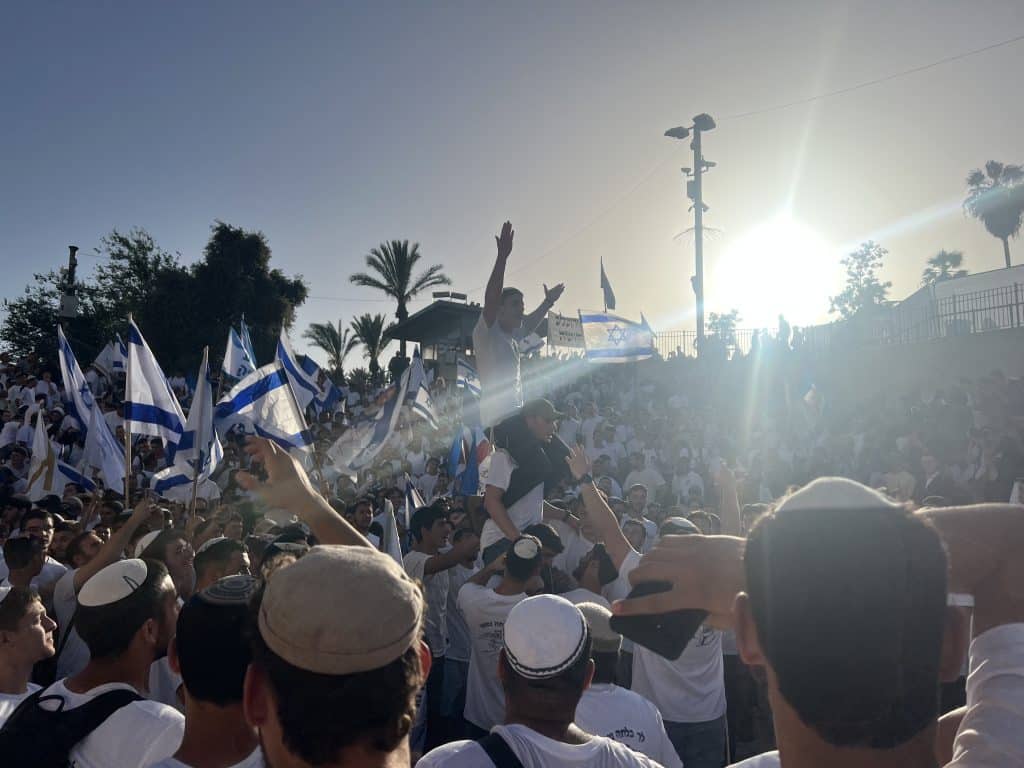
The seminal event of Jerusalem Day is the “Flag March”, which celebrates the occupation of East Jerusalem following the 1967 Six-Day War. Thousands of Israelis parade through East Jerusalem and the Muslim Quarter of the Old City, before making their way to the Western Wall.
While the rally has been a show of Jewish dominance over the Palestinian territory since its inception, in recent years, the procession has also featured racist chants and violent assaults on local residents.
This year, the trend continued. Gangs of extremist settler youth roved through Damascus Gate chanting “Death to Arabs” and “May your village burn”, as heavily armed police officers watched on. One incident, widely circulated online, showed a group of teenagers physically attacking two shopkeepers.
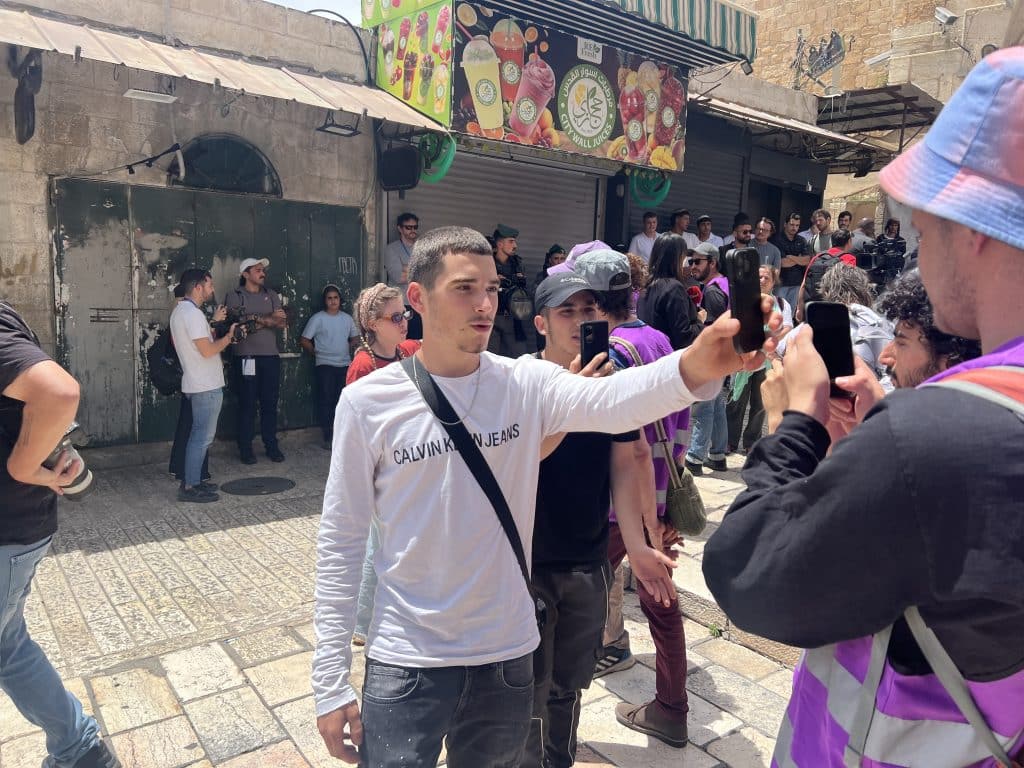
Racist chants continued throughout the day, as Palestinians required protective presence activists to escort them in and out of the Old City. As local residents became invisible in their own community, much of the settler violence turned towards the journalists and activists gathered at the scene. Several reported being shoved, spat on and verbally abused before police forced the journalists to vacate the area.
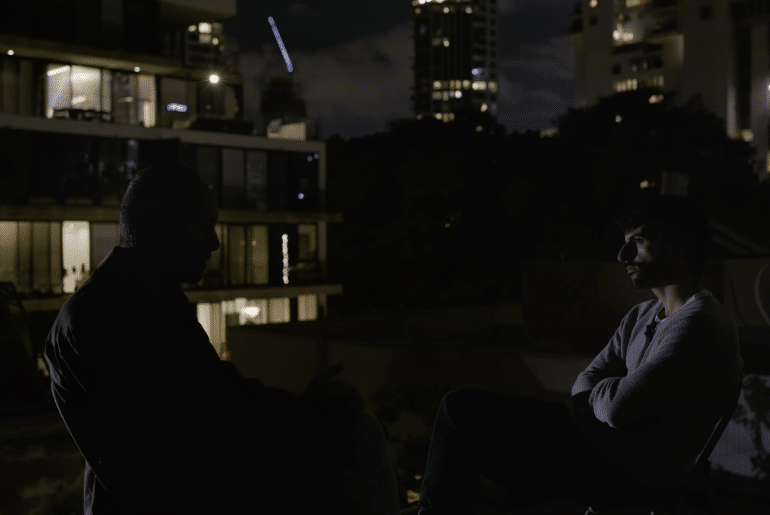
Like several others, Gary Cayman, an Israeli tour guide who spent the day volunteering as a protective presence activist, has noticed the disturbing shift. “The past 10-15 years, it has been more and more about Jewish nationalism and supremacy,” he told Mondoweiss.
Throughout the interview, settlers stopped to taunt him, shouting “no occupation” or calling him a traitor. “They don’t want a joint society, they want a Jewish one,” Cayman sighed.
Movement to rebuild the third temple
While many of the participants refrained from partaking in physical acts of violence, much of the imagery found at the march signaled support for extremist beliefs of Religious Zionism. Among the sea of Israeli flags, countless participants carried Third Temple flags, a symbol linked to demands that Al-Aqsa Mosque be destroyed and replaced with a Jewish temple.
It’s an ideology that Yishmael Ben Avraham, an ultra-orthodox doing protective presence for the first time in the Old City, faced particular harassment for opposing. “People say that stories about settler violence are just anti-Zionist propaganda, so I wanted to see with my own eyes what was going on,” he told Mondoweiss. “So far, all I have seen is violent settlers and Palestinians on the receiving end.”
The verbal abuse he’d endured had also left its mark “I would like to do this work again, but I don’t know if I will have the courage.”
Ben Avraham’s views place him in the minority. Far-right Religious Zionism has now become mainstream, not just within Israeli society, but within the political establishment as well.
National Security Minister Itamar Ben-Gvir marked the day by storming Al-Aqsa compound, his second visit this week. Flanked by hundreds of settlers, the far-right politician raised an Israeli flag and declared, “The Temple Mount is in our hands”.
In an even more provocative assertion, fellow Knesset member Yitzhak Kroizer, who was part of the visit, stated on Facebook, “The time has come to get rid of all the mosques and work to construct the Temple!”
Turning rhetoric into policy
Like many of the ideas championed during Jerusalem Day, several are becoming a reality, particularly in relation to cementing further Israeli control over East Jerusalem.
While the Al-Aqsa mosque has been under Jordanian custodianship since Israel’s establishment in 1948, Israeli authorities have sought to increasingly erode this agreement.
Through a mix of restricting Muslim access to the mosque, such as during the war with Iran, near-daily settler raids, and loosening restrictions around public Jewish prayer at the site, Israel has brazenly changed the long-held status quo. Ben-Gvir himself has publicly boasted about praying at the compound and has been there at least 16 times since taking office in December 2022.
During the day, Finance Minister Bezalel Smotrich also laid out his hopes for the West Bank, telling a group of yeshiva students that the lines distinguishing area A, B, and C should be permanently erased. While area C already falls under full Israeli control, areas A and B remain under full and partial Palestinian Authority control.
Smotrich and numerous other lawmakers have repeatedly called for total annexation of the West Bank, passing both symbolic motions and unveiling concrete plans. While that goal remains out of reach for now, the governing coalition has rapidly expanded settlement across the West Bank, while equally squeezing Palestinian out of East Jerusalem.
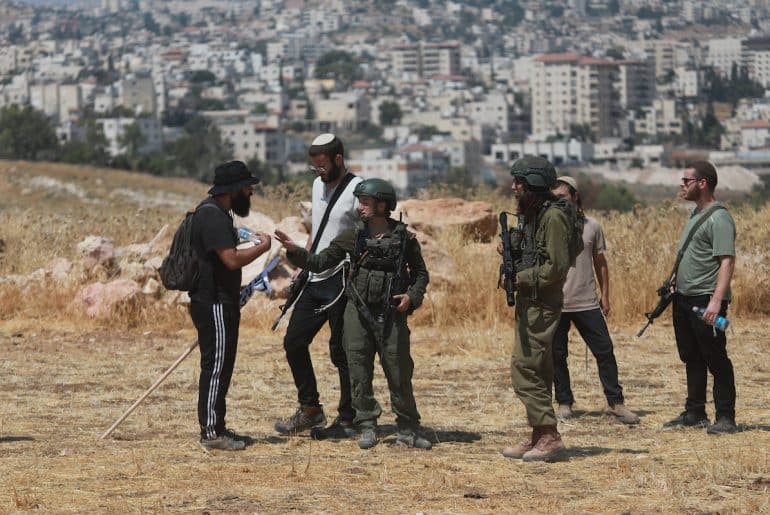
In the past few months, residents of East Jerusalem’s Silwan, particularly in the Al-Bustan section, have been forced to destroy their own homes, or have them razed to the ground by the municipality while also paying a fine. Justified as enforcement of illegal building codes, the neighborhood has long been in Israeli authorities’ crosshairs due to its proximity to the Old City walls and plans to build a biblical theme park on the land. While Al-Bustan has been under threat since the plan for the park was presented in 2005, residents have been able to resist through a combination of negotiations and international pressure. But demolitions have accelerated sharply in 2026, and rights groups are warning that the area is now being ethnically cleansed.
This current government has also expanded settlements throughout East Jerusalem, with one report finding that between 2023 and 2025, Israel had approved over 33,000 new housing units for settlers.
Ultranationalism on full display
In the lead-up to Jerusalem Day, the dozens of Israelis I spoke with expressed how the holiday would be a peaceful parade to celebrate a “unified Jerusalem”, emphasizing the live music and the party atmosphere.
“I understand it may be a provocation, but today is the only day I can walk in this area safely,” said Ron Novak, a 24-year-old from Argentina who moved to a settlement with his family when he was still a teenager. “We should be able to do it every day because Jerusalem belongs to the Jews,” he added, before joining a crowd of jubilant young men, screaming religious songs and marching towards Damascus Gate.
None of this accurately portrays reality. For one, hundreds of visibly religious Jewish men and women walk through East Jerusalem on a daily basis, without ever being subjected to violence.
While violence does exist in the area, it’s Palestinians who are nearly always on the receiving end. Before evacuating, Khemis the Old City shopkeeper joked, with a weary undertone, that he hoped his souvenir store would still be there in the morning.
A day littered with racist chants, calls to destroy mosques, and bouts of violence was anything but peaceful for the Palestinian residents of East Jerusalem. But for a country subsumed by violence, maybe this is what a peaceful parade looks like.
Jared Hillel
Jared Hillel is a freelance journalist based in Jerusalem. He has previously worked with Reuters and CBC/Radio-Canada.
Re: Movement to rebuild the third temple
I’m pretty certain Israel will still be in FIFA, because some countries in West Africa, South Asia, and the Caribbean still practice animal sacrifices. But I’m pretty certain continued Eurovision participation would be a very slim possibility. YMMV.
Re: This year, the trend continued. Gangs of extremist settler youth roved through Damascus Gate chanting “Death to Arabs” and “May your village burn”, as heavily armed police officers watched on.
True enough. This year the international press also highlighted:
Thousands of Flag waving Jews screaming “Death to Arabs we will rape their wives!”
An Israeli TV Host Jokes With A Soldier About Raping Palestinian Prisoners With Dogs Another example of how normalised the systematic sexual abuse of Palestinian prisoners is within Israeli society;
“Did they engage in some heroic act? These are literally the rapists who gang raped Palestinians on camera, celebrated and protected. This isn’t just a “Netanyahu” problem. This is the systemic dehumanization and double standard the world has normalized”
That provides pretty compelling evidence that Kristoff’s report isn’t the least bit libelous.
Aren’t both “death to America” and “death to Arabs” equally unacceptable. So, will our USA administration equally oppose the latter?
I think that Judaism’s Temple concept and history are neat.🛐 🕎 So it would be neat for me if Judaism had a Temple in Jerusalem. There are a couple obstacles or problems though.
The recipe in the Torah in Leviticus 26 runs:
The Torah’s idea is that whether or not there is a tabernacle or sanctuary is dependent on fulfillment of the Torah rules, faith, and morality. The Tanakh accounts bear this out. In King David’s rule, the Lord said that ancient Israel should build a Temple for him in Jerusalem. But then after David caused the death of Uriah, the Lord said that David’s son would build the Lord’s Temple instead of David.
The natural conclusion is that whether someone would rebuild the Temple would be dependent on their obedience to Torah and morality. The current Israeli state however is secular, the population isn’t especially observant by the Torah’s high standards, and the news reports moral scandals like the intolerant chanting of “Death to Arabs” by some of the same people promoting rebuilding the Temple. It’s hard to see those factors as leading to the Temple’s rebuilding by Biblical standards.