

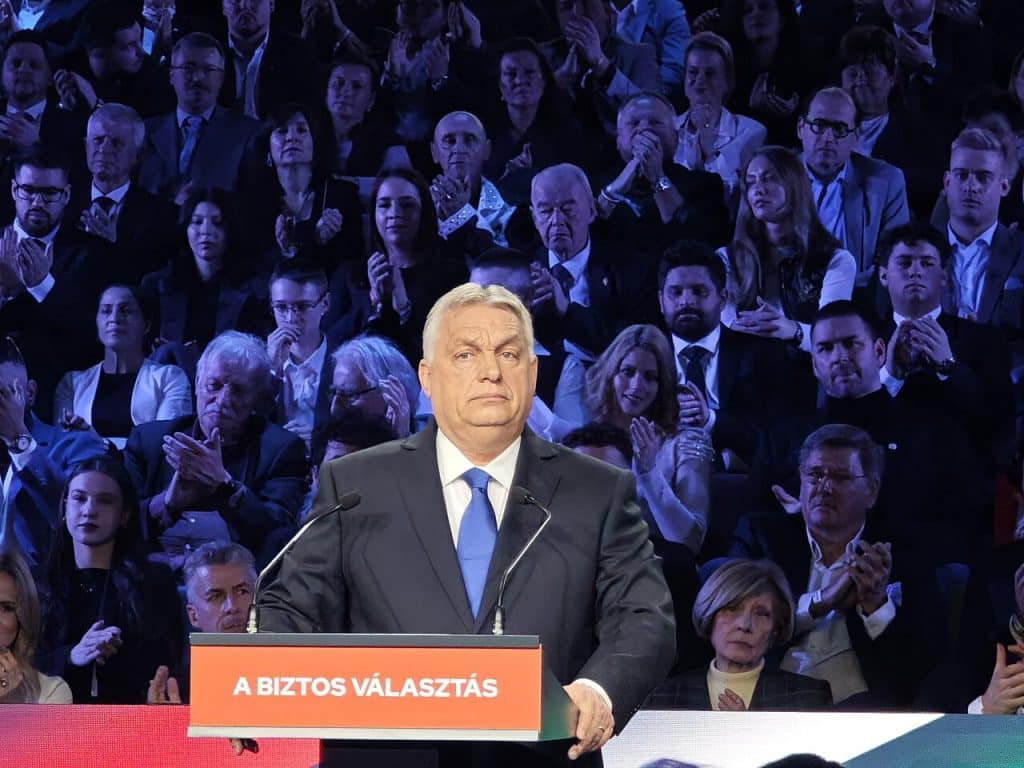
Europe’s authoritarian slide slowed slightly this week with Péter Magyar’s decisive win in Hungary, ending 16 years of Viktor Orbán’s illiberal rule. Yet in celebrating his electoral defeat, Europe’s ruling class seems to have been too distracted by the sound of the collective sigh of relief to notice—or care about—Orbán’s more lasting victory.
European democracies these days are looking a lot more like his Christian civilizational vision than any cosmopolitan opposition to it.
You know the Overton Window is broken when simply sounding less like a Nazi than Orbán gets you VIP treatment in the European Union—the post-WWII “peace project.” Magyar may have, for now, stopped the patient’s bleeding, but the ailing body politic of European democracy still lacks the medicine to save it.
His is not the cure we have been waiting for.
While a few of his policy positions may combat oligarchic corruption and working-class malaise, Magyar’s real appeal lies in his adherence to the officially sanctioned status quo—as we saw when Donald Tusk returned to power in Poland. The continued degradation of human rights, curtailing of freedom of (human) movement, and militaristic boosterism are fine so long as European Council meetings can end a little earlier, without the headache of Hungary vetoing the EU’s moralizing and strategically listless “whatever it takes” support for Ukraine.
The main difference these days between far-right nativists and the more “respectable” radical centrists to which Magyar belongs isn’t substantive, but rhetorical. As long as you don’t say the quiet part so loudly, you are free to keep undermining the social contract—and European and international law—at will.
Magyar has pledged to return Hungary to the International Criminal Court, where arrest warrants for Benjamin Netanyahu and Yoav Gallant are collecting dust.
Does it matter, though?
In almost the same breath, Magyar toed the Christian Zionist line that’s required for membership into the exclusive club of Western countries. As his fellow EU member states have shown, you can be committed to international law in theory without having to enforce it in practice.
Despite the media narrative of Netanyahu’s “loss” of an ally in Europe, it’s not like Magyar is waiting for him at the airport in Budapest with a pair of handcuffs; to the contrary, he’s inviting Netanyahu there for a party. Meanwhile, Israel has plenty of other allies—and a deeply embedded network of propaganda—to count on.
Unlike when confronting Russia, it was not just Orbán standing in the way of the EU upholding the international law and basic human decency that Israel violates with impunity. Its dementia of memory politics is enough of a blockage. After more than two years of accelerated genocide in Gaza and no-limits acts of barbarism elsewhere, the EU has taken zero substantive measures to hold Israel to account.
That’s not due to the neofascists, but right out of the liberal core of the postwar European Imaginary. At least the former have the clarity to say what they’ll do and then do it, which makes resistance easier. The latter hides disingenuously behind the institutional wait-and-see, just-following-orders logic of technocracy.
There have been some nano movements towards sanity. Though non-binding, public anger is putting renewed pressure on the EU to finally suspend its Association Agreement with Israel. Germany has withdrawn its support for Israel at the ICJ, while other European states have intervened to reaffirm their commitment to the Genocide Convention.
Most recently, Italy has suspended its bilateral defense cooperation with Israel. However welcome, it’s a too-little-too-late move that reveals just how dehumanized Palestinians are in the minds of European leaders. It took bombing Lebanon (again) and shooting at Italian peacekeepers to do what Israel’s killing of more than 70,000 people in Gaza could not.
Europe should be careful not to trip over the low bar it’s set for itself.
As always, the irony is that Europe’s support for Israel has little to do with supporting the Jews it spent centuries trying to disappear, and only relatively recently has said it cares about.
Instead, Jews have become what Hannah Arendt described as an antisemitic abstraction—abused as a political instrument to police a racialized boundary of (ethno)national belonging. If European Officialdom can convince itself that keeping out Muslims who allegedly hate Israel is good for (white) Jews, it can engineer a story of moral redemption and political rehabilitation from its own history of genocidal catastrophe.
For a liberal hierarchy built on imperial order, that’s a win-win. In his Judenstaat manifesto, Theodor Herzl himself envisioned a (European) Jewish state standing on the frontier of “civilization” to keep out the so-called barbarism of Asia. Jews who take issue with this dichotomy—choosing instead to build bridges of solidarity with Palestine—challenge the very conception of an enlightened Europe. As a consequence, the same people and institutions that claim to be looking out for them threaten to expel them to the periphery.
This is how we know that, in the same vein that Magyar’s victory was jubulantly received, Europe’s ghastly fidelity to Israel serves little more than its own narcissism of establishment practice and material interest.
Orbán’s rule showed how ambivalence toward Jews can live comfortably with Zionist support for Israel. At the same time, the gap between Jewish life and Zionism is growing. The Europe of so-called values and law is increasingly at risk of plunging into the abyss forged in between, which no single election in Hungary can save it from.


Surreal misunderstanding of Orban and what he stands for. Is the writer angry that the EU and Orban have not been more energetically helping to get Ukrainians slaughtered on behalf of the American dominated arms industry? Democracy is alive and well in Hungary, much more so than in a country like Great Britain where freedom of speech is a distant memory and invasive surveillance would make the leaders of Oceania drool. Its hard not to be sarcastic in response to this pretense of analysis pretending to be other than a sigh of relief on the part of the US Western European alliance at the defeat of a free speaker.