

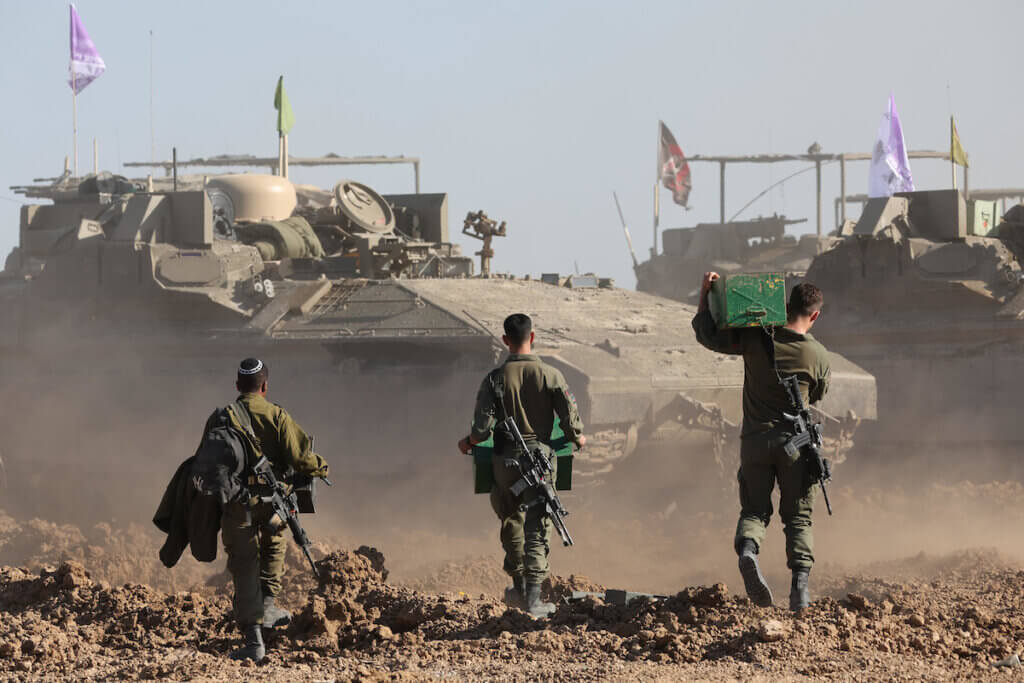
One month before genocide on Gaza began on October 7, there was already a growing mental-health crisis among Israeli soldiers and rising suicide rates within the military. Even then, the state was searching for technological and clinical solutions – experimenting with interventions such as stellate ganglion blocks, injected into the neck to disable the “fight or flight” response in the nervous system, resilience-simulating combat training, and AI-driven warfare designed to distance soldiers from direct confrontation. Yet the latest war, framed by some as an “Existential War against Moral Incertitude,” made it impossible to avoid direct combat. Whether in Lebanon or in Gaza, the Israeli Occupation Forces still sent their troops on the ground – invading, killing, and raping, and at times documenting their own crimes. Now that many have come back home, and the adrenaline of the killers has dropped, the fog of their destruction has settled and the sky has cleared for everyone to see the destruction and annihilation they carried out; now that they no longer hear the laughs and cheers of fellow criminals celebrating the bombing of houses, and now that the bodies of those they killed have turned into a smell that haunts them, their psyche is screaming, tormented.
Numbers and testimonies reveal that Israel is drowning in the consequences of its own violence, and the media have been calling it a mental-health crisis. Suicide among IOF soldiers is constantly on the rise, Post Traumatic Stress Disorder has become a routine diagnosis, and crisis hotlines are overwhelmed. Hebrew media speak of “war trauma” and “emotional first aid.” Israeli psychiatrists and Knesset members warn of an “epidemic.” But instead of asking what kind of perverted political-settler order produces this level of psychic collapse, the country, and psychiatric institutions such as the American Psychological Association (APA) are racing to medicalize in order to contain and manage the moral consequences of its own actions. The American Psychiatric Association has now recognized “moral injury” as a legitimate focus of clinical attention. Israeli clinicians, journalists, and scholars have begun to adopt the term for soldiers returning from Gaza. A new diagnostic container is being prepared to hold, neutralize, and ultimately absolve the guilt of perpetrators at the very moment the word “genocide” is entering mainstream legal and moral debate.
The genocidal turned suicidal army
For years, the IOF proudly marketed itself as a suicide-prevention success story, pointing to an average of thirteen soldier suicides a year, relying on a low annual rate and selective comparisons with other armies. That narrative imploded with the ongoing genocide on Gaza. Official IOF figures recorded 17 suspected suicides in 2023 and 21 in 2024, the highest in more than a decade. A report from the Knesset’s Research and Information Center, released in October 2025 at the request of MK Ofer Cassif, found that between January 2024 and July 2025, 279 soldiers attempted suicide and 36 died. Nearly four out of five were combat soldiers, a notable shift from previous years when fighters made up less than half of suicides. And only 17 percent of those who died had been seen by a mental-health officer within two months of their death.
The IOF’s response has been – so far – denial. A psychologist who commands the Combat Response Unit told the press that “the suicide rate in the army is more or less stable in the last five or six years” and even claimed it had declined over the past decade. Reflecting a screaming denial that Israel can commit a genocide and remain psychologically intact.
Even these statistics are partial. They count only those in uniform at the moment of death. According to the Health Ministry, as reported first by CNN citing a report that is now removed: more than 500 people die by suicide annually in Israel and over 6,000 attempt it, with an estimated 23 percent under-reporting. The removed report is now replaced with an attempt to “debunk rumors of rising suicide rates”.
Those numbers do not include reservists who took part in the Gaza genocide campaign, returned home, and later killed themselves as civilians. Haaretz has tracked at least a dozen such cases, often involving men with clear symptoms of PTSD or severe distress. Once discharged, their deaths vanish into civilian statistics, disconnected from Gaza in both the IOF records and from the Israeli public memory.
Families discover that the sons Israel hailed as “heroes” are denied even symbolic recognition when they die by their own hand after the war ends for all Israeli perpetrators of war crimes except them. The case of reservist medic Roi Wasserstein gathered much media attention. He died by suicide months after his last deployment in Gaza. Because he was not on active duty that day, the IOF initially refused to recognize him as a fallen soldier; he was to be buried as a civilian. Only after public uproar did the Chief of Staff promise narrow legislative reforms for “exceptional cases.” Yet this promise remains mere words, and the soldiers continue to break down mentally.
Meanwhile, the Defense Ministry’s rehabilitation department admits that nearly 11,000 soldiers have entered its psychological programs since October 7 and that more than a third of all mental-health injuries in Israel’s military history have been recorded in this period. By 2028, the ministry expects to be treating around 100,000 disabled ‘veterans’, at least half with psychological conditions. The genocide Israel committed leaves “a trail of traumatized soldiers, with suicides also on the rise”.
Moral Injury arrives to save the perpetrator
Since the 1990s, psychologists have described moral injury as the distress that arises when a person’s actions –or failure to act – violate their deepest moral beliefs. It is meant to capture something different from classic PTSD and it’s not necessarily terror in the face of threat, but shame, self-hatred, betrayal, loss of meaning.
The psychiatrist Jonathan Shay, in his work with Vietnam veterans at the U.S. Department of Veterans Affairs, defined moral injury as the result of a “betrayal of what’s right” by a legitimate authority in a high-stakes situation, explicitly pointing to the responsibility of leadership and structure, as well as to self-betrayal. Later, Brett Litz and his colleagues gave the concept a more systematic formulation, describing moral injury as the psychological, social, and spiritual consequence of committing acts that violate deeply held moral beliefs, failing to prevent them, or witnessing them. In these early formulations, the structural dimension remained present. Moral injury was bound up with military culture, rules of engagement, and the political decisions that placed soldiers inside morally corrosive environments. Over time, however, the concept migrated beyond the battlefield. It began to appear in civilian contexts, from abuse scandals inside religious institutions to sexual violence across various institutions, where the betrayal of authority produces a profound moral rupture. As the term spread, its critical language of structural responsibility increasingly shifted into a clinical category that could be managed.
Recently, the concept has been revived with force. Clinical literature has praised the American Psychiatric Association’s recognition of “moral, religious, or spiritual problems” as a legitimate focus of treatment, presenting that move as opening new paths for assessment and intervention. Researchers connected to academic programs that seek to integrate the social sciences with questions of virtue and meaning played a role in consolidating this recognition inside the Diagnostic and Statistical Manual of Mental Disorders, giving the term formal legitimacy within mainstream psychiatric classification. There is no institutional link between these initiatives and Israel, yet the speed with which the term has been taken up in Israeli media, clinical commentary, and even parliamentary debate reveals something beyond the ordinary movement of an academic concept. In the context of the Gaza Strip, the term is being used to describe the trauma faced by soldiers as a result of acts they participated in or witnessed: mass killing, the targeting of civilians, systematic destruction, and the guilt that follows, along with the shattering of the image they were given of themselves and of the “legitimacy” of what they were doing. It also names the erosion of trust in the military institution and in the ideology that justified this violence, above all Zionism, which was presented to them as the basis of the legitimacy that drove them into it. A term that for years had remained largely confined to veterans’ care, or to discussions of abandonment and betrayal by commanders and military institutions, sometimes within broader moral and religious frameworks, has suddenly become the leading framework for understanding the consequences of genocide in the Gaza Strip for Israeli soldiers.
“Moral injury” does not erase agency in the way PTSD sometimes can. It acknowledges the moral breach. In the context of a settler-colonial state such as Israel, built on Zionist ideology and permanent militarization, its incorporation into institutional frameworks and its transformation into a treatable diagnostic category turns it into a tool for regulating conscience, rather than opening the door to accountability. Once it is written into diagnostic manuals, absorbed into treatment protocols, and compressed into media headlines, the violence it exposes is contained again. Guilt tied to genocide and colonial violence becomes an individual psychological matter. The conscience of the perpetrator becomes the urgent site of concern, while the structure of settler colonialism and the Zionist doctrine that produced this violence recede into the background. This does not mean the psychological suffering is fabricated. It means the way it is framed is never innocent, and the chosen framework has consequences. PTSD calls forth sympathy for those exposed to danger. “Moral injury” calls forth sympathy for those who violated their own values. Without truth, accountability, and structural change, both can become languages through which power absorbs its own crisis and survives.
Michel Foucault teaches us that modern power protects itself by producing the very diagnoses through which society understands suffering. Institutions of care are never neutral – they generate categories that keep political structures intact. The rapid adoption of ‘moral injury’ exactly fits this pattern. Guilt that might otherwise point outward – toward Palestinians, toward state violence, toward the brutality of occupation – is recast as an internal, clinical problem. And once medicalized, it becomes less threatening to the political order. It becomes attached to the individual, hence treatable, and detached from politics. In this way, moral injury risks becoming less a language of accountability than a new biotechnology that contains the crimes Israel perpetrates.
In Israel, clinicians and journalists increasingly describe soldiers returning from Gaza who “realize what they’ve done” only after the adrenaline fades. Haaretz has profiled psychologists like Yossi Levi-Belz, treating men who come home to find that the official narrative no longer fits the images in their heads. Some academic work has begun to explore how moral injury pushes certain veterans into political activism as a form of moral repair, while others collapse inward, unable to articulate their suffering without indicting themselves.
This focus extends a long history in which psychiatry, through PTSD and related frameworks, has turned perpetrators of crimes in Vietnam, Iraq, and Afghanistan into objects of sympathy. But in the context of an ongoing occupation, where there is no “postwar” condition, what is being exposed is harder to contain. If guilt was marginalized in the age of PTSD, today it is being absorbed. This pattern is hardly new. Dominant groups have long translated political accountability into psychological vocabulary. Debates over “white guilt” in postcolonial contexts have redescribed structural racism as an emotional burden borne by white people, shifting attention from reparative justice to the management of discomfort. The rise of talk about “male depression” in some contexts has likewise, at times, reframed feminist critique as a source of distress for men, moving the question of gendered power into a story of wounded masculinity. Each time, political confrontation is softened inside therapeutic language.
From ‘Trauma’ to ‘Moral Injury‘
Before “trauma” became the dominant language of contemporary psychiatry, other concepts had already been used to contain the psychological collapse of soldiers produced by war. During the First World War, terms such as “shell shock” and “war neurosis” appeared to describe soldiers who trembled, lost speech, suffered paralysis, nightmares, and an inability to continue fighting. From the beginning, the question was never simply medical and the concern was never about those at the sharp end receiving the violence perpetrated by soldiers, nor the soldiers themselves. Doctors and military authorities often argued over whether these conditions were neurological injuries caused by explosions or signs of cowardice, weakness, and moral failure. The military leadership was often concerned that recognizing psychological collapse as an injury also admitted that war itself could destroy the men sent to fight it, and that such recognition might weaken discipline, obedience, and the authority of command among the ranks. That is exactly when trauma appeared as the magical political tool that is capable of recognizing suffering and managing it at the same time.
In her seminal work “Burnout,” Hannah Proctor teaches us that trauma is made political before it becomes clinical, because psychiatry, humanitarian institutions, and states all play a role in deciding which forms of suffering are named, funded, treated, and even remembered. Since PTSD entered the DSM in 1980, trauma has become one of the main languages through which violence is explained across wards, disasters, occupations, and other man-made humanitarian crises. While as a language it can offer recognition to people in pain, it is important to acknowledge that it also shapes how that pain is understood and often depoliticized by centering: who is allowed to appear as a victim and which histories and stories are swept under the rug of imperialism and colonialism.
Vietnam veterans, for example, forced the American state to admit that the war had followed them home and had remained lodged in the soldiers’ bodies, families, and societies. Manifesting as addictions, broken families, domestic violence, fear, rage, guilt, and suicide. These soldiers rallied and demanded in the 1970s for their “suffering” to be treated and compensated, and for their misery post-war to be recognized. Groups such as the Vietnam Veterans against the War lobbied in New York City and attempted to speak openly about their guilt and to redirect it to the government. As one veteran says: “We found that understanding the war shifted the blame and guilt that the vet often piled on himself or herself and directed that guilt at the government and governmental agencies like the military or the V.A., where the guilt properly belonged (and belongs today).”
Lobbying for what is often referred to as “post-Vietnam syndrome”, it officially entered psychiatric classification and recognition in the 1980s, and later became a basis for treatment, disability claims, and compensation. But this recognition also produced a dangerous shift and a moral rearrangement in how Americans remembered the war. In films, novels, and public memory, the traumatized American soldier often became the main victim of Vietnam. Even massacres such as My Lai were retold through the pain of the soldiers who witnessed, carried out, or later regretted them. The Vietnamese civilians who were murdered by American troops, including women, children, and elderly people, were forcibly forgotten and erased. Their deaths became the background to an American story about guilt, pain, and redemption.
To understand this, we need to recognize the fact that guilt was pushed out of PTSD discussions and even official diagnoses. Early discussions of “post-Vietnam syndrome” recognized that some soldiers were suffering because they had killed, followed criminal orders, witnessed atrocities, or taken part in acts they later experienced as morally unbearable. Survivor’s guilt was present in DSM-III PTSD criteria, then removed from the core criteria in DSM-III-R. By the time DSM-IV appeared in 1994, guilt was sidelined, and PTSD became organized mainly around fear, helplessness, and exposure to threat. The soldier’s suffering – and its symptoms – remained visible, while the question of what the soldier had done became easier to avoid.
This psychiatric device proved effective and became both a sedative and a language that calmed public conscience when immoral imperial crises began appearing in hospital wards or military courts. It also offered a portable way to translate political violence into individual suffering. A model that soon became known, as the German psychotherapist David Becker once called it “ the Coca-Cola of psychiatry”, in which trauma became a global product that is ready for use, and exported as part of a wider project of cultural imperialism, detached from the political conditions that produce suffering.
Trauma, as Hannah Proctor teaches us, then became part of the rise of a “trauma industry” entangled with humanitarian psychiatry. Trauma – and PTSD – as diagnoses and interventions became portable, exportable, standardized, and distributed under the authority of care and expertise. Funding started pouring in, and NGOs quickly adapted and started exporting PTSD programs across various political settings, often treating suffering as individual mental health problems detached from the violence that produced it.
In the process, the vocabularies and language of anti-colonial and anti-imperial struggles were gradually being eroded and replaced. If earlier revolutionary vocabularies named violence, repression, oppression, colonialism, imperialism, and most importantly, resistance. The language that came to dominate instead speaks of victims, trauma, resilience, recovery, treatment, extremists, and terrorists. In that shift, colonialism becomes individual trauma, depression, and anxiety. Occupation becomes distress. State-sponsored terrorism becomes a mental health crisis. The problem is no longer the order that produces psychic and physical injury, but the injured subject who becomes an object to be treated and rehabilitated within it, and sometimes blamed for failing to be “resilient” enough.
This is one of the many ways psychiatry intersects with politics, often recognizing pain while remaining neutral towards the violence that created it. Many scholars and thinkers have written extensively on this relation.
The current moment, however, reveals another mutation of the same psychiatric violence. Once again, psychiatry moves toward the perpetrators to rescue them, offering their dehumanizing acts an antidote and a language that helps them evade the truth: that they are genociders, that they deserve accountability, and that their own psyches are punishing them for what they did. Yet again, the crimes are translated into injury, accountability is replaced by treatment, acknowledgment, and further research and analysis, and the soldier’s trauma is renamed moral injury.
Turning a genocidal army into a patient population
It is precisely here that moral injury enters as a seductive new discourse to Israeli media and psychiatrists alike. It appears to reintroduce guilt into clinical language, but in a carefully controlled form that does not turn into a confession. Guilt becomes a symptom. The soldier is no longer simply guilty of committing atrocious crimes; he is “morally injured.” His anguish is a condition to be acknowledged by the media, studied by researchers and universities, and treated by psychiatrists. While the genocidal acts that produced that injury, the destruction of entire neighborhoods, the use of human shields, and indiscriminate fire, disappear into the background. The diagnosis recentres the Israeli’s suffering and pushes the Palestinian’s suffering further out of the frame.
In the coming years, when more international courts and public opinion move towards naming Israel’s campaign in Gaza as genocide, the groundwork is already being laid for a counter-narrative: “IOF soldiers are not criminals; they are casualties of impossible moral burdens”. They did not choose this, Hamas actions on October 7 made them do it, or they have been betrayed by their chiefs and asked to do immoral acts in desperate times. They are traumatized. The “most moral army in the world” deserves treatment, not judgment. That is the political function of moral injury. It does not challenge the system, but rather upgrades it, pre-empting to contain the critique. By collapsing perpetrators, bystanders, and victims into a single category of the “morally injured,” the new discourse muddies distinctions that matter for justice. It allows a settler state to acknowledge that something has gone terribly wrong at the level of conscience without ever asking whether the wrong lies in the project itself. It turns conscience into a technical/medical problem for therapists to solve, sedate, or tranquilize.
By labeling soldiers as ‘morally injured,’ Israel can frame their suffering without directly addressing what caused it. And when causes are mentioned, they are likely to be linked back to October 7 – or presented as responses to it – much like a recent Forbes article notes.
In the meantime, many of these “morally injured” soldiers who took part in genocidal acts turn to rescued animals as living beings that silently judge them for what they’ve done and help them “heal.” As one article notes, “the farm has become an oasis for dozens of veterans who have participated in its sessions — which in addition to traditional counseling includes therapy with dogs and other animals — to the backdrop of chirping birds and clucking chickens.
This move towards diagnosis also reorganizes the suffering of those accused of war crimes within the machinery of insurance, welfare, and neoliberal governance. Under the language of moral injury, perpetrators are recast as patients. Once the “injury” is named, psychiatrists can anchor it to a recognized clinical category, one insurer rely on to reimburse patients and ultimately sedate them. A strategy not unique to settler colonial states but common across neoliberal regimes, where distress – whether produced through war crimes or through structural violence – is recast as a disorder to be managed, treated, and often sedated, while the political conditions that produced it remain firmly in place.
The mind speaks the truth the state cannot admit
Any discussion of morality must begin – and end – with psychiatry’s own moral crisis. Frantz Fanon understood and long warned us that the discipline was never morally neutral. Working as a psychiatrist in colonial Algeria, he watched clinical language translate political violence into individual pathology. Torturers and tortured entered the same wards, their suffering described as symptoms rather than as the product of a colonial system built on domination and occupation. Psychiatry often appeared humane and impartial, yet it quietly returned people to the very order that had constantly violated them. For Fanon, this was an irreparable problem with the field itself. Psychiatry did not stand outside power, outside colonialism; it organized how power was felt – cognitively, physically and psychologically – then contained it within a language that served the system. He called this sociogeny: mental suffering shaped by the political world. Colonialism, he wrote, was a “fertile purveyor for psychiatric hospitals” because it produced contradictions the psyche could not absorb. What appeared in the clinic as anxiety or breakdown was inseparable from the social order that produced it.
Others elsewhere have also long warned us that psychology and psychiatry have never been neutral sciences; as they were born inside the political and economic formations that created the modern world – empire, racial hierarchy, capitalism – and they helped enforce those formations.
Even when the American Psychological Association finally apologized in 2021 for reinforcing white supremacy in the United States, the apology was narrowly contained, offering no reckoning with psychology’s global entanglement with colonial rule, militarized occupation, or the production of racialized knowledge. Psychology has never taken power as its area of inquiry, and therefore, it has long served as a stabilizer of power and not its critic.
From the nineteenth century onward, colonial administrations used psychological and psychiatric categories to classify and control subject populations. Enslaved Africans who fled captivity were framed as mentally unwell, suffering from Drapetomania; anticolonial uprisings were described as evidence of tribal irrationality, “religious mania”, and biological defect as documented in studies of colonial Kenya and elsewhere; Indigenous cosmologies and healing systems were recast as evidence of “primitive consciousness” or pathological belief, part of the wider project of ethno-psychiatry that located entire cultures on an evolutionary ladder of mental development. Early psychiatry was deeply enmeshed with eugenics, offering scientific legitimacy for the sterilization and institutionalization of racialized peoples, as well as the forced removal of Indigenous children into “civilizing” institutions. Across contexts, the field translated liberation struggles and political claims into clinical symptoms, transforming resistance into pathology. And on the rare occasions when the discipline turned its gaze toward the psyche of the colonizer, it was typically to exonerate, not interrogate – to render the perpetrators of violence as victims of their own distress.
Sixty years later, Fanon’s warning and the warnings of many indigenous people who were subjected to psychiatry’s violence feel urgent again. As Israeli psychiatrists and policymakers grapple with rising suicides, expanding PTSD diagnoses, and the growing language of moral injury, psychiatry confronts the limits of its own neutrality. The question is no longer only how soldiers suffer, but why that suffering must be medicalised at all. Here, the rise of moral injury is nothing but a strategy of survival for the discipline itself to absorb its own moral crisis.
If the concept has any political use, its value lies in the facts it makes clear; that the psychic epidemic emerging among Israeli soldiers point to a reality the state refuses to admit; that Israel is committing genocide in Gaza. And that a settler state waging a genocidal war will devastate the people it targets, but it will also damage many of those enlisted to carry it out. And for that, instead of abandoning the psychic tolls of dehumanisation produced by Zionism, Israel’s so-called existential wars are shifting towards a future where an army of robots is being prepared to sustain its next genocidal campaigns.
A version of the article was first published in Arabic in Megaphone.
Rami Rmeileh
Rami Rmeileh is a Palestinian psychologist working across critical and liberation psychology with a focus on the politics of mental health, colonial violence and Palestine.

Just occurred to me; Israel is always <i>kvetching</i> about “blood libels”.
And now Israel has plenty of what I call ‘blood liabilities’.
And they will be paid.
Looking at your article on the ease with which Iran recruits intelligence from Israel.
Then look at how precisely Iran was able to target Israel’s military fuel depots. Some of the most closely guarded locations.
I guess the US will have to fix it all, lest Bibi accuse us antisemitism.
“Numbers and testimonies reveal that Israel is drowning in the consequences of its own violence”
Israeli Teens Are Constantly Exposed to Violence. Is It Any Wonder This Ended in Murder?….Since the April 21 killing of Yimano Binyamin Zelka after his shift at a Pizza Hut near Tel Aviv, social media in Israel has been full of confessions of violence by young people. Zelka, a 21-year-old shift manager, was stabbed to death after asking teenagers not to spray party foam at the pizzeria – the foam is a tradition on Independence Day eve…..On Facebook, Dana Koll Ben Yehuda wrote about how her 18-year-old son and his friends were attacked two months ago at a sports facility by young people armed with sticks and nails. Others responded to her post with stories of their own…For three years, Israel’s young people have been exposed to violence wherever they look, like footage of Hamas’ horrors on October 7, of the bombing of Gaza, of Jewish terrorism in the West Bank – and of the violent incidents posted on social media…Nothing will change under the current government, whose business is violence. Young people wearing kippas and tzitzit are only the end users.
Israeli teens are constantly exposed to violence. Is it any wonder this ended in murder?
That’s just the way the <i>matzoh </i> crumbles; into a half-baked cracker.
I sent this on to two leading members of Psychologists for Social Responsibility. In 2015 they held a public meeting here in Toronto, when the APA, American Psychological Association, held its annual meeting here. The purpose was to try to get the APA to declare that helping the government (or anyone) to torture people is contrary to professional standards for psychologists. They succeeded, though getting it enforced is another matter.
Maybe they can take on moral injury. They should.
Thanks again for a most thought-provoking article. It brought to mind my best friend’s uncle John, who did his National Service with the British Army in Palestine just after WW2. All he would say about it was that the whole experience was utterly horrible.