

The United States was founded and exists on stolen Native American land, taken in the course of an ongoing national genocide. Israel was founded and exists on stolen Palestinian land, taken in the course of an ongoing national genocide. In both nations, these genocides are a structural part of settler colonialism. And as I will argue in what follows, the ideology grounding settler colonialism in both nations comes from the same source, helping to cement a long-standing relationship between Israel and the United States.
Settler colonialism is a variation of colonialism. Colonialism is the takeover of one country by another to exploit its resources, material and human. Settler colonialism is the takeover of one country by another to settle it with the invading country’s population through the elimination of the Indigenous population and the theft of Indigenous land. Colonialism exploits the Indigenous population’s labor and land. Settler colonialism eliminates or seeks to eliminate the Indigenous population to take its land. That is, settler colonialism typically involves genocide. I am defining genocide in two ways: first, as it is defined in international law in Article II of the 1948 Convention on the Prevention and Punishment of the Crime of Genocide:
In the present Convention, genocide means any of the following acts committed with intent to destroy, in whole or in part, a national, ethnical, racial or religious group, as such:
- Killing members of the group;
- Causing serious bodily or mental harm to members of the group;
- Deliberately inflicting on the group conditions of life calculated to bring about its physical destruction in whole or in part;
- Imposing measures intended to prevent births within the group;
- Forcibly transferring children of the group to another group.
The term genocide was coined by the legal scholar Raphael Lemkin in the wake of the Holocaust and is typically understood to entail a cataclysmic crime whose intent and enormous scale is manifest as was the extermination of six million Jews by the Nazis or the hundreds of thousands of Tutsis murdered by the Hutus in the Rwandan genocide of 1994. But Lemkin’s definition, while pointing to a cataclysmic physical crime, also defines genocide as a daily process of the social and political destruction of a national group:
Generally speaking, genocide does not necessarily mean the immediate destruction of a nation, except when accomplished by mass killings of all members of a nation. It is intended rather to signify a coordinated plan of different actions aiming at the destruction of essential foundations of the life of national groups, with the aim of annihilating the groups themselves. The objectives of such a plan would be disintegration of the political and social institutions of culture, language, national feelings, religion, and the economic existence of national groups, and the destruction of the personal security, liberty, health, dignity, and even the lives of the individuals belonging to such groups. Genocide is directed against the national group as an entity, and the actions involved are directed against individuals, not in their individual capacity, but as members of the national group. (Axis Rule in Occupied Europe, 79)
Lemkin’s definition, while it points to the Convention’s conventional definition, also points to an incremental form of genocide, what Patrick Wolfe terms “structural genocide” in his 2006 generative essay “Settler colonialism and the elimination of the native” (see also LeVine and Cheyfitz “Israel, Palestine and the Poetics of Genocide Revisited”). In this case, Wolfe defines a “logic of elimination” that exists as the bedrock of a society that imposes over the course of its existence institutional conditions that impose on its Indigenous population a failure to thrive.
My interest in settler colonialism begins in the United States because, as a scholar of American studies, I am necessarily interested in how the United States was settled and how this settlement continues to affect the course of the nation. In 1492, there were in the estimation of the demographer Russell Thornton an estimated 5+ million Native people in what would become the lower forty-eight states. By the end of the nineteenth century, this Indigenous population had been reduced through genocide to 250,000, corresponding to both kinds of genocide I have defined, and its land occupied by immigrants from a range of European countries. Of the 1.894 billion acres that are the land mass of the lower 48 states, the land occupied by and available to Native Americans in 1492, they now occupy only 68.5 million acres of land, or 3.46% of the land originally open to them, now parceled into reservations and divided among the approximately 345 federally recognized tribes in the lower forty-eight states. Although Native Americans own relatively small parcels of this land both inside and outside the borders of reservations, they do not own their reservation land, which is the vast majority of Native land that remains. Rather, this land is held in perpetual “trust” for them by the federal government in what is a colonial relationship, the relationship of a “minor” to a “trustee.” This land is governed under the regime of federal Indian law, a colonial body of law dating from the early nineteenth century that is not about justice but containment. So, for example, the prosecution of all major crimes on reservations is in the hands of the federal government, who withholding the necessary resources and lacking incentive contribute significantly to elevated crime rates in Indian country.
One result of this genocidal history, which is ongoing in structure, is that Native Americans—which include American Indians (the legal designation of Natives in the lower forty-eight states), Alaska Natives, and Native Hawaiians—are the poorest of the poor in the United States; and poverty, which could be ameliorated by the government, takes its toll: American Indians and Alaska Natives have the highest mortality rates in the US and the lowest life expectancy. These populations are incarcerated in state and federal prisons at twice the national average. “As of 2016, the National Crime Information Center…. reported 5,712 cases of missing American Indian and Alaska Native women and girls. The majority of these murders are committed by non-Native people on Native-owned land. The lack of communication combined with jurisdictional issues between state, local, federal, and tribal law enforcement, make it nearly impossible to begin the investigative process.” All of these conditions, which the federal government could ameliorate, contribute to what Wolfe has termed “structural genocide,” creating the conditions that make it impossible for an entire national, religious, or ethnic group to thrive. In the US, structural genocide insures that the past of “frontier homicide” is always present in other forms.
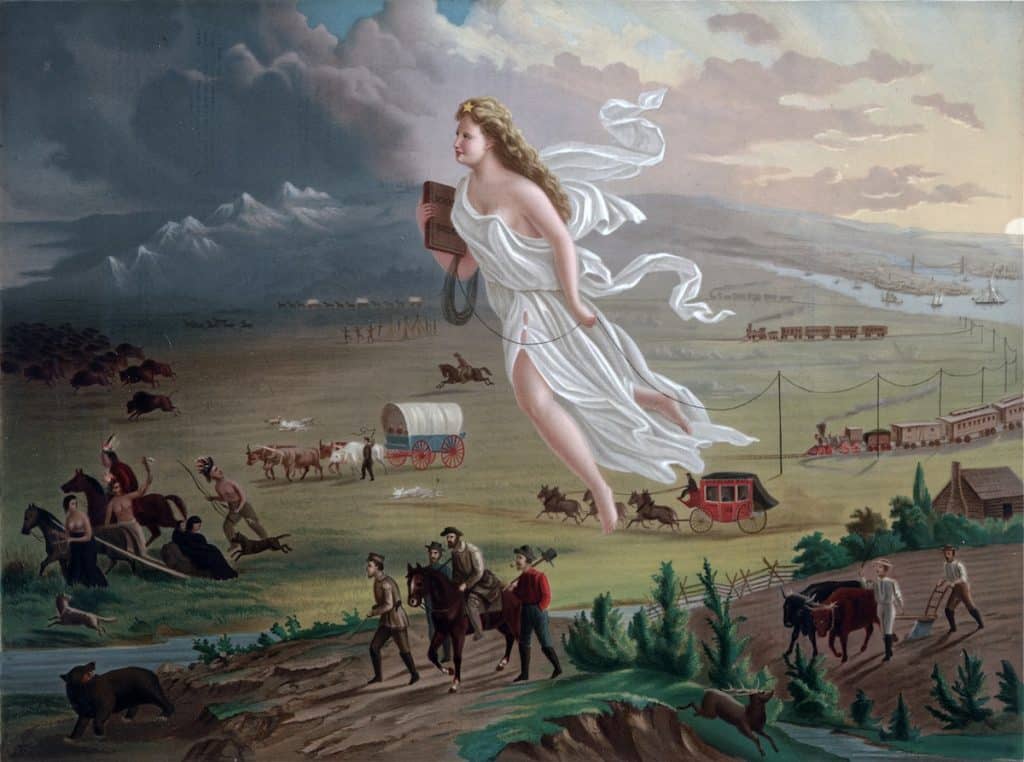
The ideological and historical agenda that has motivated the settlement of both the US and Israel is that of US Manifest Destiny, which has its equivalent in the Jewish idea of the Chosen People, as interpreted in Zionism. Both ideas have been and are being used in one form or another to justify the displacement by colonial settlement of Indigenous peoples from their lands.
Palestine/Israel is the other region of settler colonialism on which my teaching and scholarship focus, both for scholarly, political, and personal reasons, the latter, my heritage: I am Jewish, and one of my four daughters and her three children are citizens of Israel. The scholarly reasons, which I have elaborated in my writing, have to do with my understanding of the precise ideological and historical agenda that has motivated the settlement of both the US and Israel: that of US Manifest Destiny, which has its equivalent in the Jewish idea of the Chosen People, interpreted in the philosophy of Zionism, though not in traditional Judaism, where it suggests a particular relationship to the Jewish God, as a claim to the land of Palestine for all Jews who, contradictorily enough, are not largely Zionists (indeed a significant number of Jews and Jewish organizations oppose Zionism), any more than the majority of Americans subscribe to or have even heard of Manifest Destiny. Nevertheless, both ideas have been and are being used in one form or another by the factions in power to justify the displacement by colonial settlement of Indigenous peoples from their lands.
Whereas Manifest Destiny had its heyday in the nineteenth-century US and is now implicit in the nation’s imperial reach (“the greatest country on the earth”), Zionism, explicitly, has been fueling Zionist expansionism from 1917 to the present, where it is manifesting a particularly racist form in its anti-Palestinian animus (the use by the Israeli government, for example, in its Gazan genocide of typing Palestinians as “terrorists” or “human animals”). Thinking of Zionism and Manifest Destiny comparatively in the context of settler colonialism, I would say that Israel/Palestine is currently in the stage of settler colonialism that the US was in the nineteenth century: a militarized zone of concentration camps, the US called and calls them reservations. Rashid Khalidi refers to the Occupied Territories as an “archipelago of large open-aired prisons” (Palestinian Identity, Kindle edition, location 372). In this archipelago, Gaza, now undergoing a cataclysmic genocide by Israel, is widely known as “the largest outdoor prison in the world.” Thus, the West Bank and East Jerusalem compose balkanized territories under Israeli military rule aided by the collaborationist Palestinian Authority (PA) of which Khalidi wrote in 2010:
The situation [for a two-state solution] is made much worse by the delusions fostered by the fiction of the PA established by the Oslo accords [1993-94]. This is in effect a virtual body that does not have sovereignty, jurisdiction, or ultimate control. In other words it is an authority that has no real authority over anything….The PA has become a sort of subcontractor for Israel and has thus served in part to mask the reality of an Israel military occupation whose full security control over all these territories, and total domination over land and all other resources, is now in its forty-second year (Palestinian Identity, Kindle, Location 326-337 of 8833).
Bound up with the US strategic reasons in the Middle East for its close ties with Israel as “the only democracy” in the region are the ideological and historical affinity of the two countries, cemented by the financial and ideological power of the Israeli lobby in the US. A comparative study of settler colonialism in Palestine/Israel and the US helps us understand why the two countries are so intimately and destructively involved: to understand how American and Israeli “exceptionalism” are intertwined. I understand “exceptionalism” as the way the US and Israel project their histories as being exceptions to the very colonial-imperial histories that drove Western Europe, when, in fact, they are extensions of these histories. In The Jewish State (1896), the bible of Zionism in its projection of a national home for the “Jewish people,” Theodor Herzl makes this extension clear: “Palestine is our ever-memorable historic home….We should there form a portion of a rampart of Europe against Asia, an outpost of civilization as opposed to barbarism” (Kindle edition, location 1079-1089 of 2339).
I put “Jewish people” in quotes because all national groupings are fictions, that is, they are constructions that provide an origin narrative, a myth, of unity for a culturally, socially, politically, and typically conflicted, diverse population bound together by the force of law. In The Invention of the Jewish People, Shlomo Sand points out the Old Testament provides this national myth of homogeneity for Zionism and its national apotheosis Israel; and “[w]hen occasional findings threatened the picture of an unbroken, linear Jewish history, they were rarely cited; when they did surface, they were quickly forgotten, buried in oblivion. National exigencies created an iron-jawed vise that prevented any deviation from the dominant narratives (Kindle edition, page 18).”
Ironically, the influential Zionist Vladimir (Ze’ev) Jabotinsky recognized the correspondence between Native Americans and Palestinians, though in a thoroughly racist way, in his generative essay “The Iron Wall” (1923), which has substantially become Israeli policy— for example, Israel’s current program of ethnic cleansing in the West Bank is termed “Operation Iron Wall.” While professing a desire to live peacefully with the Arabs in Palestine, although insisting on a Jewish majority state, Jabotinsky contradictorily enough sees no way to bring about this peaceful cohabitation except through war. This, he argues, entails constructing an “iron wall” against Arab resistance, because “Every indigenous people will resist alien settlers as long as they see any hope of ridding themselves of the danger of foreign settlement. That is what the Arabs in Palestine are doing, and what they will persist in doing as long as there remains a solitary spark of hope that they will be able to prevent the transformation of ‘Palestine’ into the ‘Land of Israel.’” In formulating his militant approach to Zionist settlement, Jabotinsky openly acknowledges the Arabs in Palestine as the “indigenous” inhabitants and the Jews as “settlers.”
In making his argument for an “iron wall,” Jabotinsky compares the Zionist settlement of Palestine to the European settlement of the Americas, both of which, unsurprisingly, he idealizes: “But those ‘great explorers,’ the English, Scots and Dutch who were the first real pioneers of North America were people possessed of a very high ethical standard; people who not only wished to leave the redskins at peace but could also pity a fly; people who in all sincerity and innocence believed that that in those virgin forests and vast plains ample space was available for both the white and the redman. But the native resisted both barbarian and civilized settler with the same degree of cruelty.” In the settler fantasy, the “ethical” settlers always seek “peace,” while the Indigenous response is “cruelty.”
At the same time, Jabotinsky expresses typical settler ambivalence to the Indigenous inhabitants, at once lauding their resistant spirit while noting their intrinsic inferiority: “Culturally [the Arabs] are 500 years behind us, spiritually they, do not have our endurance or our strength of will, but this exhausts all of the internal differences.” In the settler fantasy, one can simply substitute the Indigenous peoples of the Americas for the Arabs.
Here, then, in the beginning of the Zionist project in Palestine, we see the material of militarism and racism that since the Balfour Declaration of 1917 has paved the road to the genocide in Gaza and Israeli expansionism, fully supported by the United States government. And Jabotinsky’s words erase the genocide of Native Americans, which, after their holocaust ended at the end of the nineteenth century, is ongoing in a structural form as the genocide in Palestine, structural in form since 1917, has now taken the cataclysmic form explicit in the 1948 Convention. (Some of the material in the final four paragraphs comes from my essay “Zionism and the Iran War” published in CounterPunch, March 31, 2026).
Jabotinsky’s early recognition of the Jews as settlers and the Arabs as indigenous (he does not recognize the potential national status of “Palestinians”) runs counter to the early Zionist mantra “A land without a people for a people without a land.” But as Zionism builds its iron wall in Palestine and in 1948 forcefully transforms Palestinian land into “Israel,” this mantra for Israelis erases the actual history of settler colonialism that, for example, enables then Prime Minister Golda Meier to say in 1969 “There was no such thing as Palestinians….They did not exist,” when Jews began to settle in Palestine under the flag of Zionism. Thus, in denial of their ongoing settler history, the vast majority of Israelis today claim to being the indigenous people of Palestine with an exclusive relation to the land, the “Chosen People.” This claim, both in Native American and Palestine, rationalizes genocide.


It so satisfies reading this article clearly defining the original settler colonialism of the US which that of the Zionist project mirrors. So often I have tried to portray this to Americans, even so-called progressives and it does not sink in. White supremacy in the US is so ingrained, especially in the white middle class that they cannot take in their own privilege has been based solely on the genocide of the Native people who suffered such horrific genocidal actions and still do. It is the same issue that prevents such white supremacists to understand that they are still profiting from the racism of slavery and ongoing structural policies and laws that still work to preserve this elitist privilege. More such articles are needed.
Both European colonisation of North America and Palestine are racist and genocidal.
However they have very different motives. North American colonisation has an economic motive. It does assimilate natives if they choose to. Zionism has an ethnonationalist motive. It rejects assimilation of non-Jews.
“Ironically, the influential Zionist Vladimir (Ze’ev) Jabotinsky recognized the correspondence between Native Americans and Palestinians, though in a thoroughly racist way, in his generative essay “The Iron Wall” (1923)…”
Incidentally, up here in the Republic of Madison public events are often started with a recognition of the natives of the region, the Ho-Chunk** . Cold comfort for the natives, perhaps, but at least it’s something.
Why not start a movement to begin each session of the Knesset in Israel with a recognition of the Palestinians who used to live on the land just a few decades ago? Certainly this couldn’t hurt a big, strong state like Israel.
**
https://madison365.com/ho-chunk-nation-flag-takes-official-place-at-madison-municipal-building/
“Ho-Chunk Nation flag takes official place at Madison Municipal Building“
FYI, Title VI of the Civil Rights Act of 1964 prohibits discrimination on the basis of race, color, or national origin in programs receiving federal funding, which legally extends to protections against discrimination based on actual or perceived shared ancestry or ethnic characteristics. So it is incorrect to suppose that it is legal to discriminate under US Civil Rights law against persons with shared ancestry.
Slander of title (or “libel of title” when in writing/recorded) is a false, malicious statement disparaging a party’s property ownership, causing financial loss. Here is an example of former Prime Minister Naftali Bennett employing slander as war propaganda and a blood libel. The history of Zionism in 3 minutes. – YouTube. Bennett’s ancestors were from Ashkenazi Jewish communities in Europe: from Poland, Germany, Russia, and the Netherlands. His parents, Jim and Myrna (née Lefko) Bennett, were American-Jewish immigrants who relocated from San Francisco to Israel in 1967 following the Six-Day War.
It’s not a matter of believing the false Bible mythology or the false claim they are recent immigrants. The Palestinian Christians and Muslims share the very same DNA ancestors as Jews. The Biblical Archaeology Society (BAS) has reported genetic studies which indicate that both modern Jewish populations and Palestinians are descendants of the same ancient Canaanites who lived in the Levant region. Research shows that both groups share a high proportion of recent Christian era ancestry—over 50% in many studies—from Bronze Age Levantine Canaanites. See also Jews and Arabs Share Recent Ancestry | Science | AAAS.
I have never seen the usefulness of arguing about black letter prohibitions in international law. If it’s worth arguing about, then it’s also worth submitting the question to a criminal court. Attempts to create loopholes, using the rules of grammar, propaganda, or artificial statutory limitations will not succeed in the long run to permit mass atrocities, plunder, piracy and pillage.
The Nuremberg and Tokyo Tribunals did not employ the Genocide Convention. The Judgement : The Law of the Charter stated that there was no doubt that every state could establish their own courts and prosecute the same Hague Convention (1907) list of crimes themselves. This list is universal and can still be used to prosecute the USA or Israel today:
(1) Murders and massacres; systematic terrorism.
(2) Putting hostages to death.
(3) Torture of civilians.
(4) Deliberate starvation of civilians.
(5) Rape.
(6) Abduction of girls and women for the purpose of enforced prostitution.
(7) Deportation of civilians.
(8) Internment of civilians under inhuman conditions.
(9) Forced labor of civilians in connection with the military operations of the enemy.
(10) Usurpation of sovereignty during military occupation.
(11) Compulsory enlistment of soldiers among the inhabitants of occupied territory.
(12) Attempts to denationalize the inhabitants of occupied territory.
(13) Pillage.
(14) Confiscation of property.
(15) Exaction of illegitimate or of exorbitant contributions and requisitions.
(16) Debasement of the currency, and issue of spurious currency.
(17) Imposition of collective penalties.
(18) Wanton devastation and destruction of property.
(19) Deliberate bombardment of undefended places.
(20) Wanton destruction of religious, charitable, educational, and historic buildings and monuments.
(21) Destruction of merchant ships and passenger vessels without warning and without provision for the safety of passengers or crew.
(22) Destruction of fishing boats and of relief ships.
(23) Deliberate bombardment of hospitals.
(24) Attack on and destruction of hospital ships.
(25) Breach of other rules relating to the Red Cross.
(26) Use of deleterious and asphyxiating gases.
(27) Use of explosive or expanding bullets, and other inhuman appliances.
(28) Directions to give no quarter.
(29) Ill-treatment of wounded and prisoners of war.
(30) Employment of prisoners of war on unauthorized works.
(31) Misuse of flags of truce.
(32) Poisoning of wells.