

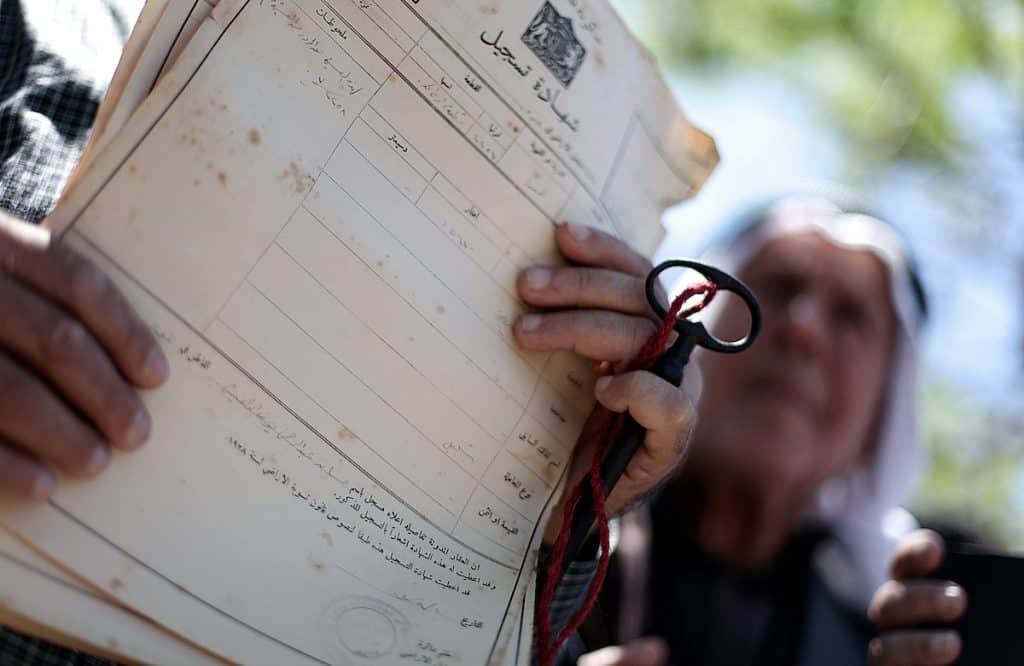
The loss of Palestinian homes in 1948 was not only the loss of roofs, orchards, and property deeds. Many Palestinians also lost access to bank accounts, deposits, securities, safe-deposit boxes, receivables, and legal claims. The event is often described through the language of war and exile. Yet another story appears in law offices, land registries, ministries, and financial institutions, where Palestinian absence was converted into a legal instrument.
The decisive act was not simply to record that people had departed. It was to classify them as “absentees.” The 1950 Absentees’ Property Law, together with the emergency regulations that preceded it, altered the legal meaning of absence. What had been a fact of displacement became a status. A Palestinian who crossed a border, found shelter in another part of Palestine, even a few feet from his home, or was unable to return during the prescribed period could be treated as legally absent, even when that absence resulted from war, fear, expulsion, or blocked return. Some Palestinians who remained within the newly established state were classified as “present absentees”: physically present in the country, but legally absent from their own property.1
A transfer of control then followed. Once property was classified as absentee property, it vested in the Custodian of Absentee Property. The word “vesting” sounds administrative, almost neutral. In substance, it meant that the owner’s rights passed to a public Israeli authority empowered to manage, lease, sell, or transfer those assets. The Development Authority and subsequent land legislation then helped move property into state and quasi-state channels. Retrospective validation and restrictive evidentiary rules made recovery increasingly remote.
The language of “abandoned property” is therefore misleading. A house is not abandoned when its inhabitants are driven out, barred from returning, or converted by law into absentees. A bank account is not abandoned because its depositor is Palestinian and has become a refugee. A citrus grove does not lose its owner because the road back has been closed by Israel. The legal classification did not merely describe absence; it turned absence into a mechanism of power.
Palestinian dispossession did not stop at physical land. After 1948, Palestinian accounts, deposits, receivables, safekeeping assets, securities, and even safe-deposit boxes were subjected to freezing, control, and transfer. Under the legal category of “absentee property,” property could include not only land and buildings, but also money, debts, business interests, commercial paper, contractual rights, and other financial claims.
The financial dimension of displacement matters because money is mobility, legal capacity, and survival. A family expelled from its home but still able to access its funds can rent shelter, hire counsel, educate children, restart a business, preserve documents, or challenge an administrative decision. A refugee family whose accounts are blocked is not merely poor. It is disabled before the law. It loses the means to prove, contest, litigate, and rebuild.
The order of magnitude is crucial. UNCCP-linked estimates placed movable refugee property at roughly £18–20 million, while scholarship on frozen bank accounts estimates about £6 million across thousands of accounts. Even read cautiously, these were not marginal sums. Inflation, lost yield, and decades of foregone stewardship push the issue into the realm of billions. Under an aggressive but transparent opportunity-cost scenario, combining roughly £25–26 million in movable property and frozen accounts, converting at a historical rate of about $4.03 per pound, and capitalizing at 10 percent annually over 78 years would produce a figure in the approximate range of $155–161 billion. That figure should not be read as a liquidated legal claim. It is a sensitivity analysis: a way of showing scale, economic deprivation, and the price of being excluded from one’s own capital.2
The records and cases of the 1950s show that this was not theoretical. Palestinian depositors and institutions tried to recover money held in branches located in the territory that became Israel. Banks were caught between their contractual obligations to customers and Israeli measures that ordered, recognized, or justified payment to the Custodian. In Arab Bank Ltd. v. Barclays Bank, the House of Lords dealt with a substantial balance held at Barclays’ Allenby Square branch in Jerusalem and later paid to the Custodian of Absentee Property. Around the same financial crisis, individual Palestinian refugees and claimants, including people who had fled to Beirut or pursued claims through Jordanian courts in places such as Nablus, Jerusalem, and Amman, confronted the same hard reality: the money existed, but access to it had been legally severed.3
Palestinian displacement was not only produced by soldiers, borders, and battles. It was also produced by banking controls, development agencies, and bureaucratic barriers. Law did not merely arrive afterward to manage the consequences of conflict. It helped transform displacement into an institutional order that has illegally benefited and enriched the State of Israel exclusively.
The trap was procedural as well as substantive. How could a refugee effectively claim funds from a state that had classified him as absent, transferred his assets to a custodian, restricted legal representation when he was outside Israel, and barred or controlled his physical return? If entry into Israel was prohibited and representation required official consent, the remedy became almost unreachable. The refugee was told to seek justice inside the very legal order that had made his return impossible.
The issue is not that every document reveals a single explicit motive behind every act. The point is narrower and more troubling: a sequence of legal mechanisms repeatedly produced the same material result. Classification made people absent. Vesting moved their property. Transfer and validation secured the result. Procedure narrowed the path back. The system did not need to shout; it only needed to record, register, certify, and close the file.
International law has long treated forced displacement and uncompensated property loss as wrongs requiring remedy, not merely administration. They require return, restitution, and compensation. They are legal responses to a continuing deprivation where property is withheld, remedies are blocked, and rights are treated as bargaining chips rather than enforceable claims.4
The Palestinian property question remains unresolved. It is often framed as an old dispute overtaken by war, diplomacy, and recognition. But recognition of a state does not erase the injustice of confiscation. Nor does it grant moral or legal immunity to the structures created after the fact. A system can persist for decades and still remain legally and morally defective.
The central point is simple. Palestinian displacement was not only produced by soldiers, borders, and battles. It was also produced by definitions, custodianship, banking controls, development agencies, validation statutes, evidentiary presumptions, and bureaucratic barriers. Law did not merely arrive afterward to manage the consequences of conflict. It helped transform displacement into an institutional order who has illegally benefited and enriched the State of Israel exclusively.
To understand the conflict fully, one must look beyond maps, diplomacy, and military history. One must also examine ledgers, title deeds, bank records, court files, and unresolved claims. The loss of land was tied to the loss of the means to return, litigate, finance survival, and rebuild. That is why the question today is not only whether Palestinians once lost property. It is whether a legal order that transformed absence into dispossession can still be treated as a neutral mechanism for managing the aftermath of war.
This article is adapted from the author’s book Palestine Dispossessed: How the Law Organized the Dispossession of a People.
Notes
- Israel, Absentees’ Property Law, 5710-1950, secs. 1, 4, 6, English translation reproduced by UNISPAL; Adalah, “Absentees’ Property Law,” accessed May 7, 2026. ↩︎
- Arie Arnon, Nu‘man Kanafani, and Saeb Bamya al-Daqqaq, “Absorbing Returnees in a Viable Palestinian State” (paper prepared for the International Development Research Centre, 2004), 4–5;
Sreemati Mitter, “A History of Money in Palestine: The Case of the Frozen Bank Accounts of 1948,” The Jerusalem Fund, May 23, 2014. The US$155–161 billion figure is an illustrative sensitivity calculation based on combining approximately £25–26 million, applying a historical exchange rate of about US$4.03 per pound, and compounding annually at 10 percent for 78 years. ↩︎ - Arab Bank Ltd. v. Barclays Bank (Dominion, Colonial and Overseas), [1954] A.C. 495 (H.L.);
Mitter, “A History of Money in Palestine.” ↩︎ - United Nations General Assembly, Resolution 194 (III), Palestine—Progress Report of the United Nations Mediator, December 11, 1948, para. 11;
Arnon, Kanafani, and al-Daqqaq, “Absorbing Returnees,” 2–6. ↩︎

80 years of looting. The most recent examples:
Israeli soldiers testify to ‘routine’ looting of south Lebanon homes
Israeli soldiers testify to ‘routine’ looting of south Lebanon homes
Israeli soldiers looting homes in Lebanon on large scale, report says | Middle East Eye
Israeli soldiers looting homes in Lebanon on large scale, report says
Testimonies describe widespread theft of motorbikes, televisions, paintings and sofas without accountability
Israeli Soldiers Testify to Widespread Looting in Lebanon: ‘Commanders Know and Do Nothing’ – Israel Security
Motorcycles, TVs and Couches Israeli Soldiers Testify to Widespread Looting in Lebanon: ‘Commanders Know and Do Nothing’
From Palestinian territory to Southern Lebanon: Systematic looting policy rife within Israeli Army, left unpunished
From Palestinian territory to Southern Lebanon: Systematic looting policy rife within Israeli Army, left unpunished
You shouldn’t forget that there were articles in every post WWI treay that required all of the state parties to recognize the boundaries of the newly created states. Their rights and the obligations were adjudicated by LoN Arbitration in the Ottoman Public Debt case and their contractual obligations and possession of state archives were awarded to Palestine, not the UK in the Mavormatis, and other cases. That included Article 434 of the Treaty of Versailles, Article 60 of the Treaty of Neuilly, Article 74 of The Treaty of Trianon, Article 90 of The Treaty of Saint-Germain-en-Laye, and
Article 46 of the Treaty of Lausanne. France, Great Britain, and the surrounding states established the borders of Palestine by LoN multilateral Treaties.
The Religious and Minority Rights Declaration and the International Conventions articles in Resolution 181(II) were subject to two separate ICJ dispute resolution compromissory clauses. Those have been referred to the ICJ twice, and acknowledged by the Court. But it has not disposed of the legal consequences as part of the legally binding provisions of either clause in an Advisory Opinion or contentious case. The Court is both empowered and required to resolve any dispute.
Those rights are more valuable to the Arab States than mere bank accounts. The other compromissory clause applied to the Boundary Treaties and other International Treaties regarding shared right of transit, navigation on lakes, rivers, and seas, archives, and financial rights. In short, any matter that Israel, Palestine, Jordan, Lebanon, Syria, and Egypt could not unilaterally denounce:
2. International conventions
The State shall be bound by all the international agreements and conventions, both general and special, to which Palestine has become a party. Subject to any right of denunciation provided for therein, such agreements and conventions shall be respected by the State throughout the period for which they were concluded.
Any dispute about the applicability and continued validity of international conventions or treaties signed or adhered to by the mandatory Power on behalf of Palestine shall be referred to the International Court of Justice in accordance with the provisions of the Statute of the Court.
Now let’s see Mondoweiss run an article about the theft of Jewish assets in Arab countries such as Iraq, Morocco, Lebanon, Yemen et al during the period of anti-Jewish pogroms and persecution, roughly from 1941-55. Jews were fired from their jobs, assaulted, unjustly imprisoned and murdered in those countries during that time. MW has not printed a single article about this. Apparently, what it finds objectionable is not theft of financial wealth per se, but only when it can be attributable to Israel. I’m surprised that MW hasn’t tried to build a case accusing Israel of causing COVID or global warming.