

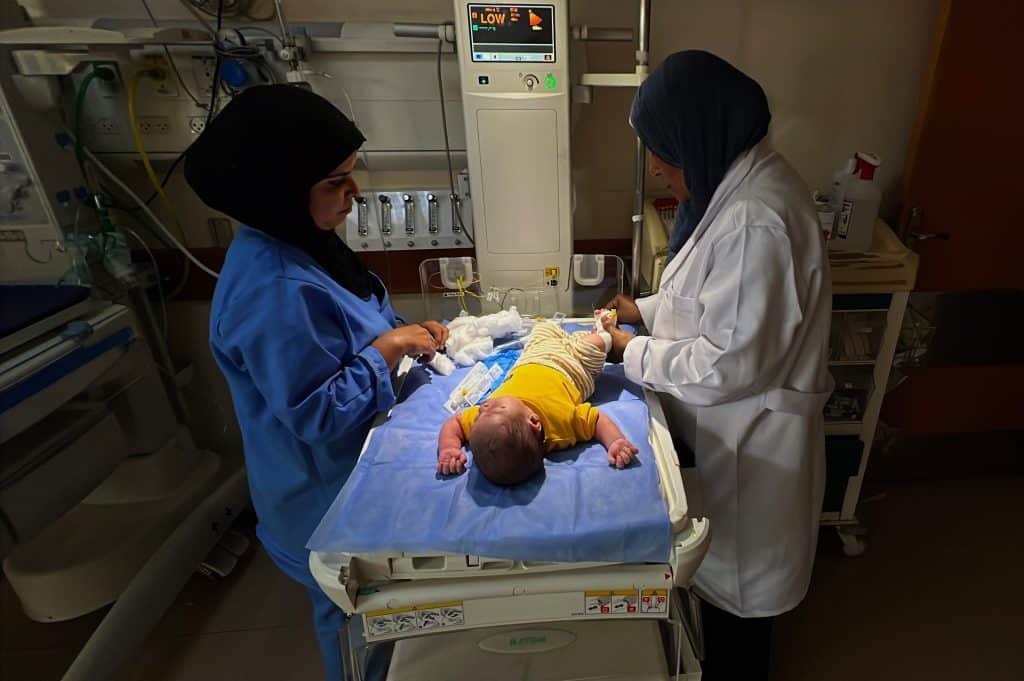
On May 31, Dr. Raed Hassanein, the Director of the al-Aqsa Martyrs’ Hospital in central Gaza’s Deir al-Balah, announced that the hospital was once again on the verge of closing its doors after its fourth generator went out of service. He explained that the half a million people who rely on the hospital for treatment are now at risk of losing access to healthcare services.
The press conference marked the latest in a continuous string of crisis that have afflicted the healthcare sector in Gaza since October 2023, when food, water, fuel, and electricity were completely cut off to the Strip. Since then, the electrical grid in Gaza has been completely decimated, forcing hospitals and medical centers to entirely depend on generators to sustain operations, which used to be used as supplements to the grid. Hospital staff say that the generators are now severely worn out after more than three years of continuous use, and several have already broken down.
The result is that hospitals and other institutions that provide essential services to the population are now constantly operating a few days away from shutting down, receiving just enough fuel and medical supplies to avoid completely closing their doors but never enough to operate at more than a fraction of their normal capacity.
Health workers and officials in Gaza observe that the rate at which hospitals continue to periodically face acute crises followed by periods of temporary relief points to a deliberate Israeli policy of calibrating the degree of deprivation. The result, they say, is that a total breakdown is avoided, but the overall health sector remains in a continuous state of precarity.
Dr. Khalil al-Daqran, a spokesperson for al-Aqsa Martyrs Hospital, told Mondoweiss that Israel is waging an aggressive campaign against Gaza’s healthcare system and remains committed to keeping border crossings closed or only partially open. At the same time, he noted, the blockade on the Gaza Strip continues, and “no medical equipment has been allowed into the healthcare sector, while only limited quantities of medicines and medical supplies have entered.” Al-Daqran stressed that what has gotten through is far from sufficient to meet patients’ needs.
Last April, Nasser Hospital in Khan Younis issued urgent appeals over shortages of medical supplies and the lack of infant formula for hospitalized children. It later faced recurring fuel shortages and a shortage of laboratory materials. Now, al-Aqsa Martyrs Hospital has sounded the alarm over fuel and generator shortages.
A systemic policy of deprivation amid a public health disaster
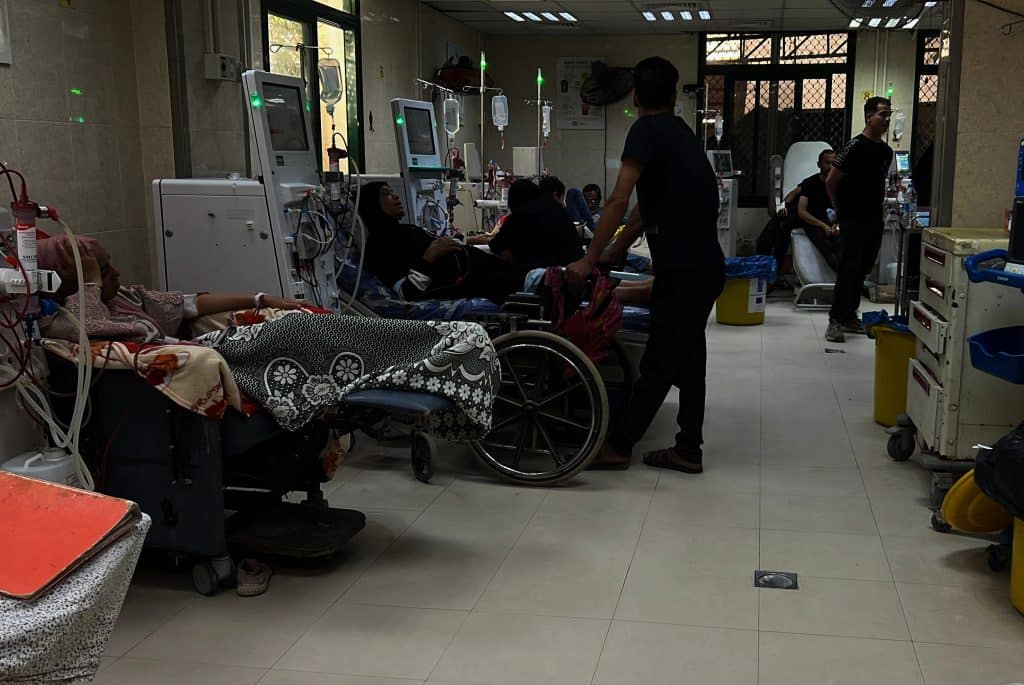
The state of permanent crisis afflicting the health sector in Gaza predates the war, but it took on an entirely new meaning during the genocide, and has continued intermittently into the so-called ceasefire between Israel and Hamas, which entered into effect in October 2025. According to hospital officials, the chronically low and intermittent flow of aid has meant that even a delay of two or three days in the arrival of supplies can trigger almost immediate critical shortages that threaten a complete halt to operations.
This is compounded by what Dr. Daqran described as “daily violations” of the ceasefire agreement, which have continued to bring large numbers of fatalities and injuries into hospitals with dwindling resources. “At the same time, more people are falling ill due to the unsanitary living conditions,” he added. “Residents are forced to live amid sewage, garbage, insects, and rodents, creating an environment conducive to the spread of disease.”
The Gaza Strip’s rodent infestation has led to a public health emergency, with over 70,000 rodent-borne infections recorded across the territory between January and May of this year. It is part of a broader policy to weaponize infectious diseases against Gaza’s population. Dr. Salman Khan, an infectious disease specialist who travelled to Gaza on a medical mission for three weeks last February, wrote in Mondoweiss that the collapse of the healthcare system, overcrowding, and poor sanitation have “all conspired to facilitate the spread of multidrug-resistant bacteria and exacerbate Gaza’s antimicrobial resistance burden,” which he described as part of a broader Israeli policy of weaponizing infectious diseases against Gaza’s population.
Al-Daqran stressed that this policy is apparent in how Israel has deliberately targeted Gaza’s healthcare system, destroying a large number of hospitals and critical departments, as well as more than 50 percent of hospital power generators. “The remaining generators have deteriorated due to continuous use for almost three years,” he added, describing the generators as the hospital’s sole lifeline for operations.
He added that the continued closure of the crossings into Gaza and the prevention of the entry of aid and essential supplies, in his view, amounts to “a deliberate policy of indirect killing, affecting both patients and civilians.” He said that the solution lies in allowing the free entry of high-capacity generators capable of powering all hospital departments and restoring a direct electricity supply to medical facilities. This isn’t limited only to fuel, he said, but also includes lubricants and spare parts for maintenance.
Hospitals on life support
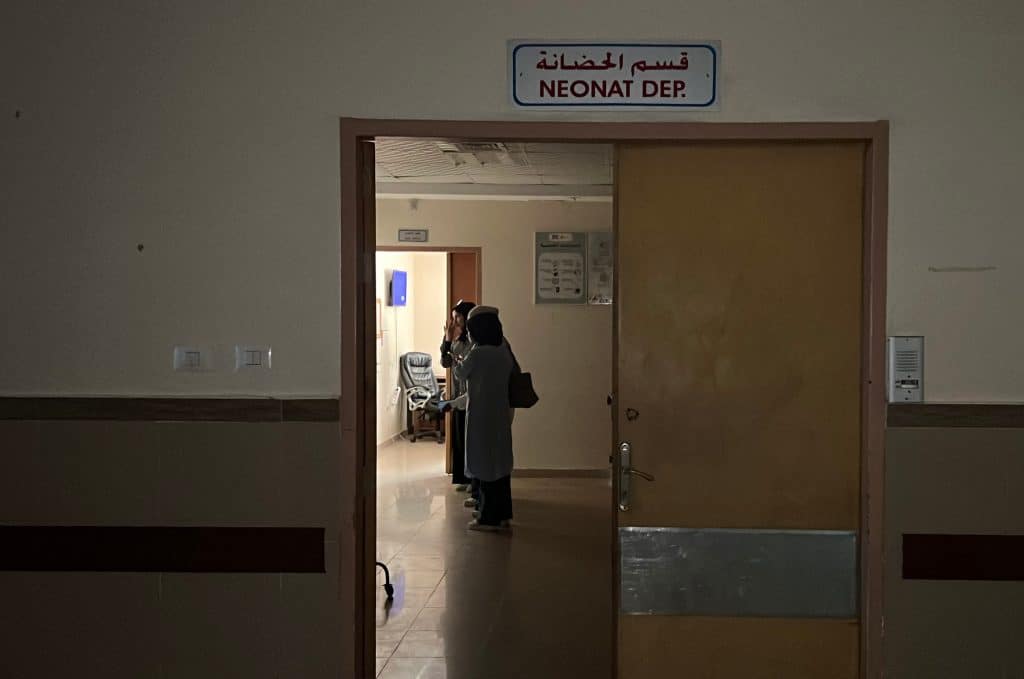
As of the time of writing, the operating room at al-Aqsa Martyrs’ Hospital has been shut down. Over 50% of services in the dialysis unit, the intensive care unit, neonatal incubators, and laboratories have also been suspended.
At the press conference on Monday, Dr. Hassanein said that some departments had already been disconnected in the week prior, but that the major blow came at the start of this week, “when work inside the hospital’s operating rooms had to be halted.”
He explained that the hospital had been operating several main generators throughout the war, but that three broke down during the first year, leaving only three of them functioning. Recently, one of the backup generators also failed, leaving just two: one operates during the daytime, and the other at night.
Ismail Abu al-Nimr, head of the maintenance department at the hospital, told Mondoweiss that hospital staff have been reusing and recycling the same engine oils in the generators since the beginning of the war, “because fresh supplies are unavailable.”
“This practice damages the machinery and generators,” he observed, “But there are no alternatives. Mineral oils for vehicles and electrical equipment have been entirely unavailable since the start of the war.”
“The hospital also had to switch off air-conditioning systems in intensive care and neonatal units to reduce electrical loads, as only one generator has been operating for several hours,” he added.
Dr. Hassanein also stressed during the press briefing that the hospital was back in familiar terrain. “We are on the path toward a complete shutdown of the hospital,” he said. “I fear that we may soon have to hold another conference to announce its closure.”
Tareq S. Hajjaj
Tareq S. Hajjaj is the Gaza Correspondent for Mondoweiss and a member of the Palestinian Writers Union. Follow him on Twitter/X at @Tareqshajjaj.
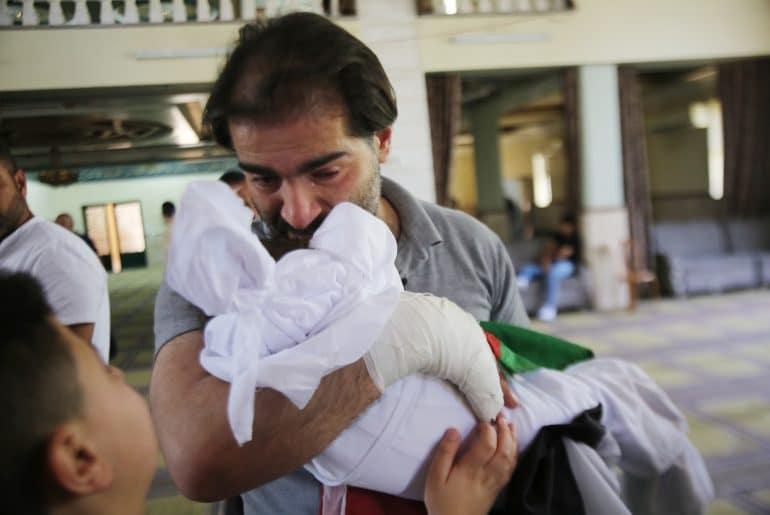

“Al-Daqran stressed that this policy is apparent in how Israel has deliberately targeted Gaza’s healthcare system, destroying a large number of hospitals and critical departments, as well as more than 50 percent of hospital power generators.”
Today’s story from Truthout:
Israel Has Engineered a Deadly Shortage of Medications and Health Care in GazaA Palestinian doctor in Gaza says the territory is facing its worst medication shortage since Israel began the genocide….The World Health Organization has warned that Israeli forces are no longer only claiming people’s lives through bombs, but are also endangering Palestinians by denying them urgently needed health care services and medication…Fifty percent of basic medications for noncommunicable diseases like hypertension, diabetes, asthma, and respiratory diseases are now missing. Around 70 percent of medical equipment is nonexistent, while 84 percent of laboratory resources are unavailable.
Israel Has Engineered a Deadly Shortage of Medications and Health Care in Gaza | Truthout
Medecins Sans Frontiers:
Gaza: Israeli entry restrictions cause critical shortage of medical supplies…
Gaza: Israeli entry restrictions cause critical shortage of medical supplies | MSF
Can we stop pretending that Israel doesn’t target civilians?
A bit off topic: there is now a Wikipedia page listing Israeli war crimes from 1948 to the present; if I’m reading this correctly it was first composed in May of this year.
Legal experts please comment:
Israeli war crimes are violations of international criminal law, including war crimes, crimes against humanity and the crime of genocide, which Israeli security forces have committed or been accused of committing since the founding of Israel in 1948. These have included murder, intentional targeting of civilians, killing prisoners of war and surrendered combatants, indiscriminate attacks, collective punishment, starvation, persecution, the use of human shields, sexual violence and rape, torture, pillage, forced transfer, breach of medical neutrality, enforced disappearance, targeting journalists, attacking civilian and protected objects, wanton destruction, incitement to genocide, and genocide….
https://en.wikipedia.org/wiki/Israeli_war_crimes#2014_%E2%80%93_2022
SOMEWHAT RELATED: DAN STEINBOCK ON ISRAEL‘S ‘OBLITERATION DOCTRINE’
■ Could Israel’s Wars Throw the Whole World into Chaos? | Dan Steinbock | Informed Comment | 06/04/2026
What began as Israel’s obliteration in Gaza now extends to Lebanon, Iran and the Gulf, thanks to US arms and finance. If diplomacy fails to interrupt this trajectory, the expansive arc of war will transform a regional conflict into a prolonged international disorder.
LINK ~ https://www.juancole.com/2026/06/could-israels-throw.html
No, the solution is to move a crappy ceasefire into a something resembling peace. And that starts with Hamas disarming and disbanding as an armed force.
There is a flood of support waiting on the Palestinians to do the right thing, way more than anything in the story above. Just stop fighting, take the peace that is offered, and let everyone start rebuilding their lives.