

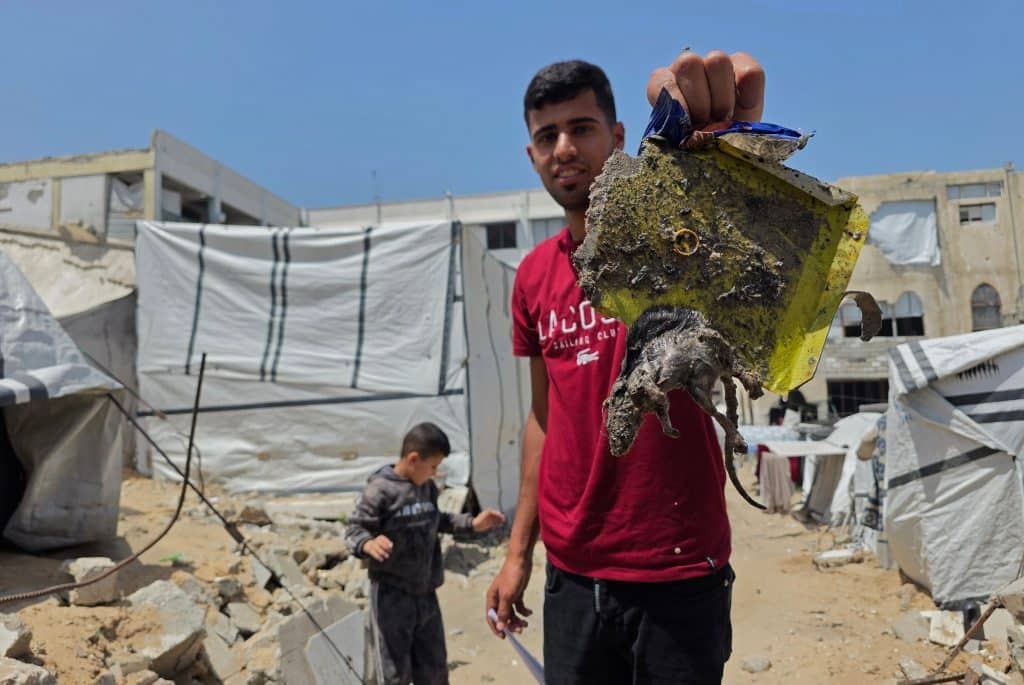
At the beginning of April, Enshrah Hajjaj, a 61-year-old woman with diabetes, woke up in her tent in Gaza City to find blood on her toes. She couldn’t figure out how she started bleeding, so she treated herself inside her tent with her family and carried on with her day. A week later, she woke up again to find the same bleeding toes — but this time, half of them were missing. She began screaming, and her family rushed her to the hospital, where doctors told her that rats had eaten through them while she slept. As a diabetic, she had lost much of the sensation in her feet, a common complication of the disease, and had felt nothing.
Enshrah’s case is far from isolated. According to the Gaza Ministry of Health, four displaced people have died from skin diseases directly linked to rodent infestations, though the Ministry was unable to confirm the specific diseases in each case, citing the absence of laboratory materials needed for testing.
Nisreen Kilab, head of the Environmental Health Department at the Health Ministry, said the symptoms observed in several patients indicate a virus transmitted through rodent waste and bites, which can be fatal in some cases. “We suspected several leptospirosis infections, but unfortunately, these cases could not be confirmed through laboratory testing due to the absence of the required means,” she told Mondoweiss.
Kilab said the skin diseases spreading in Gaza are driven by insect, flea, and rodent bites, warning that without urgent intervention, the outbreak will only deepen.
“More than 90% of Gaza’s population is displaced and living in tents, which has led to a frightening increase in population density, and a high population density means a faster spread of disease.”
Nisreen Kilab, head of the Environmental Health department at the Gaza Ministry of Health
According to the World Health Organization (WHO), more than 70,000 cases of ectoparasite infections were reported in Gaza in 2026, while over 80% of displacement camps reported recurring rodent and pest infestations, as well as skin conditions such as scabies and lice. The WHO’s representative described this as “the unfortunate but predictable consequence when people live in a collapsed living environment.”
Enshrah Hajjaj now lives in constant fear, especially at night. “I sleep while awake,” she told Mondoweiss. “I haven’t experienced a single night’s peace after this incident. I can’t feel my feet, and half my foot is numb, so I’m afraid of waking up one day to find that rodents ate off my entire foot without me feeling it.”
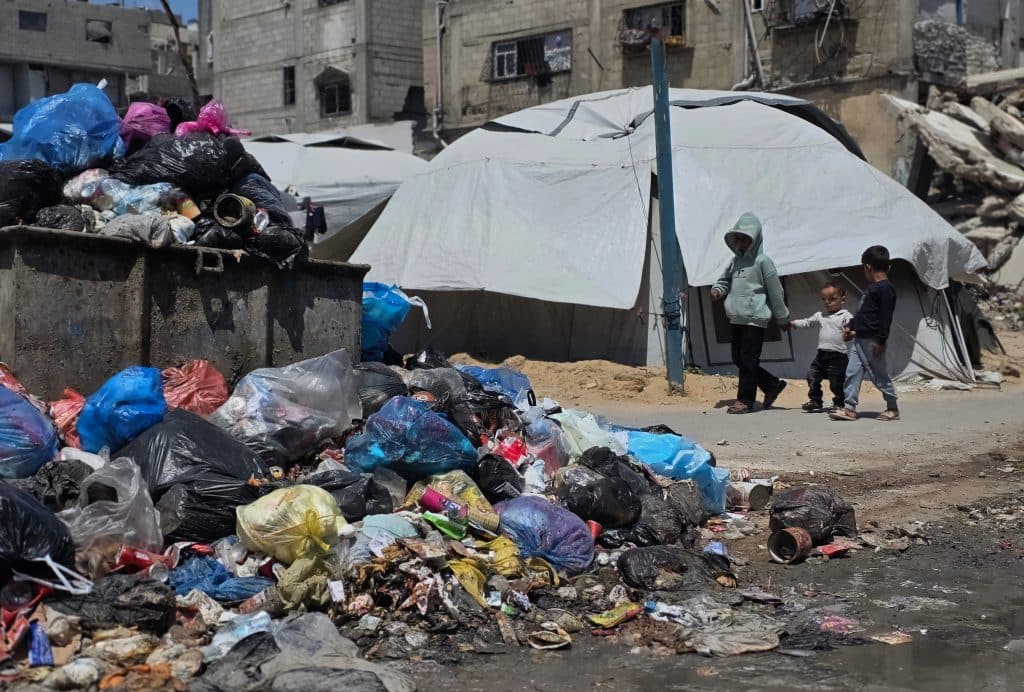
The conditions around Enshrah’s tent and the tent encampments in Gaza have been described by health officials as particularly conducive to the spread of rodent infestations, with piles of garbage rising in small hills only a few hundred meters away from the displacement camps. The camps themselves sit amid pools of sewage and mud.
“At first, there was an accumulation of rubble and debris, and later a buildup of garbage near displacement centers,” Kilab said. “More than 90% of Gaza’s population is displaced and living in tents, which has led to a frightening increase in population density, and a high population density means a faster spread of disease.”
Kilab said that the 40 million tons of accumulated waste across Gaza have made matters worse. “These conditions are an ideal breeding ground for epidemics,” she explained.
When skin disease becomes a death sentence
Contracting a skin disease in Gaza has become potentially fatal, while local hospitals lack the means of diagnosing them. Patients who need specialized care abroad cannot leave, as exit permits for medical travel remain beyond reach due to Israel’s continued closure of the Rafah border crossing, despite its obligation to facilitate medical evacuations and general travel through the crossing as part of the U.S.-brokered ceasefire with Hamas.
Last February, Muhammad Dhiban died after suffering from a skin disease that doctors in Gaza could not identify. The disease damaged his kidneys and reached his brain, causing meningitis. He was unable to travel for treatment and died in Gaza. In April, Ibrahim Abu Aram died from a severe blistering skin condition that covered his body in open sores. According to his family, the infection had spread to his brain. For months, both men and their families appealed to decision-makers to allow them to leave Gaza for treatment, but no response was forthcoming.
Dhiban and Abu Aram likely died of one of several diseases now spreading among the displaced. “There are several diseases transmitted by rodents, such as Lassa fever, typhus, and Salmonella, that are likely making up most of the infections we’re seeing,” Kilab said. “They’re all carried through rodents, insects, and their waste.” She warned that if health institutions failed to contain the epidemic, Gaza could face an outbreak of the plague, a possibility she said is no longer remote.
Abdel Qader al-Basyouni, a father of four, told Mondoweiss now afraid of what might happen to his youngest child, who was recently bitten by a rat while sleeping at night. The child developed a fever and complications that the family described as severe.
Al-Basyouni said that what Palestinians endure in the tents is something no one in Gaza has ever experienced. Rats once rarely entered homes, and hearing of a rat biting a person was extremely uncommon. “Never in my life have I ever heard of a rat attacking and biting a human,” he said. “Not until after this war.”
His wife, Yasmin al-Basyouni, said the garbage never stops accumulating. Neither does the bombing, nor the further accumulation of rubble. Meanwhile, sanitation and cleanup efforts can’t keep up with the rate at which waste is produced.
“So what awaits us?” she asked. “What awaits our children in the tents during the summer, with the greater spread of rodents and insects? Is death waiting for us? Is the plague waiting for us?”
The situation has gotten so dire, she said, that they have been reduced to wondering whether their children will die of bombs or rodent bites. “Are rats also our enemy now?” she added.

Posted yesterday by Medecins Sans Frontieres:
An analysis of medical data by MSF finds increased miscarriages, premature birth, and infant mortality linked with malnutrition. …Between late 2024 and early 2026, our teams at four health facilities MSF runs or supports recorded higher levels of miscarriage as well as prematurity and mortality among infants born to mothers affected by malnutrition during their pregnancy, and observed a sharp increase in disrupted treatment for malnourished children. …MSF links these outcomes to Israel’s blockade of essential goods and attacks on civilian infrastructure, including medical facilities. Insecurity, displacement, restrictions on aid, and limited access to food and medical care have had devastating consequences for maternal and newborn health….
The devastating impact of Israel’s manufactured malnutrition crisis in Gaza | Doctors Without Borders – USA
Rodent infestations, lice, fleas, and extreme unhygienic conditions were common in many Nazi concentration camps and ghettos, too. Nazi authorities intentionally created extreme overcrowding, starvation, deprivation, and neglect in ghettos and concentration camps. Those conditions predictably led to disease, vermin infestations, and mass death. For example, in the Warsaw Ghetto, German authorities forced hundreds of thousands of people into an extremely confined area with inadequate food, water, sewage, and medical care. Historians widely describe this as intentional structural destruction of living conditions aka genocide.
It would be helpful if Hamas (they run the place) cleaned up that pictured pile of trash and garbage.