

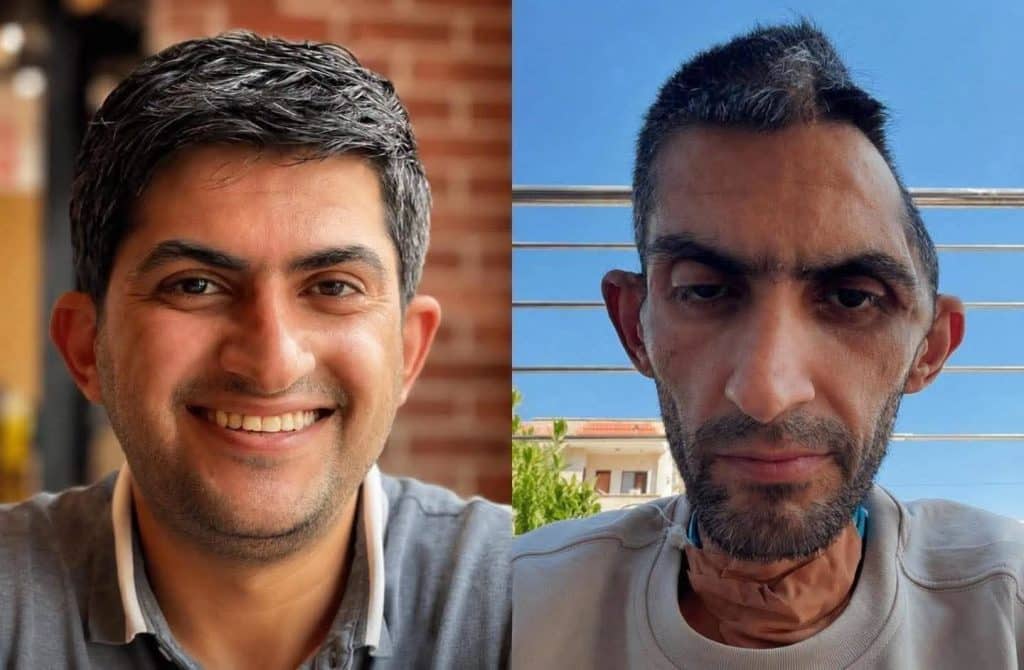
On June 24, I opened my feed and saw that my colleague, Palestinian journalist Mujahed Mofleh, had posted a shocking photo of himself emaciated, his skull caved in, six months after his release from Israeli prison. The photo was accompanied by a searing testimony about his ordeal since being released, and how his life had changed forever because of health complications from his time in prison that nearly killed him.
The photo and testimony sent shockwaves across social media. Palestinians shared them widely as living evidence of what Israel is doing to Palestinian prisoners.
Mujahed Mofleh is widely regarded as one of the finest editors in Arabic-language media in Palestine. He worked at Ultra Palestine for years, writing and editing news stories about Palestinians and their daily lives under occupation. I worked alongside him and watched him turn a lifeless text into a singular piece of journalism.
On June 28, 2025, Israeli forces arrested him. He spent seven months in administrative detention, then another seven months in Palestinian hospitals after suffering a brain hemorrhage two days after his release. The hemorrhage was brought on by medical neglect and the physical toll of his imprisonment. He is a diabetic and received no medical care during his time in prison.
In his testimony, he wrote that he came to know real hunger, where a piece of bread becomes something you dream about. He wrote about humiliation, about having every detail of your existence controlled by someone else.
Prison, he said, didn’t only damage his body, but changed what he understood to be ordinary. These were seemingly simple things: a full meal, a glass of water, a night’s sleep without fear, the ability to walk out a door.

“Fourteen months in prison and a long journey of treatment were not merely a stretch of time, but a lifetime of pain,” he wrote. “Fourteen months were enough to teach me that health is a crown, freedom is life, and dignity is not a minor detail, but the very essence of our humanity.”
I remember my first visit to Mujahed in the hospital, four months after the hemorrhage. He weighed no more than 30 kilograms. He couldn’t speak and couldn’t move anything except his right hand, which he used to write in his careful, beautiful handwriting.
As soon as I sat beside him, he wrote: “There are messages from prisoners from Jenin that I need to deliver to their families.”
Since October 7, Israel has effectively cut Palestinian prisoners off from the outside world. Released prisoners have become the only living link between those still inside and their families. They leave carrying names, messages, fragments of news, words memorized under pressure and entrusted to them for delivery to their loved ones.
In Mofleh’s case, illness, coma, and his inability to speak prevented him from delivering those messages. They remained lodged in his mind, weighing heavily on him and refusing to let him rest. He was haunted by a single thought: I wanted to reassure them, to console them, or just to give them a scrap of news that they would give anything to receive.
That was when I understood that Mujahed had never really left prison. He was still inside it, carrying the other prisoners with him.
“I watched time stop,” he wrote in his testimony. “Minutes moved like years. And I saw what hardship does to people — who stayed, who disappeared, and whose presence had never been real to begin with.”
During another visit, my friend Naela and I sat with him as he wrote to us: “Two prisoners who were held with me in the same cell died. To this day, I can still hear the final breaths of one of them.”
We told him to stop thinking about it and focus on getting better.
“I can’t,” he wrote.
Prisoners may leave the cages that confined them, but the torment they endured doesn’t. It remains with them, lingering like a ghost.
For Mujahed, this was more true than most. As a deeply empathetic journalist whose life has been shaped by concern for the stories and suffering of others, the crimes he witnessed weren’t a passing horror; they inhabited his body long after his release.
This is the most devastating part of his experience. He never truly escaped the cruelty that was inflicted on him. He emerged from detention only to enter into a coma, followed by a long period of illness, of moving from one hospital room to another.
While working with Mujahed, I once wrote a news story about a recently released detainee, referring to him as a “liberated prisoner.” Mujahed messaged me and said, “He is a former prisoner. He spent his entire sentence in captivity and was not freed. A freed prisoner is someone whose freedom was wrested back.” In other words, someone who was liberated against the will of the jailers.
When I met him in the hospital, I remembered that note and understood right then what it means for a prisoner to fight for freedom. To fight prison meant that you had to fight what prison did to you — to fight death, the jailer’s torment, and reclaim freedom on your own terms.
Mujahed’s case isn’t the exception. As the Palestinian Prisoners’ Society has noted endlessly, he is one of thousands of stories of systematic torture in the Israeli prison system, alongside starvation, the complete denial of medical treatment, physical abuse, and a continuous policy of round-the-clock psychological terror.
Hundreds of cases like his have been documented by human rights organizations: former prisoners released in catastrophic physical and psychological condition, most of them never made public because the people who went through it are too afraid to speak for fear of reprisal — not out of paranoia, but because the prison authorities and the intelligence services explicitly threatened them with rearrest if they spoke out.
For some, what the prison did to them was too much, and they didn’t survive long after their release. Again, the Prisoners’ Society reminds us that the Israeli authorities will often release prisoners only after irreversible damage has been done to them, as was done to Khaled al-Saifi, a much-beloved teacher from Dheisheh refugee camp who touched the lives of countless people. His death a week after his release in January 2026 — the same month of Mujahed’s release — shook an entire community that extended far beyond the camp.
In some sense, Mujahed was released, but he wasn’t liberated. Even worse, the prison came with him. But it is also true that his fight to survive, that his battle against what the jailers had done to his body and his soul, was its own kind of struggle for liberation. His testimony may be the first crack in the wall.
“There, between cold walls and endless nights, I learned how hunger breaks a person’s pride,” he wrote, “and how pain strips everything away except faith and patience.”
Shatha Hanaysha
Shatha Hanaysha is a Palestinian journalist based in Jenin in the occupied West Bank.

This photo reminds one of the pictures of concentration camp survivors as they left Auschwitz-Birkenau at the end of WWII. The fact that the Israeli government continues to lie about the systemic torture and brutality in Israeli prisons shows Israel’s leaders have taken the wrong lessons from 20th and 21st century history.