

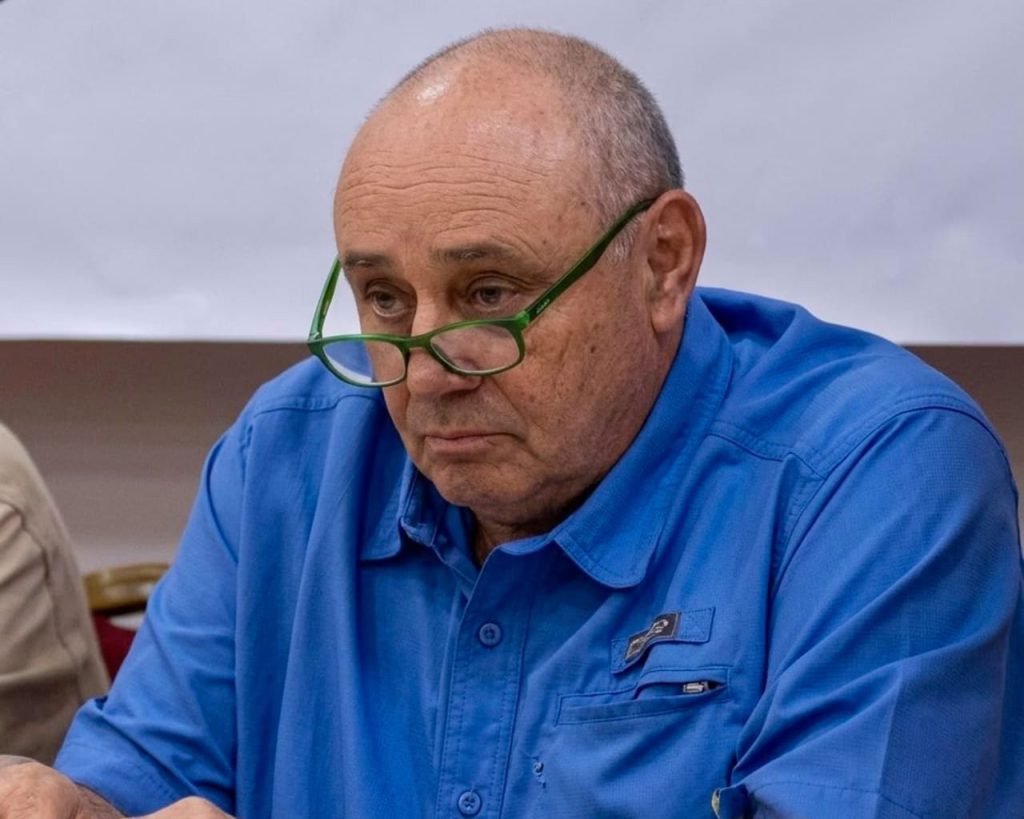
Before dawn on June 21, Israeli forces raided the al-Tireh neighborhood in the heart of Ramallah, storming the home of Dr. Mazen Rantisi, 71. His arrest by the Israeli military made headlines across the West Bank.
A renowned and respected figure, the physician is known for decades of service that earned him the nickname “doctor of the poor” for his well-known policy of waiving fees for patients who couldn’t pay. As a community figure with no history of political activity, Dr. Rantisi was the last person Palestinians expected Israel to arrest. His arrest was a clear signal that no one would be spared from Israel’s assault on Palestinian existence in the West Bank. For many, Rantisi’s arrest was proof that the nature of the Israeli crackdown was not against specific groups or individuals, but the very fabric of Palestinian society itself.
Last Sunday, Rantisi’s case returned to the forefront of the news after Haaretz‘s Amira Hass reported on Rantisi’s detention in inhumane conditions and how he was subjected to mistreatment, food deprivation, and medical neglect, as relayed by Rantisi to the lawyer for the Public Committee Against Torture in Israel. According to Rantisi’s family, the doctor, who suffers from several chronic illnesses, has been denied his medications, putting his health at risk.
Such reports have become commonplace ever since October 2023, when torture, starvation, and ill-treatment became a matter of policy in Israeli prisons. But Mazen Rantisi’s case is particularly concerning for Palestinian social workers, because of what his arrest represented.
Dr. Rantisi is facing charges of heading the board of the Union of Health Work Committees (UHWC), a Palestinian medical NGO founded in the 1980s that Israel declared a “terrorist” organization and outlawed in August 2022, as part of Israel’s broader crackdown on Palestinian civil society and human rights organizations
‘Younger detainees tried to protect my father with their bodies’
Sylvia Rantisi, Dr. Rantisi’s daughter, was in Jordan, where she and her family live, when she received the news of her father’s arrest in June. “I immediately came back to Ramallah, as did my sister, to be with my mother, who was alone in the house after my father was arrested,” Sylvia told Mondoweiss. “This is the first time that our family has had to face an arrest by the occupation. My father had never had any trouble with the occupation before, and at his age, we never expected him to be arrested. We weren’t ready for it.”
Since October 2023, Israel has banned all family visits to Palestinian detainees, which is why the only chance Sylvia has to see her father is at court. “The last time I saw him was a week ago, at his court session, where we exchanged some words before the session began,” he said. “He told me that he hadn’t been taking his medicine regularly, but that he was fine — although I could see that he had lost a lot of weight.”
“Then we sat down with the lawyer he gave the declarations to, and she described my father’s detention conditions in his own words,” Sylvia went on. “My father told the lawyer that for the first three days he didn’t eat, and that the first meal he received consisted of a tomato, a half-cooked egg, and a piece of bread.”
Sylvia says that her father also described how Israeli prison guards systematically mistreated and abused detainees as part of an apparent daily routine, confiscating their sleeping mattresses every day and spraying them with water, then returning them soaking wet. He also said that during the four headcount sessions every day, detainees would be made to kneel on their knees while handcuffed behind their backs, and their cells would be regularly raided for searches. “During those searches, guards would beat detainees, and younger detainees would try to protect my father with their bodies,” Sylvia detailed.
The ‘doctor of the poor’
Dr. Mazen Rantisi built his reputation through years of work serving Palestinians from all walks of life. His lifelong friend, Safwat Tahboub, described him as “a sensitive man with deep human values and social empathy.”
“I have known Mazen since childhood, and later we were together in Bulgaria during our [medical] studies,” Tahboub recalled. “When he came back to Palestine, he worked for some years as the campus doctor at Birzeit University, treating students. But later he began to visit villages, especially around Ramallah, where there were no medical centers.”
Rantisi later opened his own private clinic, where he treated patients from all social classes for many years, becoming known for charging no more than 25 shekels ($8) for a checkup, which he later raised to 40 shekels ($13), at a time when the standard price for a medical checkup was 100 shekels ($33). He was also known for not charging patients who he knew had a limited income, Tahboub says.
“Sometimes he received calls late in the night to go treat a patient in some village, and he would go,” Tahboub recalled. “Patients from villages sometimes brought him olives, cucumbers, home-made pickles, or whatever was in season in lieu of payment, and he accepted it.”
“When he knew that a patient couldn’t pay for the medicine, he would write a special note on the prescription that only the pharmacy owner understood, telling him not to charge the patient,” he added. “Later, he would go to the pharmacy himself and pay for the medicine.”
No one is safe
Because of his reputation and role in society, Dr. Rantisi was asked by the UHWC to serve as its board chair. “Mazen was introduced to the UHWC in the 1990s, when he began running a medical center for them that provided primary care, especially to low-income Palestinians,” Tahboub said. “About three years ago, the UHWC asked Mazen to head their board.”
In October 2021, Israel declared six Palestinian NGOs as “terrorist” organizations and banned their activities, including human rights group al-Haq, prisoner rights group Addameer, and children’s rights group Defense for Children International-Palestine (DCIP). Nearly a year later, in August 2022, Israeli forces raided the Ramallah offices of the six NGOs in addition to the office of the UHWC, which was added as a seventh organization to the original six NGOs. The doors to the offices of each organization were welded shut by the Israeli army and given a military order to cease activities.
Israel accused several of the NGOs of funneling money to the Palestinian radical-left faction, the Popular Front for the Liberation of Palestine (PFLP), but leaked classified Israeli intelligence dossiers showed no evidence to support the claims, while the European Union conducted an audit of the groups’ finances and concluded that Israel’s claims were “baseless.” A CIA investigation also reportedly found no evidence for the “terror” designation.
Amnesty International, among other groups, has characterized the targeting of these Palestinian NGOs as part of an attempt to fracture Palestinian civil society.
For Sylvia Rantisi, the implications of her father’s arrest are clear. “The targeting of people who serve the community is part of trying to weaken the community,” she said. “And I think that the reason my father was arrested is precisely that he is one of the people who inspire hope in society and help it stay resilient.”
Mondoweiss Palestine Bureau
The Mondoweiss Palestine Bureau are the Mondoweiss staff members based in the occupied West Bank and Gaza Strip.
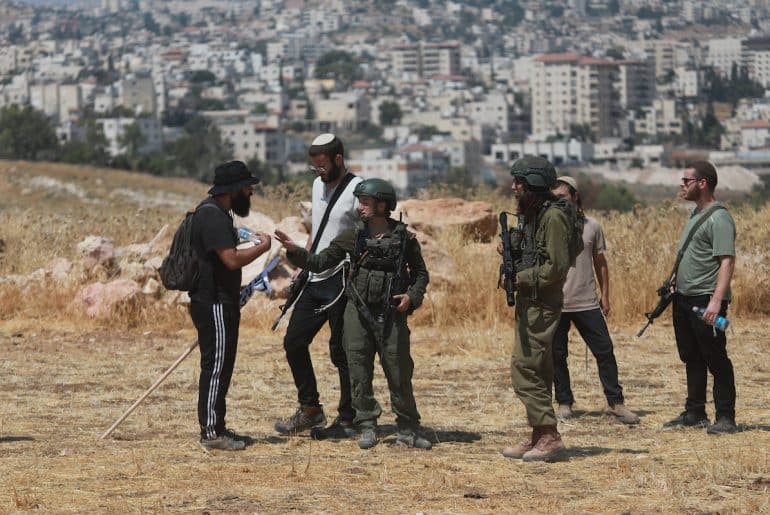
He’s a doctor ad a decent human being – like Hussam Abu Safiya. Such people are high on Israel’s hit list. Because they put Israelis to shame.
“For many, Rantisi’s arrest was proof that the nature of the Israeli crackdown was not against specific groups or individuals, but the very fabric of Palestinian society itself.”
Israel frees Palestinian clown after nearly two-year detention without charge
Israel frees Palestinian clown after nearly two-year detention without charge | Middle East Eye
Well, no. Even the briefest reading of Nazi, whoops! sorry, Jewish-supremacist strategy against the Palestinian people shows it aims to destroy the society by removing its central pillars. Being peaceable and going about one’s business apolitically is no security under Israeli oppression. That was a lethal mistake made by bourgeois Jews in 1930s Germany, and clearly today’s Jewish-supremacists have learned from that era what works.
Israel Investigating After Photo of Stripped and Bound Detainee Is Shared
The Israeli military confirmed the authenticity of the photo, which circulated widely after it was shared by a Palestinian activist. Israeli rights groups said it depicted a war crime.
By David M. Halbfinger
Reporting from Jerusalem
July 9, 2026
“The photo shows a blindfolded man lying prone on a foldout cot, naked except for underpants. His hands have been zip-tied behind his back, with a cord lashed around his body and what appears to be a broomstick, slipped through a length of square metal pipe, tying him down to the cot.
In Hebrew, a caption says, “Good morning.”
When the photo was posted on social media recently, it showed at least one war crime being committed, and perhaps two, human rights groups said.
Who the man is and where he was from remain unclear. The image circulated widely online after it was reposted by a Palestinian activist, who wrote that an Israeli soldier first posted it and had since deleted his account.
The Israeli military said it had confirmed the authenticity of the photo. “Following a thorough review, the incident in question has been identified,” the Israeli military said in a statement.
The statement said that the incident did not align with the military’s “values and regulations,” adding that “an inquiry is underway, and those involved will be dealt with in accordance with the findings.” ”
“The photograph was highlighted on X on June 30 by a Palestinian activist who goes by Tamer. He did not immediately respond to requests for comment.
Israel has detained thousands of Palestinians since the start of the war in Gaza in 2023, often without being charged, and has denied the International Red Cross access to meet with them. Many have described being stripped or otherwise humiliated, beaten, deprived of adequate food and medical care, and prevented for weeks from contacting lawyers or relatives. The New York Times extensively documented abuse of prisoners at Sde Teiman, an army base in southern Israel where most Gazans captured during the war were brought for initial interrogation.”
https://www.nytimes.com/2026/07/09/world/middleeast/photo-detainee-bound.html