


I was born and raised in Jerusalem, and I still live here. Growing up, I do not remember my generation or my father’s sorting friends and neighbors by religion. I never thought of Issam, my friend, as “the Christian,” or Nizar, my next-door neighbor, as “the Muslim.”
At some point, however, a strange new phrase entered our vocabulary: “our Christian brothers, our partners in the homeland.” I never liked it. Why “partners”? They were never anything other than an indigenous part of this country — milh hadha al-ard, or “the salt of the earth,” as we say in Arabic.
I feel the same discomfort with slogans such as “we seek national unity between Palestinian Muslims and Christians.” Such slogans often end up proving the opposite of what they intend — as though we first have to establish that people who have lived together for centuries are, in fact, one people.
This matters because the decline of the Palestinian Christian presence is real, serious, and accelerating — and the response remains largely stuck at the level of warning. Every few months, church leaders, activists, and the Palestinian media return to the same message: Christians are disappearing. But there is no plan to confront that decline.
Today, roughly 47,000 to 50,000 Christians remain in the West Bank and East Jerusalem, according to Palestinian Bureau of Statistics figures from 2017, and probably fewer today. Gaza had close to 1,500 Christians before the war; fewer than 500 are believed to remain, though no precise figure is possible amid displacement, killing, and the destruction of institutions and records.
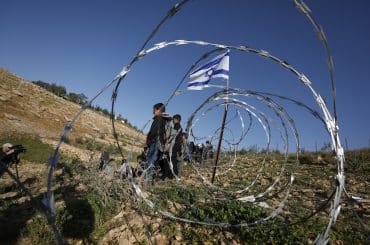
This decline does not happen all at once. It happens quietly: a young Christian Palestinian from Jerusalem leaves to study and does not return; a couple builds a life in Chile rather than Bethlehem; a family in Ramallah moves to Houston, having concluded that building a future at home has simply become too difficult. The reasons are clear to all: occupation, the permit regime, expanding settlements, escalating settler violence, severe restrictions on movement, fragmented territory, economic pressure, and the absence of political prospects. This is the cage — the open prison — in which Palestinians live. But explaining Christian emigration only through that prism is no longer enough.
Before going further, it is important to acknowledge what has already been done. More than 15 years ago, Kairos Palestine offered a different vision, beginning with its 2009 document and developing into a theological and political movement and an international advocacy platform. Its message was clear: Palestinian Christians are not a separate minority waiting to be rescued from outside. They are an indigenous, deeply rooted part of the Palestinian people. Remaining on the land and resisting its dispossession, Kairos Palestine argued, are both political and theological responsibilities. With that voice, Kairos took Palestine into churches and Christian communities abroad, calling for advocacy, political pressure, and boycott, while insisting that emigration should not become an inevitable fate.
The problem, then, is not a lack of vision. There is a language of steadfastness and an international advocacy network. What is missing is the institutional and economic infrastructure that makes staying possible. It is easy to tell a young Palestinian: “Stay on your land.” The harder part is answering the questions that follow: Where will I work? Can I afford a home? How will I educate my children, start a business, and what happens when my home is demolished, or when I cannot reach my university or workplace?
This is where the churches have a particular responsibility. They possess resources most Palestinian civil-society organizations do not: valuable land and properties, schools, hospitals, guesthouses, financial resources, and international networks. Church property cannot be treated simply as an internal administrative matter. The battles over historic properties around Jaffa Gate in Jerusalem demonstrated the consequences of losing strategically important Palestinian Christian land. The lesson should be clear: the wider community cannot be called upon only after a property has been lost. Major sales and long-term leases of Palestinian Christian property should be subject to independent local review involving community representatives and Palestinian experts in law, finance, and real estate. Palestinian Orthodox Arabs have demanded a greater role in church affairs for generations — that the reform is difficult is not a reason to avoid it.
The same principle should apply to church-run schools, hospitals, and vocational institutions. Scholarships could prioritize fields needed by the Palestinian economy, and vocational programs could equip young people to earn a living without leaving. Churches connected to the pilgrimage and religious tourism industry could work deliberately to keep more of that revenue in the local economy — supporting Palestinian tourist guides, guesthouses, restaurants, transport providers, and small businesses.
No one should overstate what churches can accomplish. A scholarship does not create a job, and a training certificate does not remove a checkpoint. Churches cannot end the occupation or create a Palestinian state. But they can decide whether the resources they control remain disconnected services or become part of a coherent strategy for community survival.
The thirteen church denominations in Palestine do not need to merge, and that is clearly not realistic. They need to coordinate and divide responsibilities according to their strengths. The Orthodox Patriarchate, because of its property holdings, has a particular responsibility for defending church-owned land. Catholic institutions can do more in education and vocational training. Anglican and Protestant churches, with their international networks, can take a stronger role in legal advocacy, residency, family reunification, and international pressure.
The diaspora is another largely untapped resource. Palestinian Christians in the Americas, Europe, and the Arab world possess capital, expertise, and business networks. The question is where they are when it comes to providing small-business loans, housing assistance, youth projects, and investment in Palestinian Christian communities — in Bethlehem, Beit Jala, Beit Sahour, Jerusalem, Taybeh, Zababdeh, and elsewhere. Perhaps more urgently: where are they when it comes to the rapidly disappearing Palestinian Christian community in Gaza? What is required is capital, competent management, transparency, and will.
Palestinian civil society, business associations, professional bodies, political leaders, and Muslim institutions should also be part of a national effort to protect the Christian presence. The decline of Christians is part of the wider Palestinian crisis of land, movement, employment, and demographics. There should be practical Muslim-Christian mechanisms to defend families facing displacement, support local businesses, and advocate for threatened communities.
Western solidarity also needs to change. “Save the Christians of the Holy Land” is an emotionally powerful message, but it can obscure the larger reality: Palestinians — Muslim and Christian — are being pushed to leave by occupation and the conditions it creates. The better message is: help Palestinians remain on their land, and help Palestinian Christians build a future there. That means supporting housing, vocational education, small businesses, legal defense, land protection, and community institutions — not simply producing another report documenting how many Christians have left.
It is time for Palestinian churches to measure their role and impact differently: How many families did they help stay? How many homes were restored? How many young people were trained and helped to find work? How much land was protected? These are the real markers.
The demographic decline of Palestinian Christians is real and painful. Occupation is the cause, and while churches cannot end it, that does not absolve them of responsibility for what they can do. They have land, institutions, money, schools, international networks, and a diaspora. Kairos Palestine gave Palestinian Christian steadfastness a language and a political voice. What is needed now is to turn that message into an institutional and economic project that makes staying in the birthplace of Jesus a viable choice.
For years, we have asked: how many Christians are left? How many have left? The right question is different: what have we done to ensure that the Palestinian Christian family can remain rooted in its home, its land, and its homeland?
From Rashid Khalidi’s “The Hundred Years War on Palestine”, page 19, emphasis mine:
“In the first decade of the twentieth century, a large proportion of the Jews living in Palestine were culturally quite similar to and lived reasonably comfortably alongside city-dwelling Muslims and Christians. They were mostly ultra-Orthodox and non-Zionist, mizrahi ( eastern ) or Sephardic ( descendants of Jews expelled from Spain ) , urbanites of Middle Eastern or Mediterranean origin who often spoke Arabic or Turkish, even if only as a second or third language. In spite of marked religious distinctions between them and their neighbors, they were not foreigners, nor were they European and settlers: they were, saw themselves and were seen as Jews who were part of the indigenous Muslim-majority society [ footnote ]. Ashkenazi Jews who settled in Palestine at this time, including such ardent Zionists a David Ben-Gurion and Yitzhak Ben-Zvi,,,initially sought a measure of integration into the local society…”
Then someone came up with the bright idea that the place should be controlled by one particular ethnic-religious tribe.
Ed Vulliamy, who reported on the Srebrenica massacre in 1995, wrote in the Guardian today, following Ratko Mladic’s death:
Mladić was the military wing of an unholy trinity: at its apex, Serbia’s then president, Slobodan Milošević, resurrected the insane idea of a “Greater Serbia”, a form of nationalist fascism whereby wherever the Serbs lived, only Serbs would live – everyone else would leave or die, and every vestige of their culture and religion (Muslim or Catholic) would be erased.
Their scheme sounds very familiar, does it not?
Kairos Palestine, the broadest ecumenical nonviolent Palestinian Christian movement, just issued a new document, Kairos Palestine II: Truth in a Time of Genocide (www.kairospalestine.ps). In the document, Palestinian Christians continue to demonstrate that they are an integral part of the population of Palestine– embracing their Muslim neighbors–and that they play a crucial role in the culture, education, medical care and nonviolent resistance to the State of Israel’s laws, policies and practices of occupation, ethnic cleansing, and genocide. Kairos II is also another urgent call to the global church to help Palestinians gain their freedom. Churches and Christians organizations around the world are responding. An increasing number are naming the apartheid regime and the reality of genocide, calling on their elected representatives to cut off aid to Israel. In the U.S., the church has played a role in exposing Israel’s hasbara and the work of AIPAC and other Zionist organizations, including the naming of Christian Zionism as a racist, colonialist and therefore heretical theology. There is much more that the church can do.
Thirty-four comments here as I write this. Twenty-eight of them responding to brent’s red herring about Palestinian resistance.
Please stop feeding the troll.
Churches posses
to show how far they have strayed from the teachings of the man whose name they take in vain.