

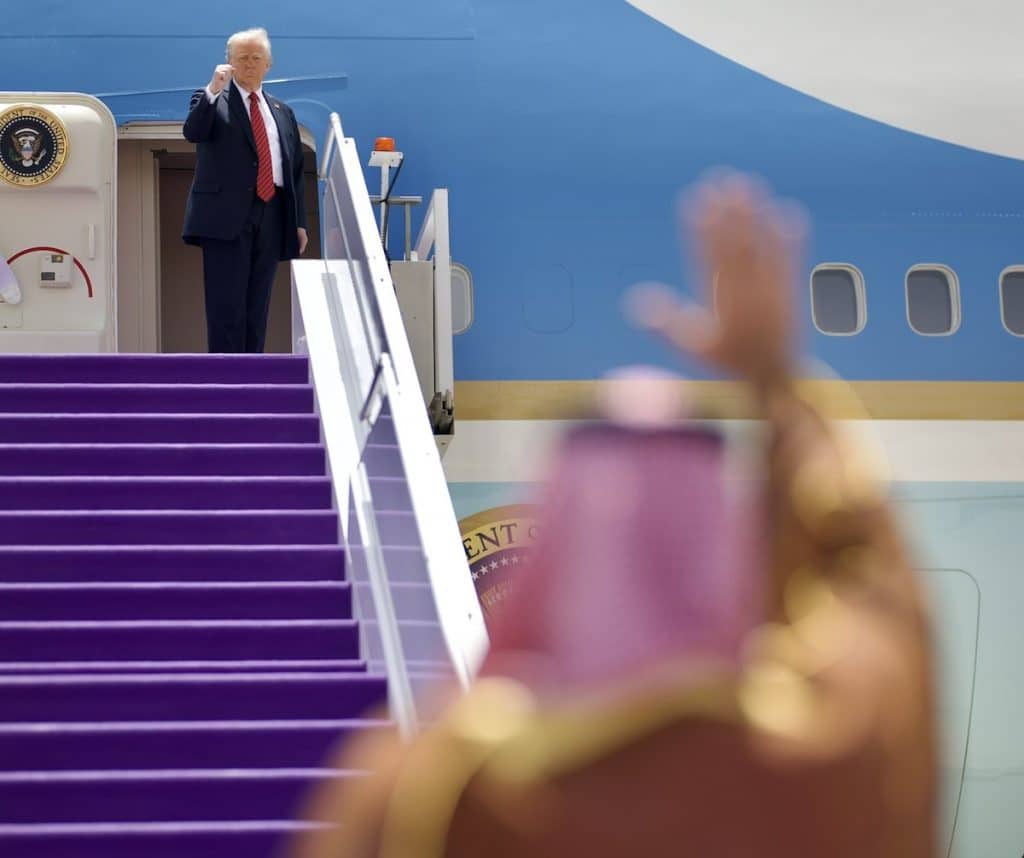
Last week, Saudi Arabia, Türkiye, and Pakistan signed a defense pact that raised eyebrows around the globe. Although the Mecca Joint Defense Agreement had been discussed publicly for some time, its actual conclusion raises questions about its implications for the U.S.-Israeli war on Iran and the longer-term security playing field in the region.
Israel and its supporters reacted with consternation to the deal, while both Iran and the United States downplayed it. What exactly the agreement will mean in practice remains an open question, despite some grandiose statements that it is a NATO-like agreement.
The deal probably won’t change a lot in the short term. There are scant details about what would trigger the mutual defense agreement, and what would be required of partner countries if it were triggered.
But it reflects the increasing sense that the United States cannot be relied on as a guarantor of security and that small and medium-sized powers will have to take security architecture more into their own hands. While U.S. concerns and interests will not be ignored for the foreseeable future, the American role is shifting more towards arms merchant than strategic partner.
The U.S. has only itself to blame for this decline in its reliability. It has not only made remarkably poor decisions of its own, but it has also helped Israel to emerge as an even greater threat to regional security than it historically has been, while neglecting all its other allies in favor of guarding Israel’s aggression and occupations.
No trust in the United States
The second term of Donald Trump’s presidency has predictably been far more disastrous than the first. His foreign policy, in particular, has been marked by foolish decisions, massive corruption, and blunders that will have ramifications for many years after Trump’s departure from office.
Trump has directly endangered his allies in Saudi Arabia, Qatar, the United Arab Emirates, Kuwait, and Bahrain with his reckless attacks on Iran. His actions have raised the specter of real disaster in those countries. Their vulnerability to Iranian retaliation is acute. Iranian attacks, at their worst, could destroy the region’s oil industry and its desalination systems, effectively making those states uninhabitable. The UAE has reacted to this by doubling down on its partnerships with the U.S. and Israel, but the other nations have moved away, slowly, from the American orbit.
Trump’s arming of Israel and encouragement of its most radical nationalists has led to Israel expanding its zone of occupation back into Lebanon and farther than ever into Syria, while permitting escalating atrocities against Palestinians that recall the worst episodes of human history.
Making matters worse, Trump didn’t do these things by himself. He built on both his own first term in office and Joe Biden’s own reckless and immoral policies to magnify mistrust.
As I’ve noted in the past, much of the Saudi loss of faith in the U.S. can be traced back to Trump’s refusal to act after Saudi oil fields were attacked by Ansar Allah. For Riyadh, that was the first major sign that the U.S. could not be counted on to keep its side of the long-held “oil-for-security” pact on which American-Saudi strategic relations were built.
Biden’s support of Israel’s ongoing genocide in Gaza, its attacks on Lebanon, and its invasion of Syria reinforced concerns over his lack of action to restore the Iran nuclear deal, which, at that time, could have built upon Iraqi and Chinese efforts that successfully lowered the tensions between Riyadh and Tehran. That was evidence that the United States, not just Donald Trump, was willing to sacrifice Gulf stability to support Israeli aggression.
The attack on Iran further undermined Arab confidence in the U.S. American allies had pressed for a diplomatic resolution to the tensions with Iran, despite some reports to the contrary. Riyadh and other Arab capitals were concerned that the attack on Iran was conceived and executed without taking their security needs into account or any consultations with them.
This loss of confidence in Washington is serious. It is not solely about Trump or Biden, but grows out of the capricious nature of American domestic politics and a proven inability for one president to promise the next will keep to their agreements. That loss of confidence will not be easily reversed by future administrations.
Iran and Israel
Türkiye, Pakistan, and Saudi Arabia all insist that this new pact is not meant to be directed at any other state in particular. While that is no doubt technically true, the deal is meant to deter attacks from potential enemy states, and the two states that are most likely to be of concern are Iran and Israel.
Publicly, Iran has not seemed worried. Foreign Ministry spokesman Esmaeil Baghaei said, “Any plan that is based on the geopolitical and historical realities of the region, is comprehensive and inclusive, and correctly identifies the enemy and the threat, has a chance of helping to strengthen security and prevent instability and abuses by the Zionist enemy and its allies.”
Iran has certainly considered what the pact might mean to its strategy of retaliation against its Gulf neighbors in the event of an attack by the United States. Yet the calm that Baghaei expressed is likely genuine.
That’s because Iran can game out the implications. First, just because there is a NATO-style guarantee in the agreement doesn’t necessarily mean there will be an immediate, collective response to any Iranian attack. Ansar Allah attacked Saudi oil fields after the pact was signed, but Islamabad and Ankara did not respond.
More importantly, the pact raises the stakes of an American attack on Iran. Should Washington attack Iranian infrastructure in an escalation of the existing conflict, it must take into account the concern that Türkiye and Pakistan might respond to Iranian retaliation, even if by non-military means. That would risk a wide expansion of the war, and it is not at all clear who would shoulder the blame, especially if China felt that such expansion warranted its involvement.
But the main focus of the agreement is less on concerns about Iran than on establishing a regional security regime. The trio of countries was very explicit about leaving the door open for other countries to join the defense pact; they hope to change the very nature of security strategy across the entire region.
It is Israel, not Iran, that requires the region to rethink its entire security structure.
Türkiye had been reluctant to enter into a formal defense pact with the Saudis and Pakistanis, fearing international complications as its own regional ambitions grew. But American fickleness and rapidly increasing Israeli belligerence toward Ankara changed their mind.
Correctly identifying the source of regional stability as coming from Israel, not Iran, the three states came together to create a defense strategy focused on Israel, the one country the U.S. can’t even consider defending them against.
For Saudi Arabia, this is a very clear message that Israel can forget about any notion of normalizing relations with Riyadh without ending the denial of Palestinian rights. Both Türkiye—due to its regional ambitions—and Pakistan—due to its rivalry with India, which is drawing ever closer to Israel—have a stake in backing Saudi Arabia in this regard.
The deal brings together three powers with unique capabilities: Türkiye’s military capabilities and vast arms production, Pakistan’s nuclear umbrella, and Saudi Arabia’s considerable resources. That makes the alliance a significant regional power, one that is capable of confronting even Israel militarily.
The obvious goal is to deter Israel from its growing belligerence toward Türkiye, which Israeli officials have ominously labeled “the next Iran.” But more than that, the alliance, especially if it grows, creates a defense structure that is not just independent of the U.S. but independent of any concern about Israel’s interests, domestic or international.
That’s no small consideration. It was enough to scare Egypt away from joining the pact, even though it has been the fourth guest at many gatherings of the other three for strategy meetings and summits over the past year.
Egypt has developed a deep dependence on the U.S. and Israel. It receives the second most annual military aid from Washington, behind Israel, and depends on Israel for a good deal of its energy supply in the form of natural gas.
Because Egypt’s economy is in perpetual crisis, it would take considerable resources and time for it to be in a position where it could abandon Israel and anger Washington in this manner. The day that it does so may come, but not for some time.
Egypt’s potential inclusion was controversial. Türkiye very much wanted Egypt in, due to its alignment with Cairo in several North African arenas. Saudi Arabia was opposed, due to growing tensions between Riyadh and Cairo, especially over Egypt’s relationship with the UAE, which is fast becoming a bitter regional rival to Riyadh.
In the end, Egypt rendered the point moot by choosing to avoid choosing between Washington, Tel Aviv, and Abu Dhabi on the one hand, and Ankara and Riyadh on the other.
The Mecca Agreement also strives to make it harder for Israel to continue its dominance over the Palestinians and its invasions of its neighbors in Lebanon and Syria.
An American-based security regime allowed Israel total impunity. That was tolerable for some in the region when it was believed that the U.S. offered at least some mild restraint on Israeli excesses and protected its Muslim and Arab allies from attack. Those beliefs no longer hold.
The United States cannot even get Israel to go along with a plan for disarming Palestinian armed groups that would leave Gaza under effective American control and pacified, a deal that was clearly favorable to Israel. It has proven unable to move Israel out of its deadly occupation of southern Lebanon, and has not even tried to get Israel out of Syria, despite the fact that Washington has been supporting Syrian President Ahmed al-Sharaa’s efforts to reunite the country.
For the past 50 years, the American-based security regime in the region has encouraged partnership with Israel, as pioneered by Egypt and Jordan in the 1980s, as the road to regional stability. That was followed by the disastrous Oslo Accords, increasing clandestine trade and cooperation between Israel and other Arab countries, and, finally, the Abraham Accords.
All of these efforts at creating “partners for peace” only reinforced Israel’s belief that it could achieve peace and regional integration without ever compromising on Palestinian rights.
With Israeli Prime Minister Benjamin Netanyahu’s decision to refuse to cooperate with Trump’s “Board of Peace” and the agreement to disarm Palestinians and have Israel withdraw from Gaza ahead of its reconstruction, the U.S.-Israel relationship is at a low ebb, despite the fact that many American leaders continue to insist on backing Israel regardless of how often it spits in Washington’s face.
The Mecca Pact can serve as a vehicle to increase pressure on Israel even as its popularity in the United States continues to wane, particularly if more countries join it.
The Iran war, the invasion of Lebanon, the closure of the Strait of Hormuz, the ongoing occupation of Syria, and the threat to the holy sites in Jerusalem can all be traced back to Israel’s dominance of the Palestinians. While not every problem, by any means, in the Middle East is due to Israel’s apartheid and aggression, many of them are, while others cannot be resolved because of it.
The Mecca pact is a first step toward a regional force that can stand against that, not out of concern for the Palestinian people (which, sadly, few states, if any, seem to have), but for their own interest in regional stability. If the pact expands, the pressure will increase, the potential for action will, at long last, widen. And if that coincides with the long-dreamed of shift in American policy, there is a real possibility for significant change, a force which even the obstinate nationalism of Israel could not resist.
Mitchell Plitnick
Mitchell Plitnick is the president of ReThinking Foreign Policy. He is the co-author of Except for Palestine: The Limits of Progressive Politics and maintains the Cutting Through newsletter.

Israel forces and contractors “taking the rubble away from Gaza so that evidence will never be properly collected. This is so criminal”
“Right now there are 400 pieces of heavy machinery operated by Israeli companies across Gaza. Over the past few weeks the UN monitor has tracked 100 Israeli trucks leaving Gaza every day.”
The rubble from buildings MORE than likely holds the remains of at least 8500 Palestinians or more. Israeli companies and contractors mixing rubble with human remains, moving it from Gaza.
Israel removing genocide evidence.
Israel’s war crimes continue to grow and grow
https://www.facebook.com/ajplusenglish/videos/israel-removes-genocide-evidence/1770317980830597/
Tonight at 7 pm est. “Israel Lobby”
https://www.dropsitenews.com/p/tonight-at-7pm-et-inside-israels
But Israel has got nothing to worry about – it can get all the support it needs from white supremacists, neo-nazis and fascists from all over the world!
Israel’s Leaders Find Allies Among the Global Far Right – Israel has been fighting a losing public-diplomacy battle on many other fronts, including in the United States. Much of the good will and sympathy that was extended to Israel after the horrific attacks of October 7th has dissipated, and antipathy toward Prime Minister Benjamin Netanyahu’s right-wing government and the ruinous legacy of its war against Hamas in Gaza, as well as the ongoing dispossession and harassment of Palestinians in the West Bank by Israeli settlers, is reshaping Democratic Party politics and has influenced the outcomes of some primary elections….Netanyahu and his allies dismiss criticism as the product of entrenched antisemitism and cast institutions like the United Nations as irredeemably biased….Israel has traditionally avoided official dialogue with far-right parties in Europe, where many factions have direct antecedents in post-Second World War neofascist movements. But last year Sa’ar instructed Israeli diplomats to set up channels to France’s National Rally, Spain’s ultranationalist Vox party, and the far-right Sweden Democrats—all of which espouse virulently Islamophobic platforms…. Last month, members of Netanyahu’s Likud Party, including Sa’ar and the defense minister, Israel Katz, hosted a visit by the Dutch far-right leader Geert Wilders. He posted an image of himself eating falafel in Jerusalem and toured an illegal West Bank settlement alongside a well-known settler leader against whom the Dutch parliament had passed a resolution urging European Union sanctions. Sa’ar called Wilders “a courageous leader and a true friend of Israel.”
Israel’s Leaders Find Allies Among the Global Far Right | The New Yorker
Judge dismisses Trump lawsuit that claimed Harvard failed to protect Jewish students
Federal court rules administration failed to plausibly show ongoing violation of civil rights law. — The Guardian
It will be interesting to see what Jordan does. Remember that the Jordanian King’s son has married a Saudi Princess. That is a blood bond that might make Jordan the next member of this MECCA Pact. Good knows that Israel gives Jordan little or no say in the West Bank bloodshed and the zionist aggression in Jerusalem’s holy sites.
Maybe I’m being naive?