

Two months before Israel’s election, Prime Minister Benjamin Netanyahu’s best hope continues to lie in the fact that, while his presumed coalition is very far from being able to cobble together a majority government, the opposition is not there yet either. He’s playing for a stalemate. In the hope that an opportunity to strengthen his side of the equation will appear, as it has in the past.
Netanyahu’s primary campaign appeal is his experience and his image as the strongman who can bring security to Israel. But that case has been weakened dramatically, and not only by the devastating attack of October 7, 2023.
Israel’s enormous military, like that of the United States, has proven quite expert at killing and destruction but it has not been effective in achieving strategic aims or in making the Israeli population feel more secure.
Netanyahu has borne the brunt of that failure, although it is a flaw that lies in broader Israeli thinking, and enjoys strong representation in the minds of Netanyahu’s opposition figures, Gadi Eisenkot, Naftali Bennett, Yair Lapid, and others.
Netanyahu makes his case with fearmongering and that does contrast to some extent with his opponents, who often talk of how they will improve Israel’s image in the world, increase alliances, open up more business opportunities and such. It’s fantastical, given that none of them offer any substantive change in policy toward the Palestinians, but no more so than Netanyahu’s brand of fearmongering.
One recent example that has drawn a lot of attention is the Likud’s campaign to frighten Israelis over the “dire consequences” that would ensue if the opposition wins.
“The Enemies” Billboard Campaign
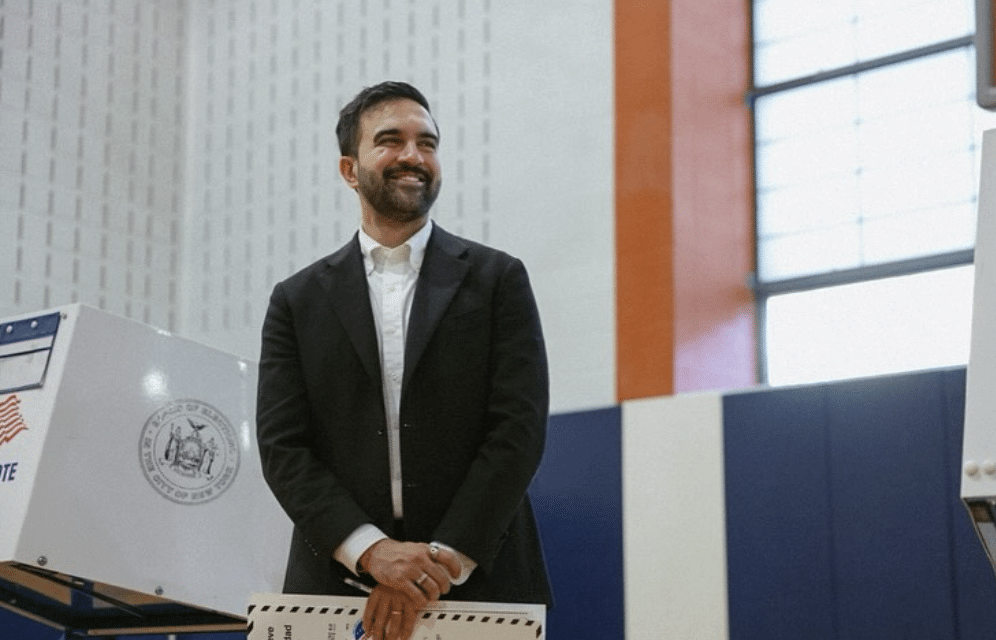
Likud has put billboards around Israel saying “They want Netanyahu to lose. Don’t help them succeed.” The words frame headshots of Iranian Supreme Leader Mojtaba Khamenei, Turkish President Recip Tayyip Erdogan, Hezbollah Leader Naim Qassem…and New York City Mayor Zohran Mamdani.
The four men are Israel’s greatest enemies in Netanyahu’s telling. It isn’t at all surprising that Erdogan would be on there next to two people with whom Israel is right now at war. It’s a little more surprising that Mamdani was included.
Netanyahu is sending several messages by including Mamdani in that image. Obviously, he is meant to stand for the “anti-Israel” or even “antisemitic” bent of the Democratic party and progressives in general in the United States.
But more than that, it is Mamdani’s image that is meant to communicate that Israel is “on its own.” It says that “the Muslims” are everywhere, working against all the world’s Jews. Netanyahu is telling his voters that Israel must always act for itself, without regard for others and their opinions, because eventually they will all turn on the “Jewish state.”
It’s a bogus and racist argument, of course, one meant to elide the fact that Israel is, and always will be, dependent on the hated European Union for trade and the “unreliable” United States for its military and political hegemony and impunity. But that’s not how Netanyahu wants to portray the world.
His problem, however, is that he is undermining a key aspect of his own appeal: his ability to deliver America.
By including Mamdani on the billboard, Netanyahu is admitting he is losing the United States, a fact which people may not need to be told, but one which it is hardly in Netanyahu’s interest to remind them about.
Likud has now grouped the rising wave of progressive Democrats in with the demonized faces of Iran, Hezbollah, and the next “great enemy,” Türkiye. That’s an admission that, for the first time in decades, there is a real force in the United States that stands in the way of Israeli ambitions.
Elections won’t change Israel’s image
Israelis are thus faced with a choice. One option is to continue trying to fortify themselves into a modern-day Sparta, as Netanyahu once suggested, while counting on far-right forces in the U.S. to pursue increasingly unpopular legislative strategies to codify American financial and military support for Israel.
The other is to try to rehabilitate Israel’s image, distance itself from figures like Netanyahu, Itamar Ben Gvir, Bezalel Smotrich, and activists like settler leader Daniella Weiss, and try to recapture the centrist and liberal support that was once Israel’s lifeblood.
Neither strategy is likely to be effective.
While it is entirely possible that Israel’s American supporters will be able to ram through provisions to further entangle the American and Israeli military machines and give Israel unprecedented partnership in American intelligence, both of those efforts have met significant resistance in Congress. They are not certain to pass, as they would have been in past years, and, even if they do, they are likely to be targeted by future Congresses, elected on popular opposition to such dangerous provisions, opposition which is growing among voters on both the left and the right in the U.S.
It will be a laborious and difficult political process to undo the tangled web of interdependency of the American and Israeli military-industrial complexes, but the political will to do so is building quickly, and Israel has kindly provided Americans with the incentive to do so with the disastrous war of choice on Iran.
But can that political momentum be blunted by swapping out Netanyahu for a new prime minister who would work to rebuild the illusion of Israel as a democracy which respects things like human rights and international law? After all, until only a few years ago, only those of us in the U.S. who chose to look directly at Israel and really investigate knew what a sham that image was.
It won’t be possible. Merely shifting away from Netanyahu won’t make the difference Israel would need.
Israel doesn’t have an image problem, it has an apartheid problem
Gadi Eisenkot or Naftali Bennett would hold an appeal for a very narrow sector of Americans. They would not attack Israel’s judiciary and other structures that mimic democracy. They’d do more to rein in the worst excesses of the settlers such as those currently occurring in Qusra. There is also no reason, at this point, to suspect that either of them would display the financial corruption or megalomania of Netanyahu and his family.
But these are mostly matters that concern Israelis, not Americans. Even for many pro-Israel Americans, they are internal Israeli concerns. It is how Israel deals with the Palestinians, with Lebanon, with Iran, and with its foreign policy in general that concerns Americans.
How will Eisenkot deal with Gaza, for example?
Eisenkot has attacked Netanyahu for lacking a political vision for continued control of Gaza. That was why the party he was in at the time, National Unity, quit Netanyahu’s government during the genocide. There was no issue with the mass killing, the brutal tactics or the war crimes. The problem was the lack of an endgame, a reasonable concern for a military thinker, but not one that shows any regard for the suffering the war caused Palestinians.
Eisenkot is the creator of the so-called “Dahiya Doctrine,” which advocates the mass destruction of civilians and civilian infrastructure to pressure governments or other authorities to abandon support for any group that might attack or resist Israel with force.
He is a devoted opponent of a Palestinian state or Palestinian equality. He also supports the expansion of settlements.
Eisenkot would likely try to open more talks with Arab states to normalize relations, but he will find no more success than Netanyahu if he continues to deny Palestinians their rights. He is less likely to confront the U.S. over Syria, as we saw Netanyahu do this week when he bombed a Syrian air base.
But will Eisenkot continue Netanyahu’s all-out assault on Palestinian institutions, the PLO, the PA, regardless of how much those groups kowtow to Israel’s every whim? His history, as well as the political positions of his coalition—including figures like Bennett, Yair Lapid, Avigdor Lieberman, and possibly Benny Gantz—suggests he will.
Would Eisenkot try to put a better face on Israel’s actions in Gaza and the West Bank? Yes, but in this age of social media, that will be exceedingly difficult. And that is the key point that dooms any upcoming attempt to put lipstick on the face of the pig that is Israel’s occupation and dispossession of the Palestinian people.
It was not only the scale of Israeli atrocities in Gaza that finally ended its ability to maintain the so-called “Palestine exception” among the general public. It was the fact that Palestinians had finally developed enough of an audience on social media that they could show the world what was happening to them despite international media that remains complicit with Israeli crimes.
The veneer around the extent of Israel’s brutality against the Palestinian people had, for years, managed to cast enough uncertainty around the day-to-day horrors Palestinians faced that people were often reluctant to speak out for fear of having been shown to have been duped by the mythical “Palestinian propaganda.” The silence that actual Israeli propaganda promoted was much safer.
But now, Palestinians have sundered that veil of obfuscation. Now, people all over the world who have not invested their time in studying the issue can see unequivocally what Palestinians are going through because it is right there on video, coming through their phones.
They can see that Israel continues to kill Palestinian children even during a so-called “ceasefire.” They can see that the mightiest army in the Middle East, a security force that claims to be able to discern which Palestinian threw a stone out of a crowd at occupying soldiers and arrest that person (whether they threw that stone or not) cannot muster a force to end a siege by its own citizens against Palestinians that even extremist pro-Israel Americans like Mike Huckabee have condemned.
Eisenkot, Bennett, or any other post-Netanyahu Israeli prime minister has no intention of changing those policies. And even if they should make an effort to curb the worst excesses in an effort to save Israel’s image, the day-to-day reality of checkpoints, Israel’s occupation of Gaza and Lebanon, and the routine abuses of Palestinians by soldiers and settlers will not end or even significantly change. And people will continue to see them.
So, when Likud voters look at that billboard, they really see threats to their current status. Those threats do not come from Iran or Hezbollah. They certainly don’t come from Türkiye, a country that has never even hinted at physical aggression against Israel.
No, they’re right to say they come from Zohran Mamdani. He stands for justice and equality. He stands for arresting war criminals like Netanyahu. He stands, in short, for everything Likud is against. And as Democrats continue to overwhelmingly insist on ending American support for Israeli crimes, and more and more Republicans demand we stop sending taxpayer dollars to Israel, Mamdani will increasingly become the symbol of a changing American policy toward Israel.

Re: “American financial and military support for Israel” and “It will be a laborious and difficult political process to undo the tangled web of interdependency of the American and Israeli military-industrial complexes,”
Nope, it shouldn’t be hard at all. Trump has added 1 trillion dollars to the national debt every six months, which just went over $40 trillion. That military-industrial complex house of cards will fall over all by itself, and neither Israel nor the USA can stop it from happening at that pace.
Until only a few years ago, only those of us in the U.S. who chose to look directly at Israel and really investigate knew what a sham that image was.
Yes. People used to ask us, at vigils and demonstrations in Toronto, what this was all about. Now everybody knows. And most people support us.
As for the Zionists, they are trying to defend the indefensible, and they know it. They have no argument, so they use abusive language and sometimes violence.
“It was not only the scale of Israeli atrocities in Gaza that finally ended its ability to maintain the so-called “Palestine exception” among the general public.”
Re Gaza: the Israeli atrocities in Gaza are not a recent invention. From Rashid Khalidi’s “The Hundred Years’ War On Palestine”, page 94:
As the occupying Israeli troops swept through the Gaza towns and refugee camps of Khan Younis and Rafah in November 1956, more than 450 people, male civilians, were killed, most of them summarily executed [ footnotes provided ]. According to a Special Report by the director general of UNWRA, in the first massacre, which took place in Khan Younis and the neighboring refugee camps on November 3, 275 men were shot. One week later on November 12, 111 were killed….I was present once when Muhammad El-Fara, who represented Jordan at the UN., recalled how several of his cousins who lived in Khan Younis had been rounded up and executed [ footnotes ]. Israel’s claim, that the Palestinian deaths were the result of clashes with troops…was decisively debunked by the UNWRA report. The civilians were killed after all resistance had ceased in the Gaza Strip…News of the massacres was suppressed in Israel…
How to put the whole world on Netanyahu’s “most hated” billboard. Israel “most hated” nation in the world. Israel has done this to themselves.
The 20 Most Negatively Viewed Countries
A new global survey by Nira Data, involving 46,667 respondents across the world, reveals which countries currently face the most negative international perceptions. Israel ranked first in negative perception among 129 countries evaluated, followed by North Korea, Afghanistan, and Iran. The rankings reflect global public opinion at the time of the survey and do not necessarily represent the views of governments or the citizens of these countries.
https://www.facebook.com/SEAheritagehistory/posts/the-20-most-negatively-viewed-countriesa-new-global-survey-by-nira-data-involvin/1061774743186483/
It is right to state that Mayor Zohran Mamdani is the face of an ever-growing political movement in America that will attempt to end all military aid to Israel.
It is also important to remember that Turkey is a member of NATO, and any Israeli attack against Turkey would be an action that all NATO countries would be required to confront with military force. Does Bibi Netanyahu think that would be a winning strategy for Israel?
In any case, the chickens are coming home to roost for apartheid Israel.