

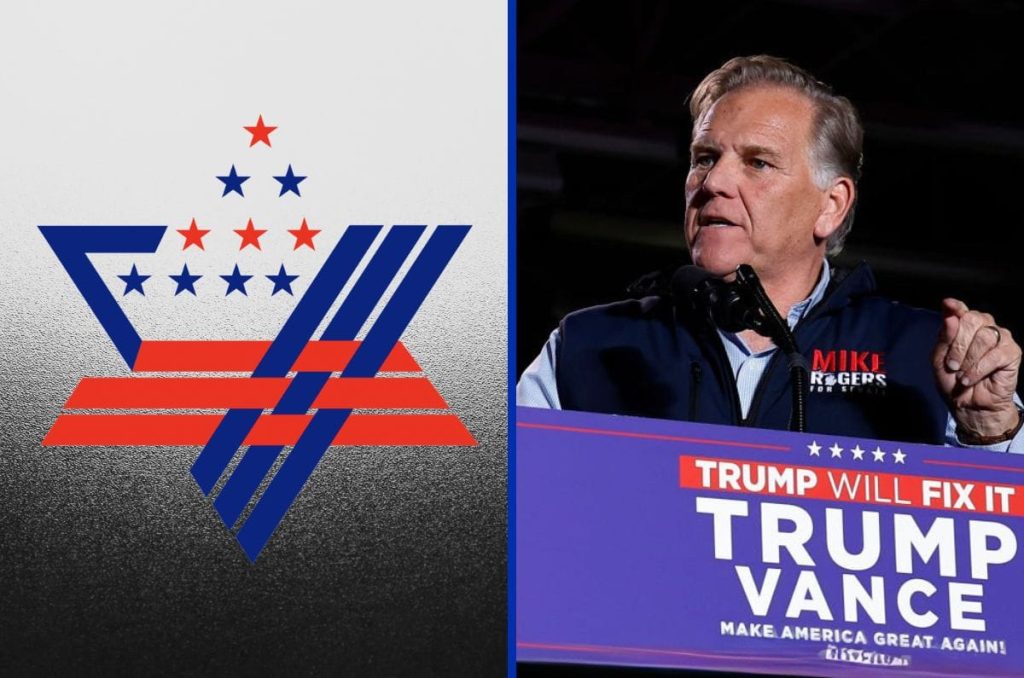
Support from the Israel Lobby has emerged as a major electoral problem for Democratic candidates, but does it concern Republicans seeking office?
In Michigan, the answer is a resounding, “Yes.”
AIPAC was primed to spend millions in support of GOP Senate nominee Mike Rogers, who is running against Abdul El-Sayed, a former public health official who wants the United States to stop sending Israel weapons and openly refers to its actions in Gaza as a genocide.
There’s just one problem: Rogers reportedly doesn’t want to be associated with the organization.
According to Axios‘s Alex Isenstadt, Rogers’s team asked AIPAC to refrain from running ads for him, which led the group to shelve a commercial it had developed. Rogers wants them to get involved in the race, but doesn’t want their name all over his campaign.
AIPAC is obviously well-versed in the art of dark money, but they’re evidently bristling at the idea of being put on the sidelines. They want their name associated with Rogers so that they can take credit if El-Sayed is defeated.
“The extraordinary tension underscores how far AIPAC’s political standing has fallen amid voters’ anger over the war in Gaza,” writes Isenstadt. “Even Rogers — a staunchly pro-Israel Republican — fears the group’s public support could be a liability in the Nov. 3 election.”
And why wouldn’t he?
So far, Rogers’ entire campaign has been about portraying El-Sayed as a frightening, un-American Muslim, pushing Sharia Law whilst fraternizing with Hasan Piker and other enemies of the state.
Back in reality, El-Sayed is essentially a reform-minded liberal who openly declares he’s a capitalist and is pushing a healthcare plan that sure as hell sounds a lot like Elizabeth Warren’s 2020 vision, but none of this actually matters.
In order for Rogers allegations to stick, he needs to lean into his role as an “America First” conservative, which might be difficult to pull off if you openly accept millions of dollars from a lobbying group that should be registered as a foreign agent.
A New York Times article on the apparent stalemate points out that Rogers has attended several AIPAC fundraisers this summer and that his staff has repeatedly said they welcome the group’s support.
However, they also note that some AIPAC officials had “hurt feelings” after a recent sit-down with Rogers and lack a clear path for involvement going forward.
“Even before the sit-down with Mr. Rogers, some people close to AIPAC harbored reservations about getting involved in the general election, believing that Dr. El-Sayed was in a weak position and that he only stood to benefit from AIPAC’s involvement in the race, which would give him a fresh rallying cry,” explains the article.
El-Sayed will certainly lean into Rogers’ connections to the Israel Lobby, whether AIPAC opens the floodgates or not. Beyond the moral component, it’s simply the savvy move. Israel’s role in U.S. politics has been met with more and more skepticism amid a war that is now supported by a mere 31% of the population, which has cost every household at least $1,200, and shows no signs of stopping soon.
To paraphrase a certain lobbying group, it’s good politics and good policy.
Pro-Israel Democrats joining foreign affairs panel
Democratic leadership is responding to the pro-Palestine sentiment of their base with open hostility.
That’s certainly one way to read Minority Leader Hakeem Jeffries’ (D-NY) recent announcement declaring that pro-Israel Reps. Debbie Wasserman Schultz (D-FL) and Wesley Bell (D-MS) will join the House’s foreign affairs committee, while the pro-Israel Jared Moskowitz (D-FL) will become the ranking member on the subcommittee for the Middle East and North Africa. He’ll chair it if the Dems take back the House.
In a social media post, Moskowitz was upfront about the role he will play on the committee.
“At a moment of enormous change across the region, I’ll work to strengthen America’s relationships with Israel and our Gulf allies, expand regional peace, advance American diplomacy, and ensure our foreign policy is grounded in strength, security, and reality,” he wrote. “I’m ready to get to work.”
He was honed in on the most important part in a comment to Axios: “If Democrats take control of the House, I’ll be in a position to help steer U.S. policy on Israel and the Middle East.”
The Democrats are allowing Mark Pocan (D-WI), a consistent critic of Israel, on the panel, but what does it say that someone like Moskowitz will be in a position to potentially sandbag any piece of legislation that highlights Palestinian rights?
The group Just Foreign Policy condemned the move as “deeply divisive and immoral.”
“Oh come on,” tweeted the Center for International Policy’s Matt Duss. “At what point can Democratic voters finally have foreign policy committee leadership that actually represents the party’s anti-war majority instead of its small and thankfully dwindling hawkish minority?”
“Jeffries naming Moskowitz — one of the most pro-Israel Democrats — as ranking member of HFAC’s Middle East subcommittee tells you *everything* you need to know about Dem party leaders’ preferred plan for dealing with their base’s fury at Israel (ignore it, maybe it’ll go away),” tweeted the Quincy Institute’s Alex Jordan.
Odds & Ends
Mondoweiss: How Sliman Mansour and his colleagues built an art movement for Palestine
Responsible Statecraft: How Citizens United supercharged ‘Israel’s lobby’
Counterpunch: Why Iran Ruffles the Feathers of the United States
Electronic Intifada: Top Democrat denounces Trump’s fake anti-Semitism probes but erases Palestine
New York Times: Trump’s Top Gaza Official Says Israel Is Jeopardizing the Cease-Fire
The American Prospect: Donald Trump Invented a New Forever War
Common Dreams: Markey Urges Congress to Block Trump-Saudi Deal, a ‘Starting Gun for a Middle East Nuclear Arms Race’
AP: Republicans face a midterm verdict as Iran war drags on months longer than Trump promised
The Intercept: Sixty More U.S. Soldiers Reported Injured in Iran War
The Nation: How Jared Kushner Snookered Hakeem Jeffries
CBS News: Trump’s oil and gas stock trades continued during Iran war, filings show
Detroit Free Press: Mike Rogers, Abdul El-Sayed agree to 1st debate for U.S. Senate seat

Never mind a “foreign policy committee leadership that actually represents the party’s anti-war majority”, how about one that represents the USA?
Democrats to Force Senate Vote on Israel’s Human Rights Practices
Senator Chris Van Hollen of Maryland is leading a group of Democrats seeking answers about violence against Palestinians in the Israeli-occupied West Bank….Senator Chris Van Hollen, Democrat of Maryland, on Thursday plans to introduce a resolution that would order the Trump administration to provide Congress with a detailed accounting of Israel’s human rights practices in the West Bank, laying the groundwork to force a vote on the matter in coming weeks…The measure, the latest bid by Democrats in Congress to challenge the policies and actions of Israel’s government, invokes a provision of the Foreign Assistance Act that allows lawmakers to request information from the State Department about the human rights record of any country receiving U.S. security assistance….
Democrats to Force Senate Vote on Israel’s Human Rights Practices – The New York Times
“…Dennis Kucinich could tell voters from experience that if Michiganders elect Mike Rogers, he will remain silent as our soldiers die, as family finances deteriorate, and as we become more hated around the world…”
+ CommonDreams, David Kelley: The Most Dangerous Person to the Michigan Senate Race Lives in Ohio
https://www.commondreams.org/opinion/kucinich-dangerous-michigan-rogers
“Kucinich is dangerous because no one interested in the welfare of American families, its soldiers, our national security, and personal liberties could vote for Rogers if they knew the evidence Kucinich produced before the War.”
+ Truthout: El-Sayed’s GOP Opponent Attended 3 AIPAC-Hosted Fundraisers in 1 DayThe Michigan GOP candidate has reportedly asked AIPAC not to openly back his campaign, wary of its image. August 24, 2026
https://truthout.org/articles/el-sayeds-gop-opponent-attended-3-aipac-hosted-fundraisers-in-1-day/
Rogers’s team, instead, is seeking to court AIPAC’s support — and the $59 million in its account as of the beginning of August — *in other ways.*
Rogers allies and AIPAC “have also been considering alternate ways to support his campaign, including AIPAC members contributing to an existing pro-Rogers super PAC or funding a group of a different name so as to not disclose AIPAC as the original donor, the people briefed on the situation said,” according to The New York Times.
The paper noted that AIPAC leaders are concerned that such a tactic could appear as if they’re trying to *hide* [something like a Genocide?]
“So far, Rogers’ entire campaign has been about portraying El-Sayed as a frightening, un-American Muslim, pushing Sharia Law whilst fraternizing with Hasan Piker and other enemies of the state.”
Just do not think Michigan voters are going to fall for it.
““Jeffries naming Moskowitz — one of the most pro-Israel Democrats — as ranking member of HFAC’s Middle East subcommittee tells you *everything* you need to know about Dem party leaders’ preferred plan for dealing with their base’s fury at Israel (ignore it, maybe it’ll go away),” tweeted the Quincy Institute’s Alex Jordan.”
Hakeen Jeffries so out of touch. He has always been an elitist Dem. Moskowitz, Wasserman Shultz would be dumped if they were in any other area besides southern Florida…well maybe not New York.
If Hakeem stays on this out of touch path Dems could lose again.
Max Blumenthal was talking about all of these very deliberate, manipulative moves to block the pro justice in Palestine crowd today at “Judging Freedom”
https://www.youtube.com/watch?v=KIr4Dq-DZag
“Rogers allies and AIPAC “have also been considering alternate ways to support his campaign, including AIPAC members contributing to an existing pro-Rogers super PAC or funding a group of a different name so as to not disclose AIPAC as the original donor, the people briefed on the situation said,” according to The New York Times.”
If I were part of the El Sayed ground campaign (hope to volunteer for two weeks in Michigan) I would be pushing for the “duck test” to be solidly applied. This to be part of an add. “It if walks like AIPAC and quacks(sounds) like AIPAC, it is AIPAC!”
Have Bernie, AOC (or Senator Warren) Mandani do the add for El Sayed. Sanders “If the support for Rogers walks like AIPAC, Senator Warren “if the support Rogers is receiving… quacks (sounds like AIPAC Many of El Sayed’s supporters in a group stating clearly “the support for Rogers is AIPAC!
All (United Auto Workers, Warren, Buttigieg, AOC, Sanders, McMurrow, Kucinich) stating. Most of Rogers economic support “is from AIPAC”
“It Rogers support walks like AIPAC and quacks(sounds) like AIPAC, it is AIPAC!”