

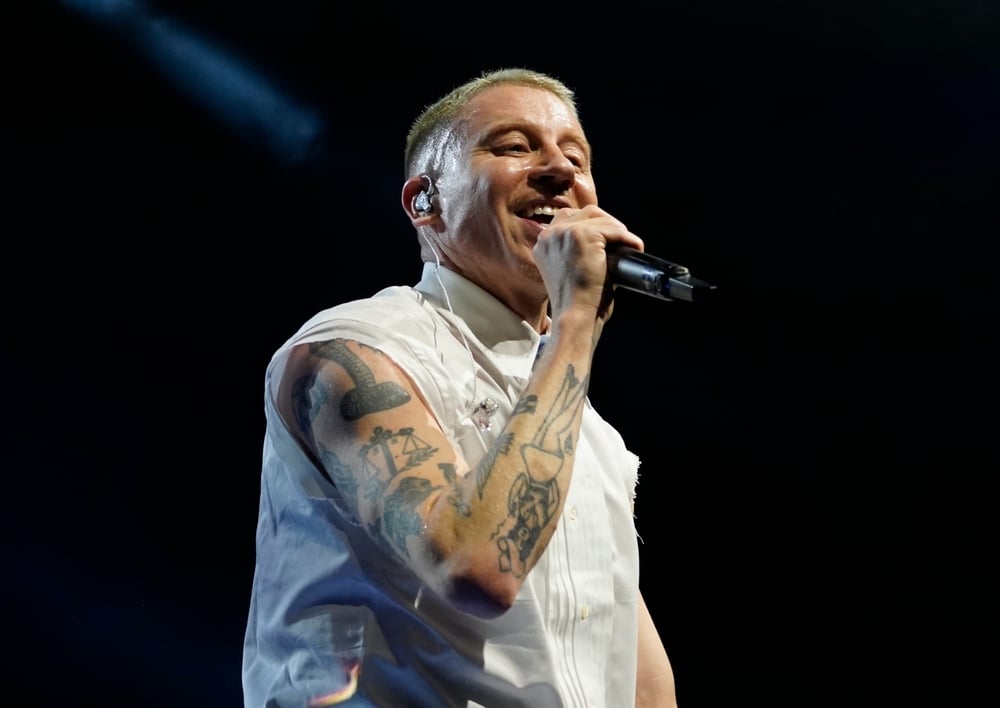
Ten days after Macklemore stood on the MetLife stage and said “Free Palestine,” which drew vocal backlash from Zionists and artists like P!nk, he was removed from Ed Sheeran’s Loop Tour. According to Macklemore, Sheeran was called by Robert Kraft, a Zionist billionaire and owner of Gillette Stadium, where they were scheduled to play later this month. Kraft had rallied together a group of venue owners and issued an ultimatum: if Sheeran did not drop Macklemore from the supporting slot, the venues would refuse to let them play, and there would be no tour.
Macklemore then recounts that Sheeran told him the words “Free Palestine” and the sight of the Palestinian flag were “hurtful to a lot of people he spoke with,” and concludes that Sheeran couldn’t get past his “public facing, ‘I don’t take sides.'”
It is this second part of Macklemore’s account that makes clear Sheeran’s decision to continue the tour without him was not due to career and financial pressures alone, but by something else just as powerful: white feelings.
And while this exchange is one between friends, one many of us have had, it is also an example of what happens when the illusion of neutrality, upheld for the sake of white comfort, clashes with the real world.
Neutrality is fiction
White feelings are not simply just the feelings of white people. They are those rooted in superiority — the internalized belief that one’s feelings as part of an in-group matter more than those of an out-group. When they meet reality, it is painful, because it exposes the violence that this superiority necessitates. What follows is shame, guilt and discomfort. That is why it is of the utmost importance to create and maintain an illusory world, one of neutrality, to protect white feelings from the truth of their impact.
It is important to note here though, that whiteness is a social construct, one created to uphold a hierarchy of exploitation, including imperialism and colonialism. Therefore people who do not fall squarely into the category of whiteness can still approximate and benefit from whiteness through upholding this hierarchy, and thus harbor white feelings, too.
Before Macklemore was taken off the Loop Tour, The Israeli-American Council petitioned to remove him. Their statement read, “This was an Ed Sheeran concert — not a political rally, not a protest, not an activist event.”
This is storytelling. It is an effort to convey a narrative as if it were reality, and that narrative is: complicity in a genocide is the default, the norm. But staying silent about an ongoing and well documented genocide is in itself a political stance. It is an endorsement of and an investment in the status quo. It is the acceptance of lack of change.
The rhetoric of The Israeli-American Council also serves up another farce: that a stadium itself is a neutral ground. But a stadium is not neutral, it is owned. In this case, owned by billionaires with political agendas. Kraft, for example, is deeply invested in Israel. Not only has he taken NFL players on trips to Israel, but he has financially backed opposition to the BDS Movement. Benjamin Netanyahu has even gone as far as saying “Israel does not have a more loyal friend than Robert Kraft.”
Despite this, succumbing to his demands is what Sheeran considered the neutral act because of what Palestinian-born intellectual Edward Said called “flexible positional superiority.” The West doesn’t need to engage with what Palestinians are actually saying to retain the power to decide whether it’s sayable at all. Kraft, Sheeran, and the venues never had to debate the substance of “Free Palestine.” They just had to exercise the authority to decide it didn’t belong in their room in the first place.
White feelings as facts
Scholar Kyla Schuller has a name for the deeper machinery underneath all of this: sentimental biopower. While her book The Biopolitics of Feeling is written mostly through the lens of Black and white America, the mechanism she describes and their modern impact, help us understand the relationship between white feelings and those of all racialized people.
Schuller traces how, since the founding of the country, the feelings of the “civilized” individual (coded white) have been treated not as a byproduct of American political life, but as its foundation.
In the 1800’s, as race science became more popular, so did the concepts on sentimentalism and impressibility. It was theorized that more evolved beings were capable of a higher degree of impressibility, or the ability to absorb external stimuli, and process it. They could then reflect back on it (sentimentalism). Primitive bodies on the other hand, were only capable of immediate feeling, or reflexes as opposed to reflection.
Race scientists then used this concept to reinforce racial hierarchy: white feelings were so valid, so evolved, that they were almost a logic or a fact. The feelings of Black people as their binary, and particularly Black pain, held no epistemological weight. It was something to be filtered out or made bearable to witness.
We are seeing a similar dynamic at play here with Palestinians as the racialized “other.” The comfort of largely white, largely American audiences is structurally protected by the corporations whose business models rely on that very comfort. The unease of billionaire Robert Kraft is acted on within 10 days. The feelings of those claimed to be hurt by the sight of the Palestinian flag and the call for Palestinian freedom require no evidence that either actually harms their well being or personhood, because their feeling alone is proof.
Meanwhile the mention of Palestinian death and suffering is simply ushered off stage because this suffering is seen as “primitive reflex”. Three years into the live-streamed escalation of the genocide of Palestinians, the actual evidence has not been enough to move Sheeran into any type of outward solidarity, let alone the amorphous pain of Palestinians themselves. Their pain is disputable. Footage, first hand accounts and casualty counts are treated as claims to be weighed rather than facts to be reckoned with. Palestinian feelings are testimonies that must be argued, contextualized and verified.
The historical throughline
This is not the first time that corporations, or in this case, a tour reliant on many of them, calculates that the emotional comfort of a specific audience is worth more than telling the truth about who’s dying and why. The refusal to name state violence in real time, rather than after it is safely historical, is a habit of the American music industry and entertainment industry at large. In fact, one of the most famous records of all time was rejected by a major record label for this same reason.
In 1939 Billie Holiday recorded Strange Fruit. Its lyrics were written two years earlier by Jewish teacher, poet, and member of the American Communist Party, Abel Meeropol. After seeing a disturbing photo of two young Black men hanging from a tree, surrounded by a crowd of white spectators, one looking at the camera while pointing to the corpses, Meeropol penned it in protest of lynchings in the United States. It was put to music and pitched to Holiday.
Holiday’s label Columbia Records refused to release it, not because they disputed the truth of what the song described, but due to concerns it would upset white Southerners. Along with not wanting to alienate Southern record stores, Columbia was co-owned by CBS Radio, and feared backlash on affiliate radio stations. Holiday instead released it through alternative jazz label Commodore records. It would become her most successful record, selling 1 million copies.
After the success of Strange Fruit the U.S. government, led by Federal Bureau of Narcotics Commissioner Harry J. Anslinger, ordered Holiday to stop performing it. The song, turned anthem of a movement, was seen as a direct threat to the status quo. When she refused, government agents framed her by selling her heroin. A decade later when Holiday was hospitalized for health complications due to drug and alcohol abuse, Anslinger sent agents to handcuff her to a gurney and banned doctors from treating her. She died days later.
The parallels to Macklemore are almost exact: The discomfort in 1939 was white Southern audiences confronted with the reality of lynching. The discomfort in 2026 is Zionists being faced with the inherent violence of an ideology hinging on supremacy and ethnonationalism. Columbia Records was the institution capable of putting Holiday’s work in front of the masses. Ed Sheeran’s tour would have put Macklemore on stages in stadiums, larger venues than Macklemore currently sells on his own. Columbia’s fear wasn’t of the song’s lyrics, but of losing business. Sheeran’s fear wasn’t of Macklemore’s words either. We can assume that Sheeran had heard Macklemore shout “Free Palestine” from a stage before. He was afraid of who it made uncomfortable, and what that discomfort might cost him.
As for the future, Strange Fruit became a civil rights standard decades after Columbia refused it. Holiday’s message reached millions despite being distributed independently. This could be the fate of Macklemore, and every artist willing to put humanity before career, too, but that is up to us.
Because while Strange Fruit was vindicated once it was safely historical, these artist don’t get that luxury of hindsight. It’s happening now, while the same institutional reflex that tried to bury Holiday’s hit is still fully operational.
Suddenly everyone was clapping
As much as the story of Strange Fruit should serve as a warning of the lengths institutions will go to suppress the voices of artists who challenge oppressive systems, it should also serve as a testament to the power of art.
In her autobiography, Holiday writes of the first time she sang Strange Fruit live at Cafe Society in Greenwich Village. It is a real account but also serves as a greater metaphor:
“There wasn’t even a patter of applause when I finished. Then a lone person began to clap nervously. Then suddenly everybody was clapping.”
There are rooms in this world, stages, stadiums, classrooms, office buildings, filled with silence. With those like Ed Sheeran who refuse to speak the truth. But once that silence is broken by those with the courage to do so, as Macklemore did at MetLife, it may only be a matter of time before everyone is clapping.
Every remaining opening act of Ed Sheeran’s Loop Tour has dropped out in solidarity with Macklemore and the people of Palestine.

Picture of the shroud containing the names of 20,000 children killed in Gaza:
Twenty Thousand Names on a Shroud: Gaza’s Dead Children Brought Before the World
“White feelings are not simply just the feelings of white people. They are those rooted in superiority — the internalized belief that one’s feelings as part of an in-group matter more than those of an out-group. “
Let’s see how the in-group responds to this:
Interfaith Coalition Unveils 330-foot Memorial Shroud Bearing Names of Children Killed in Gaza…Here in New York, an interfaith coalition has unveiled a 330-foot memorial shroud bearing the handwritten names of 20,000 children killed in Israeli attacks on the Gaza Strip since 2023. On Wednesday, groups including Priests Against Genocide; Doctors Against Genocide; and Justice for All presented the “Gaza Children’s Shroud” at the Church Center for the United Nations across from U.N. headquarters.
Interfaith Coalition Unveils 330-foot Memorial Shroud Bearing Names of Children Killed in Gaza | Democracy Now!
A powerful article in the Guardian (Mahmoud Mushtaha is a Palestinian journalist from Gaza, and the author of Sobrevivir al genocidio en Gaza (Surviving the Genocide in Gaza). This article is based on a piece first published in +972 Magazine):
https://www.theguardian.com/commentisfree/2026/sep/17/naza-film-documentary-killing-gaza
Robert Kraft has long been an ardent Zionist who has supported every aspect of the 78-year Israeli colonial project.
There was a picture showing him holding Uzi machine some years ago. He thought that was amusing.
Kraft has taken countless NFL players to Israel for the Israel brainwashing experience.
He was one of the Columbia University alumni who forced his alma mater to bend the knee to the white racist in The White House.
Also, Robert Kraft faced a sexual misconduct case in Florida that was dismissed in a way that was reminiscent of the Jeffrey Epstein case in that same state. People with money and power get away with stuff in the state of Florida.
In summary, Robert Kraft has been a hypocrite for many years.
“The rhetoric of The Israeli-American Council also serves up another farce: that a stadium itself is a neutral ground.”
Neutral ground? The stadium serves as the home of the Blue Square Alliance’s antisemitism “command center,” founded by Robert Kraft, where the organization monitors more than a billion social-media posts a day for antisemitic language and memes. And given how broadly pro-Israel apologists have applied the label “antisemitism” to criticism of Israel, who knows how many American lives will be destroyed.https://www.timesofisrael.com/inside-bostons-gillette-stadium-a-high-tech-command-center-is-fighting-antisemitism/