

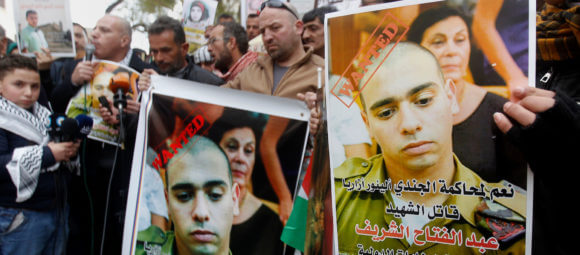
On March 24, 2016, two Palestinian suspects stabbed an Israeli soldier in the occupied Palestinian city of Hebron, moderately injuring him in the shoulder and hand. One suspect, Ramzi al-Qasrawi, was immediately killed by Israeli gunfire, while the other, Abdel Fattah al-Sharif, was shot several times and lay incapacitated on the pavement.
Eleven minutes later, Elor Azaria, an Israeli soldier and medic, arrived on the scene. He walked over to al-Sharif, who still lay unconscious, pointed his gun at him, and shot him in the head from point-blank range.
The entire incident was caught on film by B’Tselem volunteer Imad Abu Shamsiyeh, who had a perfect view from his apartment across the street.
Elor Azaria was pardoned for his murder of al-Sharif yesterday on Yom Kippur, the Jewish Day of Atonement. He wasn’t, however, pardoned by God, but by Israeli President Isaac Herzog.
Herzog issued a statement accepting Azaria’s request to “erase the remaining criminal record” of the former soldier so that he could “continue on with his life.” The President stated that “the passage of time” and the “sorrow” Azaria had supposedly expressed were penance enough.
But what “sorrow” was this? Although Israeli Defense Minister Israel Katz was the one pushing for the pardon as of last July, the military itself advised against it. The opposition to the move from the military Chief of Staff, Eyal Zamir, specifically pointed out that Azaria had “refrained from expressing remorse and taking responsibility for his actions, even a decade after his conviction.”
This was apparent from the first moment Azaria finished his prison sentence (which was reduced from Murder to Manslaughter and from 18 months to 9). He returned to a hero’s welcome and bragged that he would “do it again”:
“I’m completely at peace with myself. I did the right thing, I followed my truth, and there was no need for any of what happened,” Azaria told Israel Hayom. “I have no regrets. There’s no doubt in my mind. Take me back to those seconds in the incident in Hebron — I’d be doing exactly the same thing. Because that was the proper way to act.”
Azaria had thought this one out, and executing an incapacitated Palestinian was fully consistent with his ideology.
The judge in his case opined that he was just a “normal person” whose life was interrupted by “his current complication.”
By “normal,” the judge doubtless meant that Azaria was no different from the rest of Israeli society. Both Azaria and several members of his family had made genocidal statements online going back to 2014. Not much has changed since, with four out of five Jewish Israelis supporting the starvation of children in Gaza. These days, such views remain the norm in Israel.
An army of executioners
The erasure of Azaria’s criminal record goes beyond symbolic gestures. Criminal records in Israel prevent Israelis from working in specific fields and sectors, especially anything that is related to security or the military. But with his record now expunged, Azaria is suddenly eligible to return to the army.
This wasn’t lost on Israel’s hardline National Security Minister, Itamar Ben-Gvir, who expressed his elation at Azaria’s pardon, which he found “very moving and gratifying,” and called on the Israeli army’s Chief of Staff to allow Azaria to “return to the military if he wishes.”
A very similar thing happened months ago when the soldiers responsible for gang-raping Palestinian prisoners in the Sde Teiman torture camp were cleared of all charges by the Military Advocate General, with Defense Minister Katz calling for them to immediately return to military service.
Ben-Gvir also added that Azaria would never have been given a criminal record for his actions “had the rules of engagement been different.” Here, he is referring to the onerous rules that don’t give automatic permission for soldiers to execute Palestinians as they lie unconscious in the street.
Herzog the genocidaire
Of course, Herzog himself is an inciter of genocide. In October 2023, he infamously said that there were “no uninvolved” civilians in Gaza, stating that there was “an entire society out there” that was responsible for the October 7 attacks. He has continuously tried to gaslight those who pointed out that such statements were incitement to genocide, claiming that they were taken “out of context.”
But make no mistake, Herzog’s views are far from outliers. At least three out of every four Jewish Israelis share the perception that there are “no innocents in Gaza.” This view is highest among right-wingers, but even among self-identified Israeli “leftists,” about 30% shared this view.
It’s important for Herzog to be seen as popular among a broad cross-section of the Israeli public, as the President’s post is meant to be a ceremonial role that unites the nation. In this, the President has succeeded, because at least everyone can agree on genocide.
At the time of the Elor Azaria case, a substantial political drama ensued, with many calling for Azaria’s immediate and total pardon — including the left-wing Labor leader, Shelly Yachimovich — meaning that pardoning Azaria is far from a right-wing niche idea.
Who knows, with Azaria’s growing popularity, and his criminal record totally expunged, he might return to the military to murder more Palestinians before becoming Prime Minister. Maybe even President.


What the IDF did in Gaza is just what Azaria did magnified a thousand times:
Peter Beinart has a 15 minute video titled “What I Learned From Watching NAZA”** , the new film that interviews Israeli soldiers involved in the destruction of Gaza. Quotes from Beinart:
It’s a devastating film, and I would really recommend that people…watch it…it’s a film of interviews, in Hebrew, with Israelis who were involved in the targeting and other forms of the destruction of Gaza…it’s a devastating film for a number of reasons...I think it really very effectively dismantles a lot of this discourse about human shields...since October 7 there’s been this line from Israel’s defenders again and again that the reason that so many civilians were killed in Gaza is because Hamas used them as human shields…but one of the points you see in this film is that Israel makes this very clear decision to target people they think as Hamas operatives not on the battlefield but at home…”
I recommend watching the whole 15 minutes:
What I Learned From Watching NAZA – by Peter Beinart
**
“NAZA” could be the tipping point in the public perception of Gaza – Salon.com
What is even worse than all the pain this poor, poor murderer had to go through is the fact that he was convicted, had to serve (some) prison time, and didn’t even get a promotion!
That’s completely different from the case of the child murderer Captain R., who emptied his rifle into an innocent 13-year-old Palestinian girl who had already been shot:
And the army statement read:
https://en.wikipedia.org/wiki/Iman_Darweesh_Al_Hams
https://www.theguardian.com/world/2005/nov/16/israel2
No wonder is called the “most moral army in the world.” Apparently, they use “moral” as a euphemism for some of the worst crimes against humanity, just as others use “support for equal rights” and “coexistence” as a euphemism for apartheid and the continued expulsion of Palestinians.
I wonder what would have happened if Hamas had declared the Gaza envelope a “security zone” on October 7 and declared “Anything that’s mobile, that moves in the [security] zone, even if it’s a three-year-old, needs to be killed and then claimed, “I told you we were innocent.” “We didn’t act unethically”. Or, regarding the rapes,at least the one that could be verified, there was the reaction: “We are even heroes!” Well, at least that’s what they’d say, according to the “most moral” army in the world, its government officials, and the president of the “only democracy” in the Middle East. Not to mention the 80% of citizen-army (צבא העם) society who celebrate ethnic cleansing.