

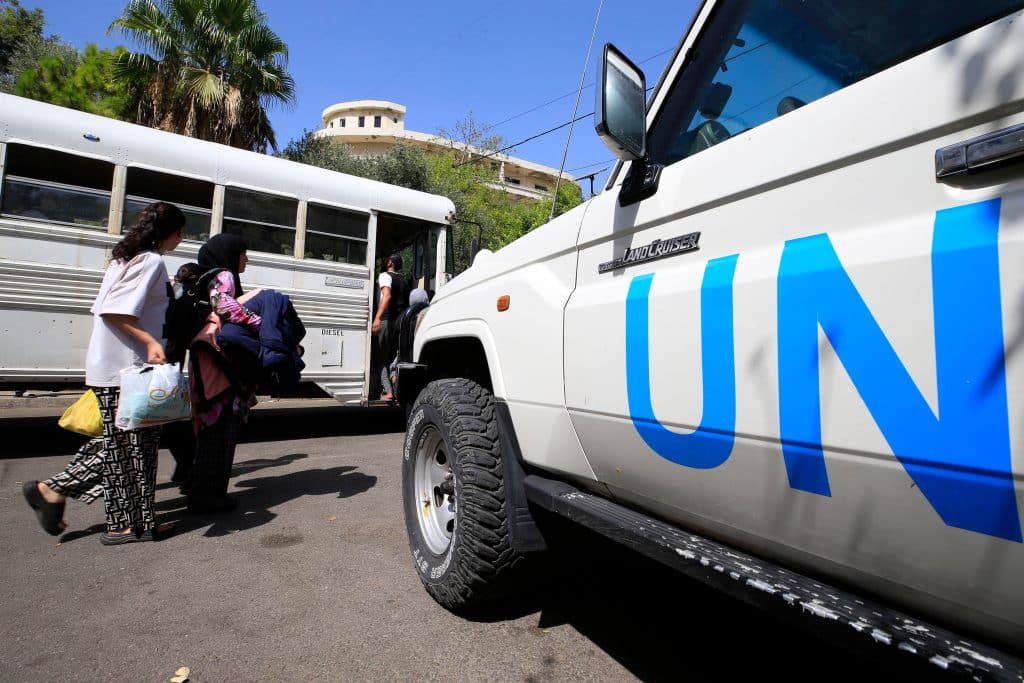
In the streets of Nahr al-Bared camp in northern Lebanon, where alleyways are barely wide enough to walk through, and buildings crowd out the sky, 45-year-old Palestinian refugee Aziza Wahbeh measures the long hours of another day.
There is the electricity that comes for only two hours a day, the water families must buy because none is supplied, the rising rent for cramped and aging homes, and the lack of work that has left many young people unable to support their families.
Wahbeh, who lives with a chronic kidney stone, says every month forces her family to choose between food and medicine — a situation facing almost a thousand other families here.
She is one of tens of thousands of Palestinian residents across Lebanon’s 12 refugee camps who have long relied on the United Nations Relief and Works Agency for Palestine Refugees (UNRWA) for food, schooling, healthcare, and employment. Excluded by law from Lebanon’s economy, the majority of roughly 300,000 Palestinian refugees in Lebanon have no safety net beyond the agency.
But now, facing its worst financial crisis since its founding in 1949, UNRWA is making choices between which camps to support and which to leave without necessary aid. The last emergency cash assistance Wahbeh received from UNRWA was distributed in the spring.
Then, in May, the agency made the decision to exclude six camps from its emergency cash assistance program on the grounds that they were not “directly affected” by the ongoing conflict in Lebanon: Nahr al-Bared and Baddawi in the north, Ein al-Hilweh and Mieh Mieh in the Saida area, and Mar Elias and Dbayeh in Beirut.
The decision, impacting thousands of families, triggered immediate protest. In mid-June, Palestinian factions and popular committees held simultaneous sit-ins outside the agency’s offices in Nahr al-Bared and Baddawi, calling the distribution unjust and demanding criteria that applied to all refugees regardless of area.
The grievance has since widened. Demonstrations broke out in Beirut on August 14 against cuts to UNRWA services, demanding monthly cash assistance for every Palestinian family without exception.
Residents argue that a war which paralyzed Lebanon’s economy, drove up prices, and halted work spared no corner of the country, least of all the camps whose fragile economies depended on the Lebanese cities around them.
“We now choose between a loaf of bread and our medicine,” Wahbeh told Mondoweiss at her home in the camp. “UNRWA was the only artery sustaining us with some food assistance, medical care, and schooling for our children. For them to come now and cut the aid, and leave us out of the latest distributions, we felt we had been abandoned by the side of the road.”
Her household now runs on what her father can forage. “He goes up the mountain to gather sage and sell it,” she said. “A bunch goes for a hundred thousand lira (~1.1 cents), and that is what covers the house. If he sells, we eat for a day. If he doesn’t sell, we don’t eat.”
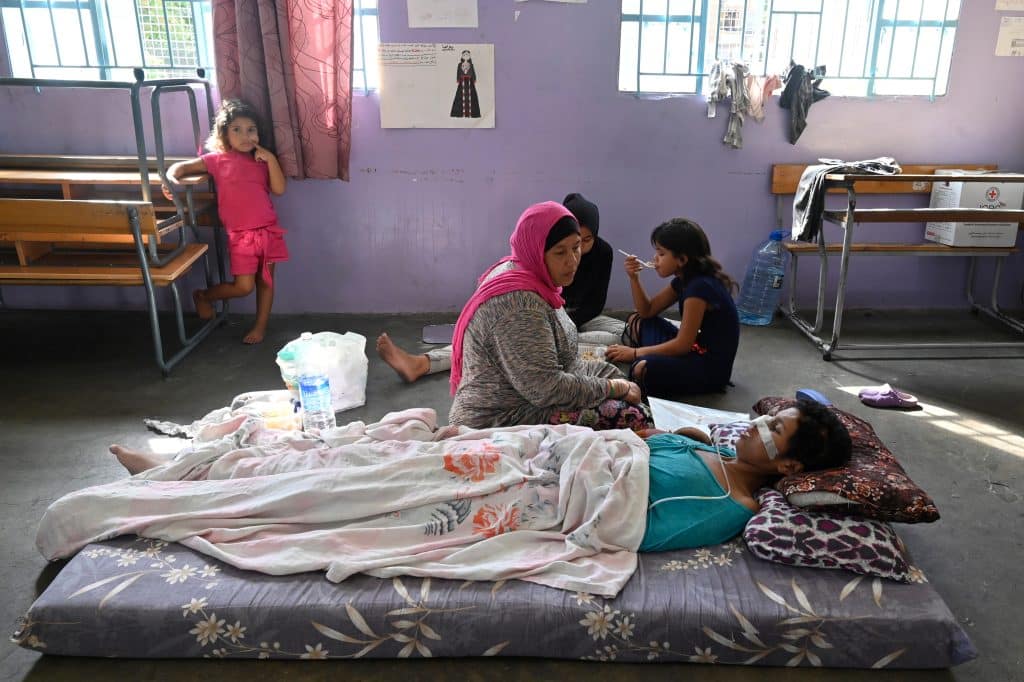
‘People’s needs are the same and their hardship is shared’
The decision lands at the moment of UNRWA’s deepest institutional crisis.
The crisis has its roots in early 2024, when Israel accused a number of UNRWA staff of involvement in the October 7 attacks. More than a dozen donors, led by the United States, suspended funding. Although most later resumed contributions, the damage was lasting.
The agency received $829 million in 2025, barely a quarter of its assessed needs, and faces a $100 million cash-flow deficit for 2026. A pledging conference in New York on June 30 raised only $4 million. The agency’s acting Commissioner-General, Christian Saunders, told donors on June 30 that the agency’s financial situation is unsustainable.
A succession of fragile ceasefires between Hezbollah and Israel since November 2024 has done little to ease conditions on the ground. Consumer prices rose by about 15 percent in 2025, even as annual inflation slowed from the triple-digit rates of recent years. Rents have climbed sharply as war damage, delayed reconstruction, and mass displacement compressed an already scarce housing market. The World Bank estimates the conflict caused $14 billion in economic losses and left Lebanon needing $11 billion for recovery and reconstruction.
In the camps, those pressures compounded the already severe conditions. Nahr al-Bared has been living with the consequences of incomplete reconstruction since 2007, when a battle between the Lebanese army and the Fatah al-Islam militant group leveled much of the camp.
Layla Rabih, 40, is pregnant after thirteen years of fertility treatment she and her husband funded themselves, because UNRWA does not cover it. He worked until he broke his hip, and now takes medication for his heart. She sells second-hand clothes from her phone when she can. There is no steady income between them.
“The decision to exclude the northern camps came as a major shock,” she said. “People’s needs are the same, and their hardship is shared. No one should be excluded from this essential humanitarian support.”
Bahiyya al-Majdoub, 38, also from Nahr al-Bared, spends her mornings asking about cleaning jobs, shop work, or anything that might bring in a paycheck. The mother of two has been unable to cover her children’s school tuition since the UNRWA cash assistance her family relied on stopped arriving.
“I just want a job,” she said. “I don’t want to tell my children they have to leave school because we can’t pay.”
According to Wahbeh, families are living on one meal a day. A bag of milk or a pack of diapers has become “a luxury for a child.” Parents have begun pulling children out of school and sending them to work.
“There are people who have completely stopped their treatment for blood pressure, diabetes, and cancer because they cannot afford the medicine, and UNRWA has not covered the costs,” Wahbeh said.
“We are not beggars,” Wahbeh added. “It is our right to live in dignity until we return to our land [in Palestine], and excluding the [camps] is collective punishment of people whose only fault is that they are refugees.”
A few kilometers away in the Baddawi camp, anger is mixed with dread.
Zeina al-Abed, 38, a mother of three, received nothing from the latest assistance.
“Frankly, we have become afraid of UNRWA,” she said. “They are cutting services little by little, systematically. We used to receive the $50 allocated to children as periodic support, then they reduced it to cover only children up to the age of ten.” Eventually, the cash assistance stopped coming altogether.
She pauses before adding: “I am very afraid that tomorrow these reductions will extend to health care and education, and we will enter a dark tunnel.”
She concedes the camp was not directly bombed, apart from one limited strike. “But the economic and social impact of the war fell on us in full,” she added. “Inflation and the lack of work have hit everyone, and the economic war spared no one in this country.”
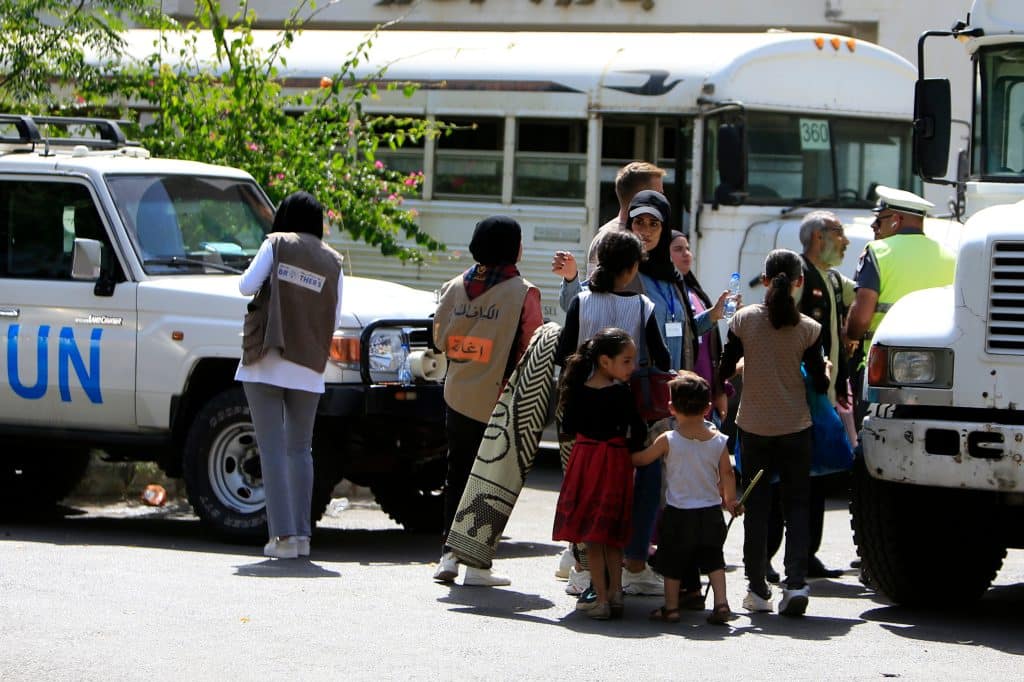
An agency at breaking point
UNRWA says the exclusion of the camps from the latest rounds of emergency cash assistance was in response to donor-imposed terms.
“The recent round of cash assistance was made possible through donor contributions specifically provided to support Palestine refugees affected by the conflict,” sources close to the agency told Mondoweiss, listing the conflict-affected locations covered by this distribution as the southern suburbs of Beirut, Baalbek, south Lebanon, and surrounding gatherings.
The amounts distributed — $20 per person to $45 per household — are “aligned with the standard U.N. cash assistance values applied in Lebanon by all humanitarian organizations,” the sources said. Essential services, including waste collection and hospital support, continued unchanged despite a 20 percent reduction in working hours as a “difficult cost-control measure” in January, the sources said.
What UNRWA has not addressed is the residents’ central argument: that a war which destroyed $14 billion of Lebanon’s economy did not confine its damage to the areas that were bombed.
But the scale of the U.N.’s financial crisis was laid out at the June 30 pledging conference. Secretary-General António Guterres warned the conference that any further cuts could push conditions past breaking point, condemning systematic efforts to marginalize the agency through disinformation, smear campaigns, legislative actions, and operational restrictions, and noting that UNRWA’s headquarters in occupied East Jerusalem was unlawfully seized earlier this year in violation of U.N. privileges and immunities.
‘We may differ with UNRWA’s administration, but never over UNRWA itself’
Inside the camps, trade union leadership reads the exclusion as part of a larger pattern of deliberate institutional retreat.
Abu Firas Moussa, secretary of the administrative bureau of the Palestinian Workers’ Trade Union Federation in northern Lebanon, warns that the agency’s relief and social services department is the structure whose collapse would hollow out the institution entirely.
“If this department collapses, the agency’s very title and central purpose collapse with it, and UNRWA would be transformed from an agency for the relief of refugees into an agency for their grief, subjugation, and starvation, not only in Lebanon and its camps but across all five fields of refuge,” Moussa said.
Moussa rejects the geographic justifications outright. There are no economic or living-standard differences between the camps of the north and the south, he argues, when refugees across Lebanon are denied by Lebanese law the right to work in the liberal professions and to own property.
“There is a clearly defined Zionist-American project that seeks to liquidate the Palestinians’ right of return through the gateway of dismantling UNRWA and ending its mandate,” he said, emphasizing that the agency was implementing “clear policies of starvation against the Palestinian people,” whether intentionally or not, “under the cover of the term ‘neutrality.’”
“But there is no neutrality when it comes to the Palestinian national cause,” Moussa added.
The deficit UNRWA invokes, he argues, is not the fault of the refugee or the overcrowded camps, and the agency’s international leadership must search seriously, with donor states and inside the United Nations, for sustainable Arab, European, or international funding rather than presenting an open-ended shortfall as fate.
Ali Huwaidi, a writer and researcher specializing in UNRWA and Palestinian affairs, says poverty among Palestinian refugees in Lebanon has reached 80 percent, while real unemployment stands at 45 percent — figures that worsened further after the latest Israeli assault on Lebanon in 2025 and 2026, yet were accompanied by no increase in funding. Overcrowding in camps, he adds, now exceeds 400 percent.
The $4 million raised at the June conference is earmarked for the emergency program to support refugees directly impacted by the war, rather than the general budget covering salaries, schools, and health care, he notes.
“The missing $100 million is negligible next to the billions spent daily on the world’s wars,” he added.
Referring to a UN General Assembly vote in November 2025 authorizing the cash-strapped UNRWA to continue its work, Huwaidi says that “a mandate extended to June 2029 by more than 155 member states is mere ink on paper unless the obligations are paid.”
On Lebanese law, Huwaidi proposes granting refugees their civil and social rights, to work, to own property, to access education, arguing that this does not constitute naturalization and does not extinguish their historic right of return. It strengthens the capacity for a dignified life in the interim.
“We may differ with UNRWA’s administration, its policies, and its distribution,” he said, “but we never differ over UNRWA itself. We must hold fast to the agency as the address of international political and legal responsibility for the refugee question, its role bound organically to the Palestinian presence until actual return and compensation are achieved.”
This story is produced in collaboration with Egab.

“The crisis has its roots in early 2024, when Israel accused a number of UNRWA staff of involvement in the October 7 attacks.”
The U.S. Postal Service has upwards of 600,000 employees. Do you think you could find 20 of them who just renewed their membership in the KKK or some neo-Nazi organization? You could bet your life on it. But that doesn’t mean the USPS has a policy of supporting the KKK or encourages its employees to engage in such activities.
UNWRA has tens of thousands of employees, I have no doubt that some of them are involved in nefarious activities. That doesn’t mean…..
Israel doesn’t want UNWRA around because it doesnt want Palestinians around.
UNRWA is a standing rebuke to Israel and its refusal to allow those it drove from their homes to return. One of Israel’s first actions after 7 October was to claim that UNRWA was part of the Hamas attack. The propaganda ruse worked: UNRWA has never recovered from that defamation.
The Reparations and Certain Expenses ICJ cases upheld the UN Charter power in Article 17(2). It states that “The expenses of the Organization shall be borne by the Members as apportioned by the General Assembly.” This creates a legally binding obligation on member states to pay their assessed contributions. Since the beginning of 2025, Israel has been allocated $11.6 billion in direct U.S. foreign assistance and military funding. It’s time for the General Assembly to collect reparations from countries funding decades of Israeli aggression and failure to pay for UN and Palestinian property it has illegally confiscated,
The UN Convention on Refugees has always stipulated that Palestinians would not be paid from UNHCR, but rather from UNRWA instead. But the Convention requires that Palestinians must automatically begin receiving regular UNHCR refugee benefits if UNRWA refugee benefits cease for any reason:
Article 1
definition of the term “refugee”
…
D. This Convention shall not apply to persons who are at present receiving from organs or agencies of the United Nations other than the United Nations High Commissioner for Refugees protection or assistance.
When such protection or assistance has ceased for any reason, without the position of such persons being definitively settled in accordance with the relevant resolutions adopted by the General Assembly of the United Nations, these persons shall ipso facto be entitled to the benefits of this Convention.
Note that the Israel Land Authority (ILA) manages approximately 93% of the land in Israel and is responsible for collecting lease capitalization fees, annual leasing fees, and permit fees from leaseholders. This includes residential, commercial, and employment properties and associated fees. Jewish citizens only purchased about 6 percent of the Land of Palestine and all the remainder was pillaged, illegally leased and illegally taxed. Israel also regularly withholds and seizes customs duties and tax clearance revenues that it collects on behalf of the Palestinian Authority (PA).
See also Israeli forces expelled Palestinian refugees from three West Bank camps, in violation of international law – UN report 04 September 2026
Not even the Israelis do this. While despicable, it certainly makes clear the politically powerful Iranian Hezbos are more concerned with killing Israelis than helping Palestinians.