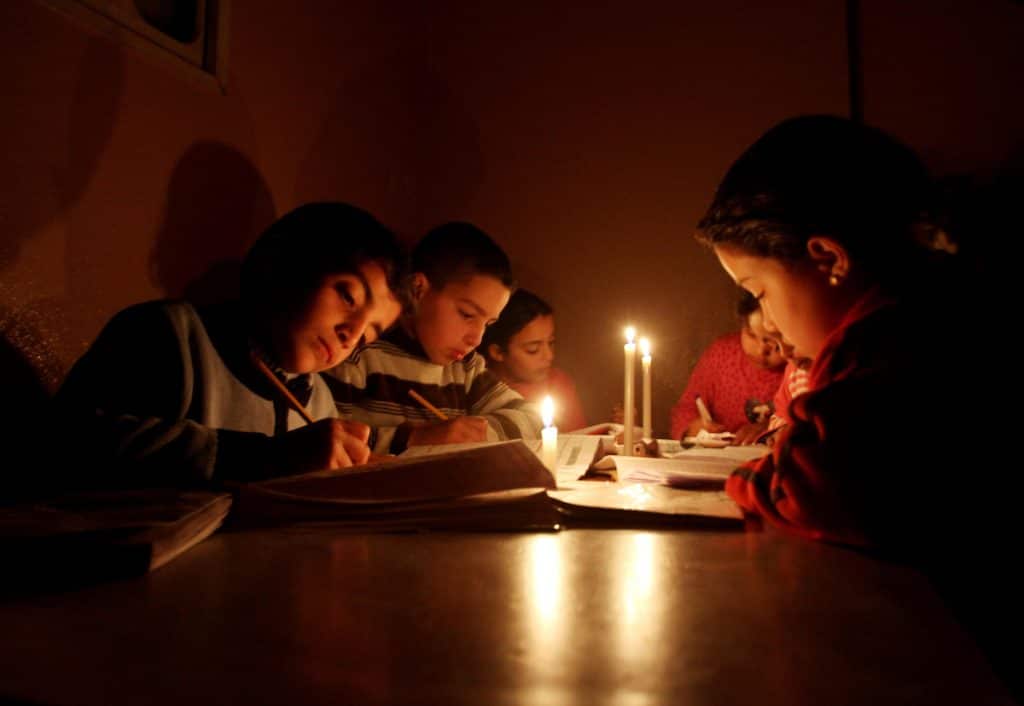
The sun is slowly setting earlier as winter approaches in Gaza. When night falls, Aseel Ayesh’s tent in the Nuseirat refugee camp goes dark. Last week, her private electricity provider cut her off after she couldn’t pay a bill of over 180 shekels (around $59).
“I need to use the light all night, so I can prepare milk and dinner for my daughter,” said Ayesh, 24, who shares the tent with her husband and their infant daughter. Her husband, Wassim Mohammed Ayesh, said he got bit by a rat that snuck into the dark tent, which resulted in an infection.
With Gaza’s power grid in ruins, private generators are now the only source of electricity for most people in the Strip, and the price has soared. Generator power costs about 30 shekels (around $9.80) per kilowatt-hour, compared to three or four shekels before the war, according to providers. Generator owners connect subscribers to their power lines, with a meter to measure energy consumption, and bills are collected every week. Anyone who doesn’t pay in time is cut off.
Gaza never had enough electricity in the past. Before October 2023, the Strip had about 212 megawatts of power, less than half of what it needed to function. Most of the electricity was supplied from Israeli power lines, with the remainder coming from Gaza’s only power plant. At best, homes got electricity in alternating eight-hour shifts. Around 350 private generators were already operating to cover the gaps.
On the night of October 7, 2023, Israel cut the power lines and stopped the fuel that ran the power plant. Since then, the bombardment has destroyed about 5,080 kilometres of power lines and 2,285 distribution transformers, according to Gaza’s government media office, which puts the sector’s losses at $1.4 billion. The generators that replaced the grid run on fuel, engine oil and spare parts, all of which Israel restricts from entering the besieged Strip.
Not far from Ayesh, Ashraf Mohammed, known as Abu Mohammed, lives with his family of nine in a hasil, a small storeroom once used as a shop or warehouse and now rented out as a home because so few houses are left standing. He lost his job in the war, and now every shekel counts.
“I lost my work because of the war, and now I need more than 2,000 shekels ($655) a month,” he said. “I sold my car during the war to provide for my family.”
Last month, the family’s weekly electricity bills added up to 582 shekels ($190). They now use power only to charge their phones, so two of his children can follow their university classes online, and to turn on a single light for a few hours at a time.
“We have to cut back on our basic expenses to pay for electricity,” said his wife, Umm Mohammed. “We don’t spend much on food, and we can’t pay the full university fees for our children.” Before the war, she explained, they had electricity for only about six hours a day, but the price was more reasonable.
The private generator economy
Abu Zayed Sons Trading and Import is one of the largest generator providers in central Gaza. Founded in 2017, the company moved into electricity when the war began, running its first lines in al-Zawayda, where it started, before expanding to ten branches across the Strip.
The private generators run about 20 hours a day, from 7:00am to 3:00am, and burn between 40 and 100 litres of fuel an hour, said general manager Aya Shaheen. “Our generators have very high capacity. They can’t be compared with competitors who own small generators.”
With fuel imports restricted, the company makes its own diesel in a private factory. It was among the first in Gaza to do so, Shaheen said, and that has allowed it to continue running. When asked about their running costs, Shaheen said that the figures change too often to provide an estimate.
The company has around 25,000 subscribers today. “The price per kilowatt is fixed at 30 shekels,” Shaheen said. “Each subscriber has an independent meter. They bring their own, and we connect it.” Bills are collected weekly so that debts don’t pile up as prices rise.
Abu Zayed doesn’t run lines to tents, because a single short circuit could start a fire and cause a catastrophe, Shaheen said. Its customers live in houses still standing and in hawasil like Abu Mohammed’s.
Mahmoud al-Baba, who owns a generator in the Central Governorate, does extend power lines to tents, including Ayesh’s. “Why, aren’t the people in the tents human beings, that I shouldn’t run lines to them?” he said.
He charges 29 shekels per kilowatt-hour and uses the same system of meters and weekly bills. “Payment is in cash or by bank transfer, and whoever doesn’t pay, we cut off the electricity.”
Opting out of electricity
Families who can’t keep up are canceling their subscriptions, choosing to live in the dark so they can cover food and rent. Some charge their phones at charging points set up across the Strip, which cost a few shekels a time but offer nothing more: no light, no heat, no way to cook.
Solar panels, which have eased electricity shortages in places like Lebanon, are too expensive and hard to find in Gaza, said economic analyst Ahmed Abu Qamar. High electricity prices have also raised production costs for small businesses by 10 to 15 percent, he said, and goods could be 15 percent cheaper if power were available at normal prices. If prices keep rising, he warned, families will drain their savings and sink into debt just to cover the basics.
They are likely to keep rising. On October 12, Gaza’s Energy and Natural Resources Authority capped the price of generator electricity at 29 shekels per kilowatt-hour. Shaheen said her company holds a permit from the authority but can’t bring its price down.
“There is a severe shortage of generator oil,” she said. “I expect the price to rise within days,”
This article was published in collaboration with Egab.