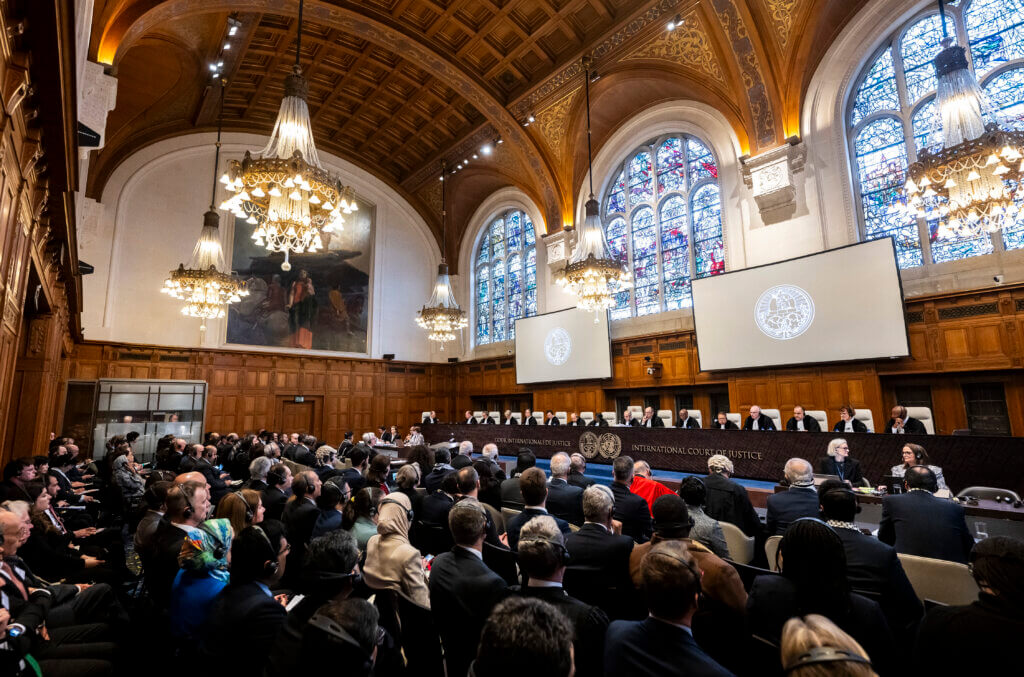
On Thursday, the International Court of Justice announced its landmark ruling in the case brought by The Gambia accusing Myanmar of genocide against the Rohingya people.
For the first time in the ICJ’s history, it found a state directly guilty of genocide.
It is hard to overstate the significance of this case. Supporters of Palestine are immediately, and correctly, going to draw parallels to South Africa’s case against Israel. But the ruling also has deeper, more global implications.
Why is the Myanmar ruling so important?
“Genocide” is a highly contested term. Defenders of Israel’s actions in Gaza often say that it is a legal term, and they’re not wrong. But it is not only a legal term; it has colloquial meanings as well.
The term was coined relatively recently, in 1944 by Raphael Lemkin. He was spurred to create the word in his book, Axis Rule in Occupied Europe by the Holocaust of World War II but did not intend for that horror to stand as the definition of the term. In fact, he noted himself that he would apply it to the Ottoman Empire’s atrocities against the Armenian people three decades prior.
The argument that genocide is a purely legal term is dangerous. With no court to rule, would that exclude the obvious genocide of the Indigenous Peoples of the Western Hemisphere? Perhaps more to the point, would the fact that no state has, before today, been found guilty of genocide by the ICJ mean that it has not happened since the agreement on the Convention on the Prevention and Punishment of the Crime of Genocide of 1948?
That would certainly be disputed in the cases of Rwanda, Darfur, Cambodia, Bosnia, the Yazidis in Iraq and Syria, and a depressing number of other cases, just in the past seventy-eight years.
These facts are important to note because the argument that the ICJ has not declared genocide in Gaza does not mean there is no genocide in Gaza. That will remain so even if the ICJ does not hold Israel responsible for the crime of genocide in Gaza.
But it is obvious that the outcome of South Africa’s case against Israel carries monumental weight, and the case against Myanmar holds many parallels.
The Rohingya lived under a brutal junta in Myanmar which severely restricted their rights. Myanmar claims that their actions against the Rohingya community were a response to Rohingya violence. Myanmar, like Israel, argued that the refugee crisis and the sizable number of civilian deaths were part of security operations.
Yet it was never certain what the ICJ ruling would turn out to be, and as much as the case has many similarities to Gaza, the ruling does not by any means guarantee that the case of Gaza will be decided in the same way. But it does offer a strong ray of hope in that direction.
Only two accusations of genocide had ever come before the ICJ prior to this one. One was a cross-accusation between Serbia and Croatia which the Court summarily dismissed. The other was the Srebrenica massacre of 1993, where Bosnia and Herzegovina accused Serbia and Montenegro of genocide.
In that case (which, it should be noted, took fourteen years between when it was filed and when it was decided), the ICJ decided that genocide had been committed, but that the states were not responsible for the genocide. The ICJ ruled only that Serbia had violated its obligation to prevent genocide.
That was worrisome because the case clarified that conviction for genocide has an extremely high bar. The ICJ ruled that, to prove genocidal intent, the circumstances must lead to only one conclusion: that genocide was the goal of the state’s actions. If any other motive is possible, then intent cannot be legally established.
Proving intent is already difficult, since genocidal states do not generally announce, as the Nazis did, that they intended to wipe entire groups of people out of a specific place. Saying that such proof requires that no other conclusion is even possible was seen by many as a bar so high that no state could ever be held responsible for genocide.
The ruling against Myanmar shows that, although the bar is high, it can be reached. That is an enormous development for those who hope to see Israel held accountable for genocide.
What did the ICJ rule?
Specifically, the ICJ ruled that Myanmar was guilty of both the commission of genocide and the failure to prevent it, which are two different crimes. That’s important because it covers both acts that were directly ordered by the Myanmar military or government as well as any acts that might have been perpetrated by Myanmar’s forces or others acting without direct or implied orders.
The Court also found that Myanmar had violated its order to preserve evidence related to the case. This will strengthen this precedent in the case of Israel and, should it ever come to trial, the case against Russia brought by Ukraine.
Interestingly, the ICJ ruled that Myanmar was not guilty of public incitement to genocide. That will likely be different for Israel, regardless of how the other verdicts land, given the unusually large volume of genocidal statements that Israeli officials made, especially in the earliest days of the genocide.
How is the ICJ ruling enforced and what are the penalties?
This part is complicated. Individuals held responsible for genocide are expected to be tried by their home countries first and foremost, but if that fails, international courts, such as the ICC, or tribunals are the alternative, according to the Convention on the Prevention and Punishment of the Crime of Genocide.
The Convention does not prescribe penalties for states. The Court can order reparations, but there are no specific guidelines or requirements for the Court to impose penalties on states.
In the Myanmar case, the Court ordered Myanmar to cease genocidal activities; prosecute any individuals responsible for the crime of genocide; assure the Rohingya that this won’t happen again; provide for the safe return of refugees who wish to return and ensure they are reunited with their families; and “to compensate the Rohingya group and its members for the damage caused,” the parameters of which the Court said it would determine in a subsequent document.
The Court also expects states that are party to the Convention to take their own actions, and this could be significant.
The European Union, unlike the United States and Israel, considers international law important. Although they have repeatedly shown a willingness to ignore it in Israel’s case, the EU’s procedures acknowledge the law and the international legal system. There is only so far they can bend these procedures.
In the case of Myanmar, the EU already had strong sanctions in place, since it was obvious, on a colloquial level, that the state had committed genocide or, at the very least, abhorrent crimes against the Rohingya.
But Israel is obviously treated differently.
Nonetheless, the politics of international law matters in Europe in a way it does not in the United States, let alone in Israel. EU agreements and the laws of many EU states mandate adherence to international law, creating a tension in Europe that, in a legal and political sense, doesn’t exist in the U.S.
In the case of Gaza, this is compounded by the fact that a case is pending before the ICJ against Germany. Nicaragua accuses Germany of breaching the Convention Against Genocide by supplying Israel with arms and by withdrawing funding for UNRWA. Germany has claimed the case is inadmissible and that Nicaragua lacks standing to bring it, and that decision is pending. It will not be decided for years, in all likelihood, even if it is not dismissed.
But Germany is concerned because, as Israel’s main benefactor aside from the United States, it faces disturbing historical echoes when it is accused of genocide, and its support for Israel has become increasingly controversial domestically, especially among rising parties on the left.
More significantly, a recent petition in Europe to suspend the EU-Israel Trade Agreement over Israel’s human rights violations reached one million verified EU signatures, which means the European Commission must consider the call.
No one seriously expects the EC to submit to the petition’s demand, but it is a big weight on the scale of moving EU policy toward Israel. A finding by the ICJ of genocide will give such a citizens’ demand a lot more weight.
Broader international sanctions would need to be mandated by the UN Security Council. For the foreseeable future, that is a dead end. The shift in American politics with the incoming Congress might change American policy in years to come, but for now, real punishment for Israel is still going to face a U.S. veto at the UNSC.
Conclusion
The ICJ decision is a monumental moment for international law. It crucially demonstrates that a finding of genocide is not beyond the ICJ. Indeed, it strengthens the argument that the crime of genocide, being understood as the worst possible crime, should need to meet a high bar for conviction.
The substance of the ruling was that the evidence proved the intent to commit genocide. The ruling states: “The Court considers that, in the present case, the scale and nature of Myanmar’s actions and the methods it employed went well beyond what would be required to punish the population and are instead characteristic of an intent to destroy a substantial part of the group. Features of such intent include the large numbers of persons killed, injured or displaced and the widespread brutal attacks on women and children… In the Court’s view, the only reasonable inference that can explain Myanmar’s actions is an intention to destroy a substantial part of the protected group, namely the Rohingya population in northern Rakhine State.”
The reasons the ICJ gives for its ruling all echo Israel’s actions in Gaza.
Giving even more hope for some justice, the Myanmar government was not so brazen or foolish as Israel as to state explicitly that it intended to carry out genocidal acts. Israel openly stated that it was cutting off food, water, medicine, electricity, and anything else it could cut to the entire population of Gaza and repeatedly ordered that besieged population to relocate from one destroyed area to another, on trips that were often hazardous.
The outcome of this ruling, in terms of its implications for the South Africa case in Gaza, could not have been better.
And as a demonstration that Israel and the United States have not yet succeeded in killing the entire concept of international law? That will be determined by whether this is a principle that holds in all cases, not just ones that the West approves of; and by whether the response of the international community suits the verdict, in Myanmar and in Palestine.