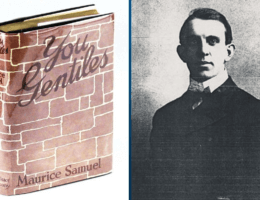
Maurice Samuel’s 1924 tract, “You Gentiles,” is cherished by antisemites and Zionists alike because it says that a Jew can never mix successfully in a non-Jewish world because the Jew’s concerns are more serious, and the gentile’s more playful, so the Jew will always be “a source of unhappiness to himself and to those around him.” Samuel’s book insists on the impossibility of Jews and non-Jews living in stability and respect, and thus, the necessity of Jews living in their own land.
Palestinian activists, human rights workers, Israeli military, and Jewish settlers have all trained their lens on Israeli state violence—some to contest Israeli military rule, others to consolidate it.
The legendary human rights lawyer Michael Ratner’s life is exemplary for Americans seeking to undo an outmoded view of Israel. “I thought of [Israel] as the home of my people. I had my bedroom ceiling painted with the seven wonders of the world and a huge map of Israel. I had no idea how my view of Israel would change later in life,” Ratner relates in his posthumous memoir, Moving the Bar.
Jody Sokolower’s new book challenges the distorted picture of Palestinians her students had gained from media. “The struggle to bring Palestine into our classrooms is as important to freeing Palestine as all our other acts of solidarity,” Sokolower writes.
After every ceasefire, Rana Shubair tries to imagine leading a normal life. In Gaza, the bar is set low and means not living under raining bombs. “Mama, who broke our house?” the neighbor’s three-year-old asked. His mother ignored his question. The following day the toddler announced, pleased that he had figured it out, “The Israelis broke our house.”
Over the past century more than 20 international commissions have been convened on the question of Palestine, Dr. Lori Allen uses them as the basis for her investigation into Palestinian political history.
Over 16,000 artists, including hundreds of Palestinian artists, six Academy Award winners, and eight Pulitzer Prize winning writers, have signed a letter denouncing Israel’s apartheid system and calling on countries “to cut trade, economic and cultural relations.”
“Facing History,” a rich source of teaching materials, tells students that the bigotry and hatred we see today are legacies of past injustices. And systemic racism and indigeneity are the subjects of entire Facing History courses. But the nonprofit’s omission of Palestinian history is intentional. “Facing History” functions as though it is possible to be both anti-racist and Zionist.
This spring as the fight to save Sheikh Jarrah, Gaza, and all of Palestine from Israeli settler-colonialism slowly became a mainstay in mainstream public discourse, thousands of artists, musicians, and other culture makers have spoken out in support if Palestine. These statements are not only important political bellwethers, but also essential catalysts for social change.