The only sustainable way forward is to engage in the “decolonization” of Greater Israel. What comes next remains an open question.


The only sustainable way forward is to engage in the “decolonization” of Greater Israel. What comes next remains an open question.
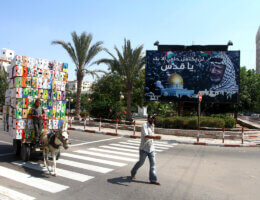
Donkey carts may be slow and noisy, but they have become essential fixtures in the besieged Gaza Strip.

Thousands of stories are out there are waiting to be told. Thousands of agonies are screaming to be heard. Every Palestinian story is worth being told.

It does not take long to realize the true value of Gaza’s shores to its people. In no other place do you see the people in such a joyful state, and it is exactly for this reason that the shores of Gaza hold such deep meaning.

Marcelo Svirsky says Zionism is not a political ideology or movement in the narrow sense but a way of life that permeates all spheres of Jewish-Israeli culture and society. It can therefore be overcome only by means of a deep cultural transformation.

The Middle East Union festival is a literary festival that includes musical and queer performances, readings, live panels, and online discussions, held in Berlin from August 12 to 15.

A new song celebrates the Sumud (steadfastness) of the people of historic Palestine following the latest horrific Israeli onslaught on the besieged Gaza Strip.
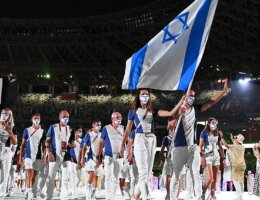
Palestinian citizens of Israel are 20 percent of the population. But not a single one was on Israel’s 90-member Olympic team. “Sports Apartheid” is the correct term for preventing 20 percent of your fellow citizens from competing internationally. What’s also amazing is that until now, no one in the U.S. mainstream press has even bothered to report on this injustice.

The Israeli historian Shlomo Sand has ventured into a territory– Judeophobia– that is nowadays mostly occupied by ardent Zionists intent on proving that Jew hatred is eternal and that the state of Israel is the only place where the Jews can feel safe. In today’s Europe, argues Sand, Judeophobia has been largely replaced by Islamophobia, while erstwhile Antisemites have become admirers of Israel, particularly of its way of “dealing with the Muslims”.
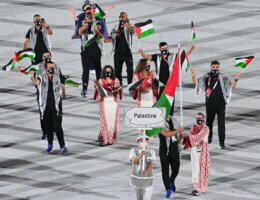
The politics of the Olympics is unlike daily politics. Indeed, it is about something profoundly deeper, related to identity, culture, national struggles for liberation, equality, race and, yes, freedom.