Dareen Tatour, a Palestinian citizen of Israel, faces the possibility of eight years in prison for “incitement” and support to a terror organization – for a Youtube poetry video and two Facebook posts.


Dareen Tatour, a Palestinian citizen of Israel, faces the possibility of eight years in prison for “incitement” and support to a terror organization – for a Youtube poetry video and two Facebook posts.

Israeli authorities denied Human Rights Watch’s (HRW) Israel and Palestine director, Omar Shakir, a work visa, the group announced in a statement on Friday. The group said Israel’s Interior Ministry accused HRW of “Palestinian propaganda” and not being a “real human rights group.”

The Washington D.C.-based music collective, FHTMG (Jefe, PacMan Slim, and Nine Five) releases a music video inspired by Jefe’s interrogation at Israel’s Ben Gurion airport.

In practice there has never been a serious limit on theft of Palestinian land. But now, after passing the “Regularization Bill,” Israeli government support for the plunder will be explicit in law. It will be impossible to blame the outposts on “rogue” settlers, or claim that Israel is trying to safeguard Palestinian property rights.
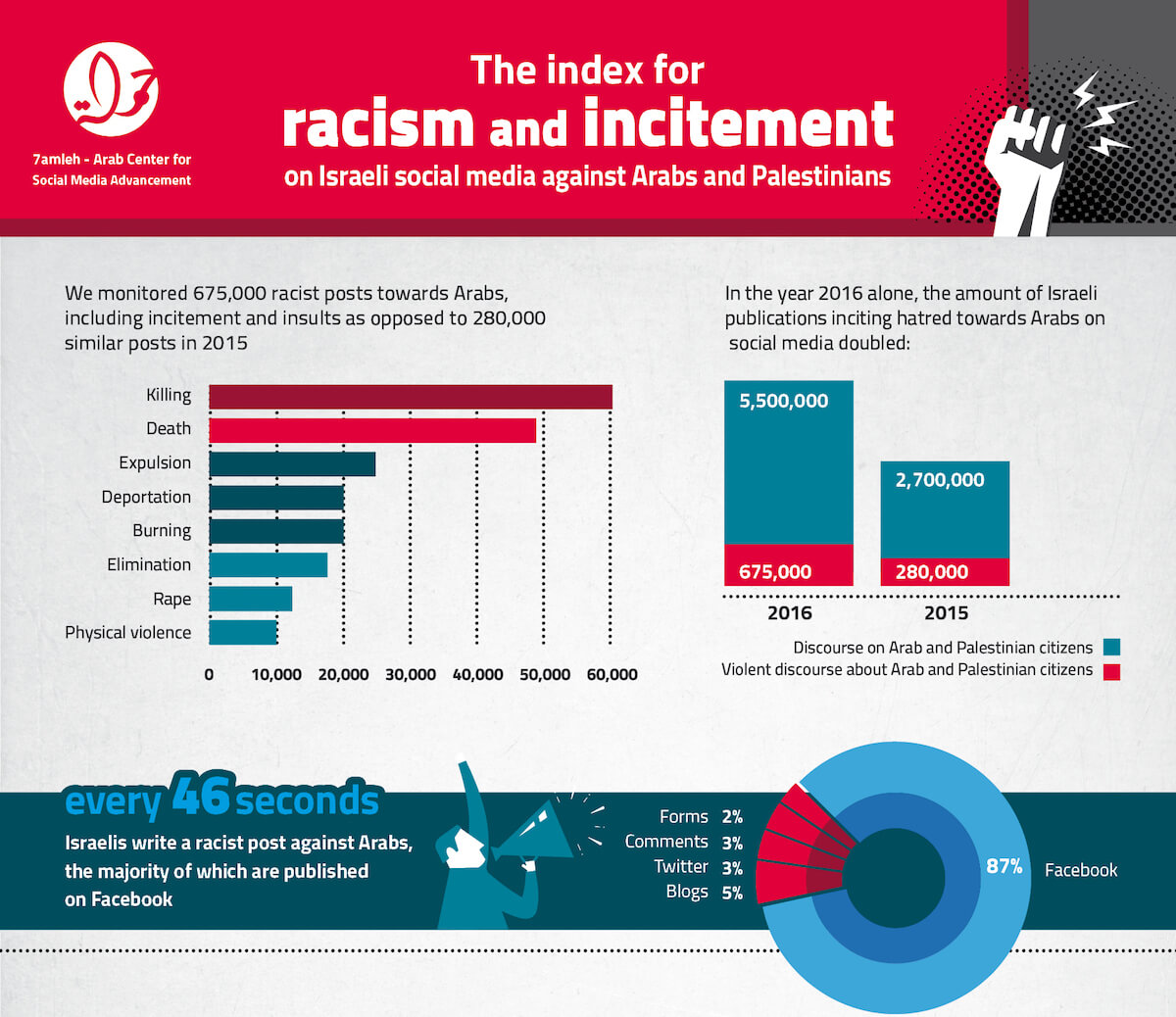
An Arab rights group has found tens of thousands of Israelis are publishing “widespread hatred and incitement against Arabs and Palestinians” on social media, and are often motivated to harass following charged statements by Israeli politicians. A report published by 7amleh, the Arab Center for Social Media Advancement shows slanderous, provocative, and threatening posts made by Israelis against Arabs and Palestinians more than doubled in 2016, reaching 675,000 posts made by 60,000 Hebrew-speaking Facebook users. That number amounts to one inflammatory post every 46 seconds.

The new law legalizing theft of Palestinian land is very similar to earlier legislation the Israeli government passed after Partition in 1950 and after the occupation in 1967, giving legal title to Jews of land formerly owned by Palestinians, who had either fled, been expelled, or were gerrymandered out of Israeli bounds.

The Israeli Knesset on Monday passed a controversial new law that allows the Israeli government to expropriate private Palestinian land in the occupied West Bank and East Jerusalem, making more than a dozen Israeli settlements legal under Israeli law. It is the first time in history that the Knesset has imposed Israeli civil law the occupied West Bank, which is under Israeli military and civilian rule. Xavier Abu Eid, a spokesperson for the PLO’s Negotiations Affairs Department said the law essentially “legalized theft of Palestinian land” adding that the legislation “negates peace and the possibility of the two-state solution.”

Mohammed al-Qiq, a Palestinian journalist who spent 94-days on hunger strike last year to challenge his administrative detention—Israel’s policy of imprisoning Palestinians without charge or trial—announced Monday a second hunger strike, this time against his re-arrest. Al-Qiq’s wife, Fayha Shalash, told Mondoweiss that the proceedings, which were held in Ofer Military Court, were illegitimate, “This whole thing is just a way to put Mohammed back in jail, they have no proof of anything against him, they just want to keep him away from everything.”

Benjamin Netanyahu claims Palestinians celebrate murderers and Israel does not, but grocery bag glorifying Elor Azarya proves he’s wrong. The medic who killed an incapacitated Palestinian on the ground last March is pictured with a rifle on bags given out for free at Rami Levy supermarket chain.

The Israeli Knesset on Monday night is scheduled to vote on the so-called “Regularization Bill,” which, if passed, will appropriate hundreds of hectares of Palestinian land in the occupied West Bank by legalizing — under Israeli law — thousands of settlement units built on privately owned Palestinian land. The bill would legalise at least 3,921 Israeli settlement units in the occupied West Bank built in contravention of Israeli and international law. The Palestine Liberation Organisation called the bill a “declaration of war.”