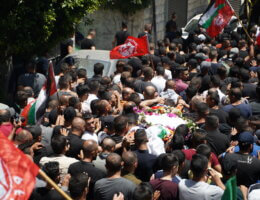
On Wednesday afternoon, Israeli forces shot and killed 11-year-old Mohammed al-Alami in his father’s car, as the family were on their way home from grocery shopping. The next day at Mohammed’s funeral, Israeli soldiers attacked the procession, killing 20-year-old Shawkat Awad. “They killed my boy, and then they wouldn’t even let me bury him,” Moayyad al-Alami tells Mondoweiss. “That is my most basic right as a father, and they took that from me too.”
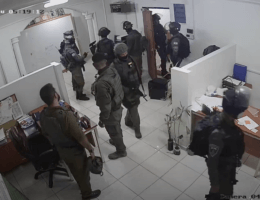
Israeli forces raided Defense for Children International – Palestine’s headquarters in the central occupied West Bank, confiscating computers and client files. The organization says it is part of an ongoing campaign to silence and eliminate Palestinian civil society and human rights organizations.
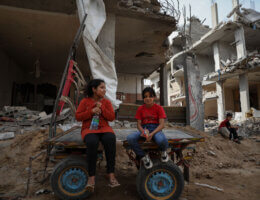
In the report published on Tuesday, Human Rights Watch said that it investigated three Israeli strikes that killed 62 Palestinian civilians “where there were no evident military targets in the vicinity,” in some cases, killing entire families in one airstrike.
Two Palestinian teenagers were killed by Israeli gunfire in the span of just a few days in the occupied West Bank, bringing the death toll of Palestinian youth killed by Israel in 2021 to 77.
On Sunday, Israeli forces fired tear gas and rubber bullets at Muslim worshipers at the Al-Aqsa compound and violently detained a number of Palestinians. Later that day forces escorted a reported 1600 Jewish settlers into the compound to pray, in a violation of established procedures at the holy site. Israeli PM Naftali Bennett came under international condemnation for allowing the prayer.
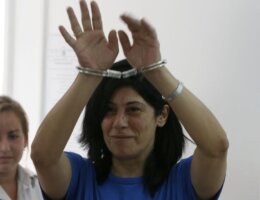
Read the letter Khalida Jarrar sent to be read at her daughter Suha’s funeral after Israel refused her request to be released from prison to attend.
Palestinian activists, human rights workers, Israeli military, and Jewish settlers have all trained their lens on Israeli state violence—some to contest Israeli military rule, others to consolidate it.
In early May, a group of Israeli settlers arrived with caravans and set up an illegal outpost on the top of Jabal Sabih on the outskirts of Beita, in the northern occupied West Bank. Every single day since then, protests in the village have been nonstop. “Nothing will appease us until this settlement is returned to how it was, as olive groves,” a school teacher from Beita tells Mondoweiss.
Zuheir al-Rajabi walks through his East Jerusalem neighborhood past Israeli flags hanging from the homes of his former neighbors who were forcibly evicted from their homes to make way for Jewish settlers. “This is an occupation and nothing is going to stop them from enacting their policies,” al-Rajabi said. “They will do everything, arrest us, imprison us, and kick us out, just as they did with our neighbors.”
The author Rob Nixon uses the phrase “slow violence” to refer to “the inattention we have paid to the attritional lethality of many…crises, in contrast with the sensational, spectacle-driven messaging that impels public activism today.” Slow violence is the defining condition of living as Palestinians: in between the sharp escalations of protracted conflict, the ongoing trauma of an existence under apartheid is typically not viewed as violence at all. When we demand freedom for Palestine we are not just demanding an end to military assaults on Gaza, we are demanding Palestinians to have a right to life, dignity, and freedom.