Israel is continuing an offensive on the West Bank city of Jenin that analysts say is meant to appease the settler movement as it pushes the government to exert more control over the occupied territory in preparation for annexation.


Israel is continuing an offensive on the West Bank city of Jenin that analysts say is meant to appease the settler movement as it pushes the government to exert more control over the occupied territory in preparation for annexation.

A new report details a shipping and logistics giant’s role in sustaining illegal Israeli settlements in occupied Palestine and Syrian territories.

Scenes of celebration overtook the streets of Ramallah as the first group of Palestinian prisoners, mostly women, were released as part of the Israel-Hamas ceasefire deal. Despite the joy many felt, tensions remain high in the West Bank.

The Palestinian Authority’s deadly military operation in Jenin continues to fan the flames of internal tensions in the West Bank. Meanwhile, Israeli leaders are calling for ‘Gaza-like’ operations in the West Bank, and to cut all ties with the PA.
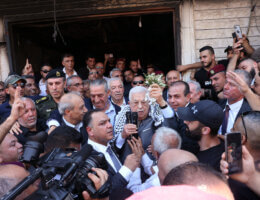
The PA’s deadly campaign against the resistance in Jenin is breaking long-standing taboos against spilling Palestinian blood. It is also raising profound questions over the future of resistance in the face of the Gaza genocide.
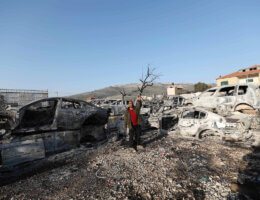
Congressional Democrats led by Rep. Summer Lee and Sen. Peter Welch have introduced legislation to sanction Israeli settlers that commit acts of violence in the West Bank.
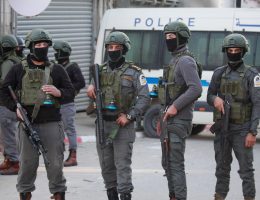
The Palestinian Authority is in the midst of a deadly operation it says is to ‘restore law and order’ in the Jenin refugee camp, home to the Jenin Brigade. But as the PA seeks to assert its control, it could risks undermining itself in the process.

Residents of a number of Gaza City neighborhoods received evacuation orders from the Israeli military, fueling fears that Israel may be extending it’s military operation, ‘The General’s Plan’ from the northern areas of Gaza to Gaza City.

As a ceasefire deal appears to be inching closer in Gaza, Israel continues to carry out massacres in the Strip, killing at least 26 Palestinians in one attack. In the West Bank, Israeli settlers continue to attack Palestinian towns.

Despite being the victims of an attack on our own land, we now face the possibility of imprisonment. It’s not a normal way of life, but it has become the normalized reality under Israeli occupation.