

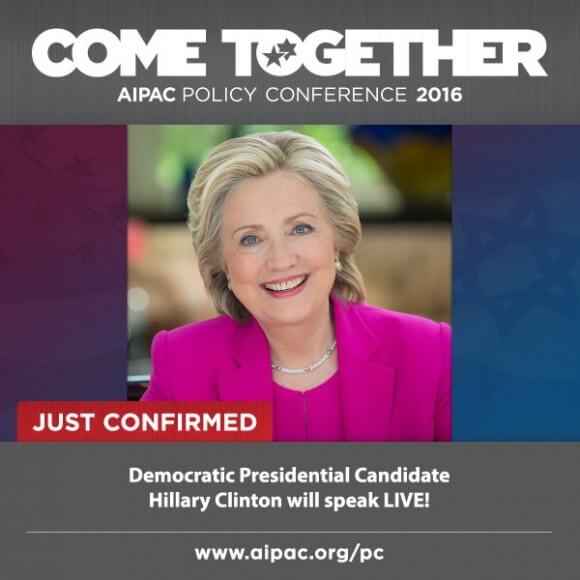
Notice something about this election? The Washington establishment IS the Israel lobby. Millions are pouring into Republican establishment candidate Marco Rubio’s feckless campaign in an effort to guarantee and preserve a neoconservative foreign policy. Jeffrey Goldberg, who once served in the Israeli army, explains to a credulous National Public Radio host why a hawkish foreign policy in the Middle East is the right and righteous path for our country. And Hillary Clinton vowed yesterday that she will stand with Israel against Iranian threats and the leading Israel lobby group, the American Israel Public Affairs Committee, AIPAC, announced she will be speaking at its annual hoe-down in ten days:
JUST CONFIRMED: Democratic Presidential Candidate @HillaryClinton will speak LIVE at #PC16! https://t.co/Oh7IwyJfbb pic.twitter.com/T2iuq2a1cV
— AIPAC (@AIPAC) March 9, 2016
AIPAC wants Bernie Sanders to come too:
AIPAC has extended invitations to all of the active presidential candidates of both parties, and we will inform you as others confirm their participation in this year’s conference.
Will he or won’t he? You’d think this is an opportunity for Sanders. His reliance on Arab-American voters to deliver Michigan Tuesday had a good effect on his policy positions. Murtaza Hussain at The Intercept reports:
On Tuesday, Bernie Sanders called for the U.S. to seek a “level playing field” in its approach to the Israel-Palestine conflict. Speaking after his surprising victory in the Michigan Democratic primary, Sanders asserted that there are people of good will in both “Israel and the Arab communities” whom he would seek to bring together as president.
“All I can tell you is I will make every single effort to bring rational people on both sides together, so that hopefully we can have a level playing field, the United States treating everybody in that region equally,” Sanders said.
Sanders made that promise even before the election. JTA reports on a rally in heavily-Arab-American Dearborn on Monday:
“For decades now there has been hatred and warfare in the Middle East, everybody knows it,” he said. “We’ve had some presidents — Carter, Clinton others — who have tried to their best to resolve it.
“All I can tell you is I will make every single effort to bring rational people on both sides together so that hopefully we can have a level playing field, the United States treating everybody in that region equally.” The crowd erupted in applause.
Sadly, Bernie Sanders is still afraid to make political hay of this issue nationally. He talked about Clinton’s relationship with the sinister Henry Kissinger again in last night’s Florida debate with her– but Kissinger is yesterday’s bad guy, and Democrats despise Benjamin Netanyahu for how he tried to show up our president. Hillary Clinton has said she would invite Benjamin Netanyahu to the White House in her first month as president. Sanders boycotted Netanyahu in Congress a year ago. But he just won’t touch this issue (I think out of a generational attachment to Israel as the deliverance story for his parents; Chris Hedges notes that Sanders was an AIPAC wind-up doll on the Support Gaza slaughter vote of 2014).
Donald Trump has of course made similar “neutral” noises to Sanders. And he is the anti-Establishment candidate, on the right. Establishment deacon Bill Kristol is utterly desperate. He’ll support anyone over Trump:
Watching the debate, had a moment of mystical insight and clairvoyant vision: Could we end up with a Cruz-Kasich ticket?
— Bill Kristol (@BillKristol) March 4, 2016
Finally, this is unseemly. At a debate in Las Vegas last night between the rightwing Israel lobby (the Republican Jewish Coalition) and the lib version (Jeremy Ben-Ami of J Street), a lot of greenbacks were flashed. From Jewish Insider:
RJC vs. J Street: “I would take my billionaire over your billionaire any day” — Brooks & Ben-Ami Battle in Vegas at a debate moderated by Jon Ralston at Temple Beth Shalom: “Who funds your organization?,” Ralston questioned Ben-Ami who replied: “We have over 10,000 donors. I know that the name you all are begging to hear is the name George Soros, and George Soros does fund J Street. There was controversy at the beginning of J Street as to the involvement of George Soros in our launching. A lot of miscommunication. I have apologized for all of that, and we are well beyond that. The only thing I have had to say about George Soros’s funding since then, is that I wish there were more of it.”
Brooks: “George Soros does not give us any money. I would take my billionaire over your billionaire any day.” Ben-Ami: “The billionaire you are stuck with, in this cycle, is Donald Trump, and you are going to earn your salary all year long defending Donald Trump.” Brooks: “I will take my billionaire and his wife (Sheldon and Miriam Adelson) over your billionaire any day.” Ralston: “So, Sheldon Adelson funds the RJC completely? Brooks: No. He doesn’t, of course not. We have a wide range of donors; we have 45,000 members across the country.”
There are so many political fights that pols are invited to take sides in. I think Sanders has decided where to concentrate, to “pick his fights”, and sees no advantage to his campaign by becoming outspoken either as pro-Palestine or pro-human-rights or pro-international law. He might — just might — drift in that direction a bit now and again, dipping his toe in that water, but that’s not where his votes will come from. Or so he probably believes.
A straight-out policy announcement that because the settlements are an obstacle to peace AND illegal therefore USA policy should be to demand the removal of the settlers and perhaps the dismantling of the settlements themselves would make he entire nation stand up and take notice, sure, resolute honest rectitude can be popular, but Kennedy got assassinated and etc etc etc.
Sanders impresses as very clever politically, especially in light of courting the Arab-American vote in Dearborn, and his pointed efforts to pull that off. Capable of thinking outside the box, acting on it, to pull off a important upset. He’s been very careful in the issues he chooses to address, and in timing and nuance. A Socialist with a very practical manner of succeeding in politics.
So he’s being careful on the Israel relationship. You think it is emotional: “a generational attachment to Israel as the deliverance story for his parents.” I expect that emotional attachment is there in the background, but I also assume his parents have passed on, and I doubt Netanyahu, Likud, and the entire right-wing Israeli government inspires any positive emotions in him today – just the opposite. I expect he seethes inside toward Netanyahu and the Neocon playbook with similar feelings he expressed about Kissinger. But he is holding that back, for now, reading the political winds as best he can.
The holding back occurs on his side and on the MSM side. There’s still a taboo about who can say what where, but we’re in a season where taboo-smashing is becoming the new phenomenon.
Trump is showing that he can flaunt such taboos, violate them for positive political effect among a large and passionate part of the Republican electorate, in WrestleMania style, all the while treating every interaction as part of future deals to be negotiated. “Megan, I called you unfair, said I didn’t like you, attributed your behavior to your menstrual cycle, and walked out on a debate claiming you were unfit to ‘moderate.’ Now, what is our relationship going to be going forward [now that you and I – two high profile celebrities – have such a fascinating feud going on?]:”
“Mr. Trump. Hi. How are you?” “I’m well, thank you, and you’re looking very well.” One of the attention-grabbing high-points of last Republican debates, of celebrity value to both of them.
There is a level where politics are like Wrestlemania, as others including David Brooks have pointed out: dramatized conflict that on some level everyone knows is fake, but that doesn’t prevent the fascination. Kabuki Theater is another example from a very different culture. He’s insulted the Mexicans, the global Muslim population, the Chinese, the Japanese, the RJC, which has set an awkward table for when he will sit down with them next, but isn’t that just what he wanted to do? He has shown that he will punish each and every critic with double quid pro quo. But it is all set up for the main event, the future deals to be made, where terms are malleable, you prioritize and make trade-offs, which cannot be missed!
Somehow I’d love to see Trump debate Sanders. I think Sanders can and is rallying support among Dem activitists by not fawning over Saban and Netanyahu, and Hillary could slip on that front, on the email indictment front, on some other messy secret front, of which we can only assume there are more. Somehow Hillary drives via looking through the rear-view mirror, striving for perfection based on how it was, but is blind to bumps in the road ahead. Her speech to AIPAC could be such a bump, if Sanders plays it right. If they’ve invited all the candidates, and they all show up, it could be beyond fascinating to compare Trump and Sanders and Clinton, and how they play to that audience. It could frankly be Clinton’s opportunity to go too far. Blind loyalty and no daylight vs friends don’t let friends drive drunk vs straight level table, someone, a Jew, who is prepared to campaign for the Muslim American vote vs a talking points reciter, vs one who might not get invited at all and who doesn’t take slights lying down. A real three ring circus.
Somehow I think the Israel-America relationship will get to front and center, and I don’t think AIPAC-Likud-Neocon-Netanyahu will survive the glare in the main event. Can Hillary and her pledge of loyalty stand the take-down from both the nuanced Socialist on the Left and the Wrestlemania rabble-rousing deal-maker on the Right?
Not by looking in the rear-view mirror.
Hopefully, she’ll vow to move the embassy to Jerusalem the Capital of Israel and call out Sidney Blumenthal and Max Blumenthal as the haters of Israel that they are.
Looks like Saban’s getting his money’s worth.
By the by, has his name crossed anyone’s lips on the campaign trail yet?
Phil, thanks for bringing in that debate in Las Vegas. Truly precious. The standard bearers of the New Mandarins chatting among themselves – how cute!
I hope that once Hillary gives her supine address to AIPAC Sanders will find the courage to comment on the power of lobbies in the US, even if he doesn’t take her on directly. Of course that will take place after the Ides of March, when many things can either change or not.
I do BTW agree with DD that Sanders’ “emotional” attachment to israel is somewhat dubious. At best, he has very mixed emotions as do many once idealistic jewish israel supporters in the US. Chances are that what he feels is a deep sense of sadness for the country that could have been and isn’t (putting aside for a second the original sin of colonization and dispossession of the natives). Ultimately though he has to wrestle with his own political instincts that right now are telling him that taking Israel and/or AIPAC head-on in inadvisable. His plate is plenty full already and for the battle against the big bad wolf he will have to be much better weaponized than he is at the moment.
Speaking just as a tactician here, not a wisher for all good things. On that second front I am of course with you and all true progressives.