


When Iranian ballistic missiles streaked toward the Galilee in the early hours of June 8, followed by Israeli warplanes striking Tehran, Isfahan, Tabriz, and the petrochemical complex at Mahshahr a few hours later, it was not a simple exchange of missiles and strikes, but an argument over the terms of the regional order. And like all arguments conducted in the register of fire, its meaning didn’t lie in the pyrotechnics themselves, but in the strategic logic that they etched, line by line, into that order.
At the center of that argument is a single strategic question: can Israel and the United States fight their enemies one front at a time, or are they forced to fight every front together? Iran’s Foreign Minister, Abbas Araghchi, put it unambiguously: “The ceasefire between Iran and the U.S. is unequivocally a ceasefire on all fronts, including in Lebanon. Its violation on one front is a violation of the ceasefire on all fronts.”
Washington and Tel Aviv insist on the opposite, maintaining that the April ceasefire applies only to the direct exchange of fire between the U.S. and Iran, while Lebanon would remain a separate front that could be fought in isolation. The weeks since the ceasefire began have been a sustained, escalating contest over which logic prevails. The question that remains is how we read that contest.
Interpreting it accurately means that we need to first clarify the meaning of a central concept that the analysis of Tufan al-Aqsa (Operation al-Aqsa Flood) once demanded, and which the current moment today confirms — the doctrine of wihdat al-sahat, or “the unity of fields.”
This doctrine made a simple assertion: that all the fronts of the axis of resistance — Gaza, Lebanon, Yemen, Iraq, and Iran itself — are not separate theaters but a single interconnected field of struggle. As a result, such a unity of fields would imply that pressure on one front could and should elicit a response across all others. When Iran attacked Israel on June 8, it was in direct response to Israel’s bombing of Beirut’s southern Dahiya district. What this tells us is that the idea of the unity of fields is not dead.
But it has changed. It isn’t what it was before October 7, when it functioned as a horizon of aspiration and as a shared imaginary that the resistance axis rehearsed but never fully inhabited. Rather, what we’re witnessing now is something far more interesting: a doctrine that’s being paradoxically tested by its own partial failure. Wihdat al-sahat was reassembled from the rubble of its setbacks and is now wielded with a tolerance for risk that would likely have made the doctrine’s pre-Tufan strategist balk.
The strategy that has unfolded over the past several weeks, most recently culminating in Iran’s volley toward Israel, is organized around three interrelated axes aiming to frustrate Israel’s strategic goals. Each axis reinforces the other, and when taken together, they deny Israel’s ability to carve out the conditions for strategic success — namely, a pacified Lebanon, a deterred Iran, and a disaggregated resistance.
1. Geographic denial
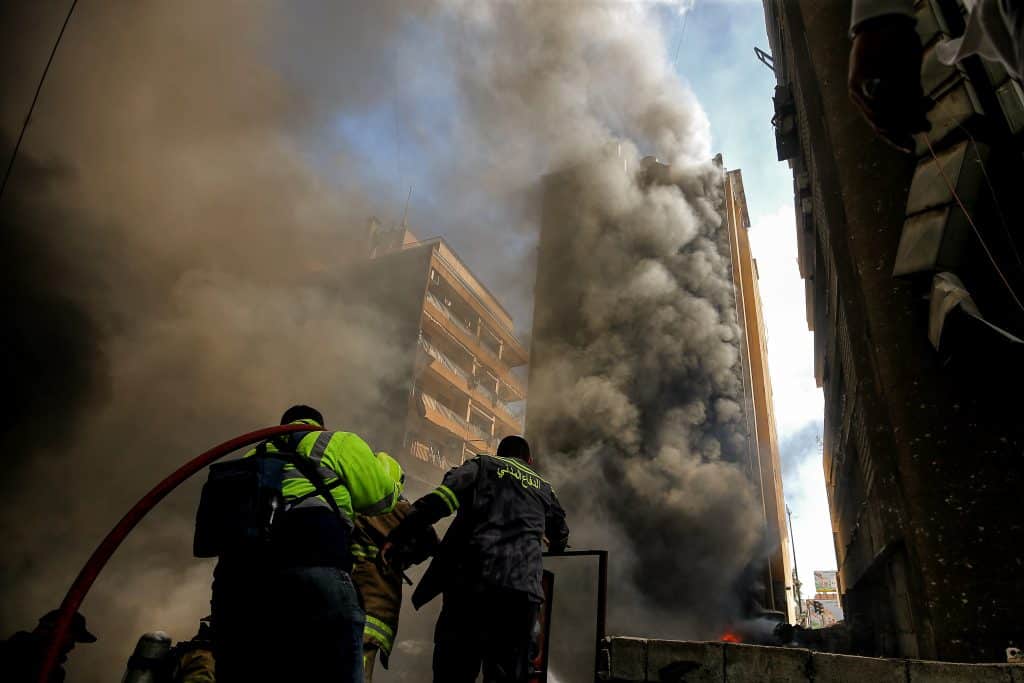
The first axis is geographic denial, which I define as the systematic effort to constrain Israeli freedom of military action across Lebanese territory, denying it the spatial prerequisites it needs to operationalize its most destructive military doctrines. But to understand the implications of that denial, we must begin with what it is denying: the implementation of what has come to be known as Israel’s Dahiya doctrine — a theory of strategic coercion through mass civilian punishment.
Named for the southern Beirut suburb leveled by Israeli air power in 2006, the Dahiya doctrine’s logic is simple: destroy enough civilian infrastructure on a sufficient scale, and the population or its leaders will restrain the resistance on Israel’s behalf. But in order to do that, Israel needs to be able to escalate freely and threaten the destruction of entire neighborhoods, cities, and civilian economies. It needs to be able to threaten large-scale massacres against Lebanese civilians, with the aim of turning the population against the resistance.
In Lebanon, that freedom is being revoked. Trump himself called back the strike on Beirut’s southern suburbs on June 1, announcing that Israel and Hezbollah would halt fire against each other — only for Netanyahu to announce minutes later that operations in southern Lebanon would continue. This capricious moment, with the patron restraining the client in real time and the client immediately half-defying those restraints, shows that Israeli strategic freedom of action is no longer self-authorizing. It requires American permission, and American permission is no longer unconditional.
There’s another Israeli security discourse and practice that’s being thwarted by geographic denial: the creation of “buffer zones,” which requires the expansion of Israel’s borders to establish permanent “security belts.” It has been doing so in Gaza ever since the October 2025 ceasefire, progressively expanding the so-called “Yellow Line” to seize more territory in the Strip, which Israeli army Chief Eyal Zamir said in December 2025 would become Israel’s new borders. In recent months, Israel has also articulated this strategy in Lebanon, announcing its ambition of establishing a Hezbollah-free security belt that extends all the way north to the Litani River.
This doctrine requires holding territory, and holding territory in southern Lebanon is a task that has consumed Israeli military generations without resolution. Today, Israeli ground forces are pushing deeper into the south, taking casualties in intense combat with Hezbollah fighters, while rocket barrages continue toward northern Israeli settlements. This is the other face of geographic denial: Israel is being drawn into an unforgiving terrain that forces it to fight village-by-village, valley-by-valley, consuming its military energies as it has for decades, all without producing the clean decision that its doctrine demands.
The reason is that the south is not a space that submits to clearing operations. Rather, it is a space that absorbs and degrades them, converting their force into attrition and their ambition into exhaustion.

2. Attrition without terminus
The second axis is attrition without terminus, a strategy that Hezbollah has been composing in the south over several weeks. To understand what gives this attrition its bite, we must descend from the strategic to the tactical, delving into the specific type of degradation Hezbollah has sought to effect.
Israel’s military machine, at its most lethal, is a machine in the precise sense of the word: it operates through the automation of destruction, subbing out the exposed body of the soldier with firepower and engineering. The D9 armored bulldozer is the emblem of this substitution — a fifty-ton instrument of landscape erasure, capable of destroying homes, tunnels, orchards, and the entire physical infrastructure of resistance without requiring a human being to leave an armored enclosure. The algorithmic air campaign, the tank column, the engineering battalion — all of it is organized around the same principle: maximize destructive output while minimizing Israeli casualties, because the Israeli home front’s tolerance for body bags is the binding constraint on every military campaign its governments have ever conducted.
The body bags are coming. They have been coming since the renewed fighting began in March. And in Israeli political culture, body bags without a visible end — without the promise of a decisive result that justifies their weight — are the most corrosive political material in existence.
What Hezbollah has been doing in the south is a systematic attack on this logic at its mechanical foundations. FPV drones — cheap, first-person-view quadcopters that cost a few hundred dollars and can be manufactured in a basement — have been deployed against Israeli armored vehicles, against D9 bulldozers attempting to clear terrain, against troop concentrations during daylight and nighttime, hunting the machines that Israel deploys precisely to avoid the exposure of its soldiers.
Crucially, an FPV drone does not need to destroy a Merkava tank to be strategically significant. It only needs to force the soldiers inside it to slow down, to proceed with caution, and to abandon the tempo of mechanized advance that Israeli doctrine requires. When a D9 is destroyed or disabled, the clearing operation it was meant to accomplish either stops or requires a human being to take its place — in other words, a human being in range of the next drone, the next anti-tank missile, the next sniper position that the south’s terrain has always provided in abundance.
There is no “mowing the grass” when the grass fights back with drones that cost less than the fuel in the armored vehicle they destroy.
This is attrition at the molecular level. It isn’t a dramatic clash of armies, but the slow, patient dismantling of the conditions that make mechanized warfare possible. Combined with the geographic denial of freedom of action across Lebanon as a whole — the inability to strike Beirut at will, the American hand on Netanyahu’s collar — the kind of war that emerges is one in which Israel is being forced to fight on terms that are unwinnable for its doctrine: a war of bodies, of soldiers in the south moving through terrain that has been prepared against them, facing an enemy that regenerates because the political conditions for its elimination are unavailable.
The body bags are coming. They have been coming since the renewed fighting began in March. And in Israeli political culture, body bags without a visible end — without the promise of a decisive result that justifies their weight — are the most corrosive political material in existence. There is no “mowing the grass” when the grass fights back with drones that cost less than the fuel in the armored vehicle they destroy. There is no restoration of deterrence when the deterrence never stabilizes long enough to be restored.
Into this military landscape, the Lebanese state has inserted itself — and it is worth pausing on the precise nature of this insertion, because it is being systematically misread. The Lebanese state is engaged in negotiations with Israel, mediated by Washington, in which it presents itself as a sovereign interlocutor capable of delivering a political resolution to what is, at its core, a resistance war that the Lebanese state did not initiate and cannot terminate. Lebanese President Joseph Aoun announced a ceasefire deal, saying it would take effect within 24 hours after all concerned parties approved it, but Hezbollah rejected it.
This sequence is the Lebanese state’s political situation condensed into a single episode: a government that negotiates, announces, and is then publicly overruled by the party that controls the weapons and the strategic logic. What is being witnessed here is Lebanon’s Oslo moment: a political authority presenting itself as a legitimate interlocutor for a struggle it does not represent, offering a legibility that the occupier and its patron can use while the resistance continues on its own terms.
But Lebanon’s Oslo moment is structurally weaker than the PLO’s, because the Lebanese state has already expended most of its leverage without receiving anything in return. The symbolic and legal legitimation it could offer — the formal recognition of Hezbollah as a resistance movement embedded in the state’s political order, the doctrine of al-muqawama (resistance) as state policy, the legal and political architecture that gave Hezbollah’s weapons a national justification — has already been withdrawn, or is in the process of being withdrawn.
What remains? A state that is negotiating, but whose commitments, even if made in good faith, cannot be translated into anything concrete on the ground. It cannot disarm Hezbollah. It cannot guarantee the south. It cannot deliver the security arrangements that Israel demands as the price of any settlement, because the party that controls the relevant variables is not at the table. What is left is two parties negotiating over terrain that a third party controls, producing documents that the third party will comply with or ignore according to its own strategic calculation. In this configuration, the Lebanese state is not a mediator, but a legitimizing surface for a process whose actual dynamic it cannot shape.
3. Clashes with Israel as a test of American constraint
The third axis is the most delicate and, for our analysis, the most revealing: direct clashes with Israel as a test of American constraint. Iran’s position is that Israel does not act independently of Washington, that the United States bears direct responsibility for ceasefire breaches, and that the latest exchange will “only worsen a chaotic diplomatic process,” as the common turn of phrase has it.
This is not only a rhetorical move but a strategic bet: that the United States, desperate for a deal that closes the Iran file before it devours whatever remains of Trump’s “no new wars” mandate, is itself a pressure point on Israeli action. Trump told Netanyahu that the U.S. President “calls the shots” and that Israel “won’t have any choice” but to accept a U.S.-Iran deal. That formulation, for all its crudeness, confirms the Iranian reading. If Washington can be made to restrain Tel Aviv, then direct Iranian action serves a double function: it shows the resistance that Iran is more assertive, but it also tests whether the American will to contain Israel is stronger than the Israeli will to escalate.
Iran’s declaration of an end to its military operations after the exchange — unilaterally, before Israel had formally responded — was a deliberate performance of controlled escalation: sufficient to reestablish deterrence, insufficiently provocative to justify a full resumption of the war that Israel’s military says it is prepared for.
Israel’s narrowing horizon and the rising tide
Considered together, what does this all add up to?
Israeli settlements near the border with southern Lebanon are in an existential crisis. The settler project that they represent is being slowly strangled by the impossibility of the conditions its realization requires: a Lebanon cleared of Hezbollah, a north free from rockets and drones, and an Iranian threat neutralized at a cost the American patron is willing to sustain.
None of these conditions are available to Israel, despite its wholesale destruction of villages in the south. What holds, instead, is a southern Lebanon locked in grinding attrition, a ceasefire too fragile and too consequential to abandon, a Trump administration pulling in two directions simultaneously, and an Iran that is capable of firing nearly thirty ballistic missiles at Israel from across a thousand miles and walking away having made its point.
This is perhaps not the unity of fields that Muhammad Deif, the chief of Hamas’s armed wing, invoked on the morning of October 7, when he called on the region’s forces to converge in a synchronized flood. That invocation was tested and found wanting in important respects: Hezbollah did not cross or breach the North in force, the Yemeni missile campaigns were more symbolic than strategic, and the broader regional mobilization the doctrine promised did not materialize at the scale its architects had imagined.
Critics of wihdat al-sahat were not wrong to note its limits. This includes analysts on the Arab left who had long argued that the unity of fields functioned more as an ideological consolation than an operational plan, and that the asymmetries between Iran’s actual capabilities and its rhetorical commitments had been systematically obscured. The doctrine’s failure to produce synchronized escalation, coupled with Iran’s prolonged hesitation and avoidance of direct involvement in the war, exposed real contradictions between the axis’s political solidarity and its operational coherence.
But a doctrine does not have to achieve its maximal aspiration to be historically significant. What the unity of fields is accomplishing in its current form is something more modest and perhaps more durable: denying Israel the strategic success that it so desperately needs. It is achieving that end not through outright victory, but through the patient, low-cost, and indefinite reproduction of insecurity on the Israeli home front.
The horizon is narrowing. Not for the resistance, which has no horizon to narrow, and only a present to survive and a future to insist upon, but for Israel. What that looks like is the shrinking of the geographic theater in which Israel can operate freely, the lengthening of a war it cannot end, the discovery that its American patron has limits, and the slow, irreversible erosion of the fantasies it tells itself about its total victory.
What Iran is asserting, at the cost of missile exchanges that rain down on its own cities, is the refusal of defeat and the growing ability to assert its own power — a refusal conducted across multiple fields simultaneously, at deliberately calibrated escalation thresholds, and premised on the bet that Israeli overextension and American exhaustion will, in time, do what direct confrontation cannot: offer it opportunities to resurge as a political and military force with more leverage in its coffers. This is wihdat al-sahat as a form of strategic, but proactive, patience, rather than a synchronized strike. Less flood, more tide.
Abdaljawad Omar
Abdaljawad Omar is a writer and Assistant Professor at Birzeit University, Palestine. Follow him on X @HHamayel2.


“Considered together, what does this all add up to?”
What it adds up to is that the only way out for Israel is to actually negotiate with Hezbollah, Hamas and the Palestinians, something it seems structurally incapable of doing – see Uri Ben-Eliezer’s “War Over Peace: One Hundred Years of Israel’s Militaristic Nationalism”.
Do not believe that Israel’s technology is going to save it from another 20 years of a war of attrition in Lebanon, it’s only going to get worse:
Turkish volcanic spray-on coating claims major radar stealth boost for drones
Turkish volcanic spray-on coating claims major radar stealth boost for drones