

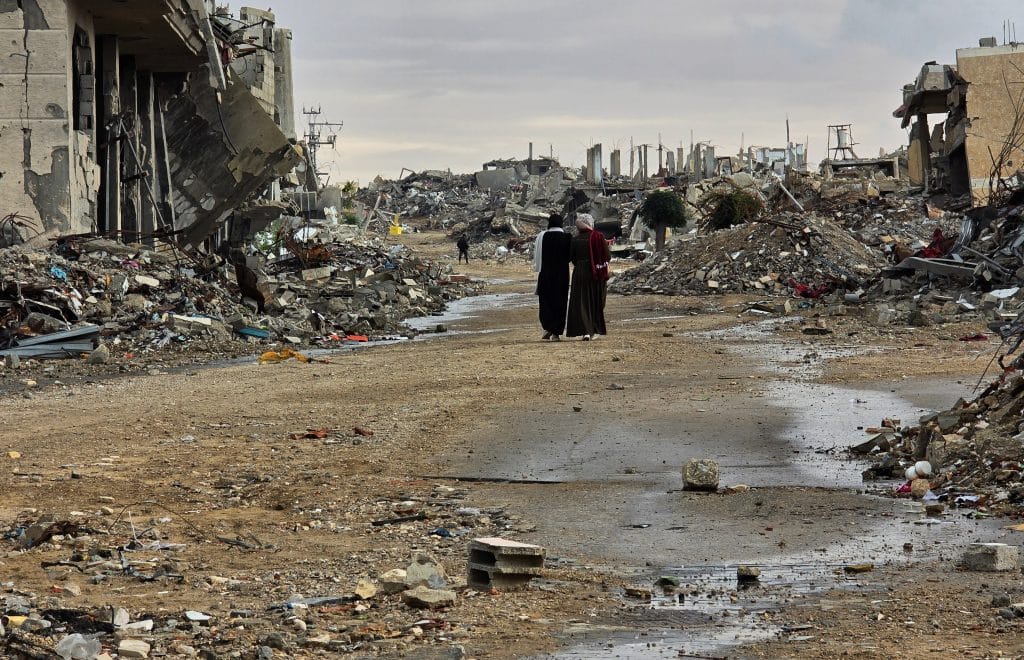
It was not the first time I had watched a video of a mother embracing a human skull, crying and holding it close to her chest as she wept. But it was the hardest video I had ever seen come out of the genocide, perhaps even harder than things I saw with my own eyes when I was there during the first few months of the war.
Fatima Abu Khammash, 56, dropped to her knees before opening the black plastic bag. A member of an Israeli-backed militia in Gaza had just handed it to her at the edge of the so-called “Yellow Line” that divides the Strip between Israeli and Hamas control.
“This is your son,” he told her.
Widely shared across social media, the video was from July 11. Nine days earlier, Fatima’s 30-year-old son, Muhammad, had gone missing. Fatima told Mondoweiss that he had gone over to the Israeli side of the Yellow Line, where she says Israeli forces killed him. Palestinians have been barred from crossing into the Israeli-controlled zone since the October 2025 ceasefire, and on many occasions, have been shot and killed for even wandering near the invisible border. Fatima says that Muhammad was one of them, and that his body remained where he had been killed, unreachable for days as it decomposed in the summer heat.
The family confirmed that the entire period in which Muhammad went missing, all up until the militia member gave Fatima the bag of human remains, was only 9 days long. But the remains that I watched Fatima pulling out of the bag and holding so close to herself were clean bones and a clean skull. The first thing I thought was that this can’t be enough time for a body to fully decompose.
Looking it up online seemed to confirm my hunch — a human body takes months to fully skeletonize, a quick Google search showed. But I wanted to speak to an expert.
I called Dr. Ahmad Dhuheir from the Forensic Medicine department at Gaza’s Ministry of Health to ask him about the case. He confirmed that a body needs well over a month for that level of decomposition. “Total decomposition depends on the environment,” he explained. “In the first ten or so days, the body begins to bloat and starts to show signs of advanced decomposition.”
I asked him whether the bodies of Palestinians killed beyond the Yellow Line, exposed to the elements and to stray dogs, which have been known to devour the bodies of the dead in Gaza, might accelerate the process. He agreed that they can play a role, but that “the process of skeletonization may take longer than ten days.”
Duheir said he was only giving a general medical opinion, but that he hadn’t been assigned to this particular case. “Usually, a body requires a longer period to decompose completely, and there are several possible explanations in any given case,” he said. “This can only be resolved by identifying the remains.”
But in Gaza, there are no advanced forensic means of identifying bodies.
Duheir also told me that “there have been many cases inside the Yellow Line where bodies remained for extended periods and decomposed into skeletons.”
That’s when the disturbing idea came to mind that the Israeli army, or the militia members, might have given Fatima the bones of someone else who met a similar fate beyond the Yellow Line.
But who would dare to share such a thought with a grieving mother who said that she felt a sense of closure upon receiving her son’s remains?
For many who watched the video of Fatima, it became one of the most haunting images to emerge from the genocide: a mother cradling a human skull as though it were still alive, but for Fatima, there was nothing symbolic about the moment. She says she wasn’t holding a skull at all. It was Muhammad. You can see her calling his name as she wails.
Fatima said that they identified her son’s remains by matching the skull to a panoramic X-ray of his teeth, which she says he took at a dental clinic in Gaza months before his death.
It’s impossible for me to know if the human remains that were given to Fatima actually belonged to Muhammad. But there’s one thing I know for certain: regardless of whose remains were in that bag, her story is the same story as countless other mothers, fathers, sons, and daughters in Gaza.
In the past, we’ve reported on how, in the wake of Israeli massacres, people’s bodies were so blown apart and disfigured from the force of Israeli bombs that it was impossible to separate the bodies. Forensic teams ended up giving grieving families an anonymous bag of human remains to bury. Every 70 kg was considered a martyr.
And the story of Muhammad, like the story of so many other martyrs in Gaza, is an entire universe that cannot fit inside a plastic bag.
This is his story.
Muhammad’s final steps
Muhammad had lived with a severe mental illness that, according to his mother, often left him unable to understand what was happening around him fully.
By the time he was killed, Muhammad had already survived a different kind of devastation — two of his brothers, Marwan and Osama, had been killed during the war. Fatima says Muhammad never recovered from their deaths.
Osama and Marwan were his closest friends. Fatima says they were his world, and after their death, he was overcome by shock. “He became a different person,” she told Mondoweiss. “He began wandering the streets, sometimes barefoot, calling out his brothers’ names, searching for them, even though he regularly visited their graves. Yet, each time he returned from the cemetery, he would ask, ‘Where are they?’”
“Whenever Muhammad disappeared, we always found him sitting beside his brothers’ graves, crying,” Fatima said. “Sometimes, he would whisper to them, repeating the same words: ‘Take me with you.’”
The cemetery where his brothers were buried lies only about 300 meters away from the Yellow Line, but another place was also pulling him just as strongly: their family home in eastern Deir al-Balah, inside the Israeli-controlled zone.
According to Fatima, Muhammad became convinced that if he could somehow return to the house where he had grown up, he would find his brothers waiting for him. Or at least something that still belonged to them.
He never stopped trying to go back, she says, until one day, she believes he crossed the Yellow Line. That was the day he went missing. She says that the militia members told her that an Israeli quadcopter had repeatedly ordered Muhammad to turn around. But due to his mental state, she believes the warnings didn’t register.
For the first three days after Muhammad disappeared, his family did not know he was dead. “We searched everywhere we could think of,” she said. “Perhaps he had wandered toward Gaza City. Perhaps he had walked to the sea. Perhaps he had lost his way back to our tent, which has happened before.”
Fatima kept asking strangers whether they had seen him, but the answers came in fragments.
One stranger asked her if he was wearing a white t-shirt. He was. “We saw him walking through the streets calling for someone named Osama.” Each conversation pointed her in a different direction, each clue ending in another dead end.
Then, she heard that a body had been lying inside the Yellow Line in eastern Deir al-Balah. Before anyone could confirm it, something inside her told her it was Muhammad, she says.
She immediately turned to the International Committee of the Red Cross and other international organizations, hoping they could recover his body. But again and again, she received the same answer: Israeli authorities would not allow anyone to enter. Every day passed with the image in her mind of Muhammad still lying where he had been killed.
When Fatima asked people near the cemetery about her son, some recognized her. One person also asked about the man in the white t-shirt calling out someone named Osama as he walked. When she confirmed it was him, they told her they had seen him heading toward the yellow iron gate affixed to the cement blocks that mark the Yellow Line.
A militia member stationed in the Israeli-controlled zone told her there is a body of a man who was killed days ago.
“In my heart, I knew it was my son,” Fatima said. “The direction he had taken was the same road that led to our home in eastern Deir al-Balah, and he was eager to go.”
She returned every day to the edge of the restricted zone, standing at a distance, looking into the distance, searching for answers. Israeli forces prevented anyone from entering the area to recover the body. Each day ended the same, but she kept coming back.
Eventually, waiting became impossible.”After days of going from one organization to another, no one could promise me they would bring my son back, so I decided to go myself,” Fatima said.
She picked up a white flag and began walking toward the Yellow Line. She knew exactly what that decision could mean, and that she might never return. But she says there was no longer any choice she could live with except trying.
“When I reached the gate, an Israeli quadcopter immediately ordered me to turn back,” she recalled. A young man nearby also shouted out warnings. She heard neither. “All I could hear was Muhammad calling me,” she said.
“Mother, come and take me home.” She knows those words existed only in her heart, she says, but in that moment, they felt more real than the drone overhead.
“I told myself that even if I were killed beside him, I would not leave without him, ,” she said. She remembers feeling as though turning back would have been a greater death. “If I had returned without Muhammad, I would have lost my mind. What mother could see her child abandoned like that and simply walk away?”
A mother tracing her son’s steps
Before the war, Fatima’s home had stood there. During those past two years, she often dreamed of returning, of seeing the neighborhood where she had raised her children, of walking the streets that had once defined ordinary life. But when she finally crossed the gate at the Yellow Line, she says, none of those memories remained.
“I didn’t think about my house, I didn’t think about the streets, I didn’t think about the past,” she said. The only thing that existed in that moment was Muhammad.
The Israeli drone continued ordering her to leave, warning that she would be shot. Without stopping, she answered, “Kill me, but I will not leave my son’s body behind.” She says that she was no longer walking toward death, but toward motherhood’s final obligation: her son’s calls to take him back.
In a propaganda video published by the Israeli-backed “Free Homeland Forces,” the militia’s leader, Shawqi Abu Nasira, is shown handing off the black bag to one of his suborinates, saying “this is a humanitarian case, and the [Israeli] army allowed for this.” The video then cuts to a militia member handing the bag over to Fatima, who collapses on the ground as she opens the bag.
Fatima says that for her, the bag contained nine days of searching, three sons lost during the war, a lifetime of motherhood, and one final promise she had refused to break.
“I felt victory when I got the bag and returned with my son in it,” she said.
Later, people asked her how she was able to hold the remains and press them against her chest so easily. But she maintains that they didn’t understand what she was holding. “People don’t understand how I could do it, but it was my son. The child I carried inside me. The child I raised day after day. Nothing was frightening about it. How could a mother be afraid of her own child?”
What haunts her the most, she says, is not what she touched, but what she remembers of him. “My son was a gentle man. He was beautiful,” she said, adding that Israeli forces had denied her the chance to say goodbye to him while he was whole, as he had been in life.
Yet even now, when she closes her eyes, that is not the image she sees. All she remembers is how sweet he was. “He was so kind that he never ate even a single biscuit without sharing it with me,” she said.
When she received the bag, Fatima’s grief didn’t end. It changed.
Those nine days were filled with a tortured uncertainty, but now she has a painful, irreversible closure. But closure nonetheless.
Today, Fatima is raising five children. Three of them are Muhammad’s, and two belong to Osama. The rest of the family is in pieces now, and the only place she can see the loved ones she lost is in her dreams. Whenever she cries, she says she imagines that Muhammad is in front of her, telling her, “Mother, don’t cry. I have been reunited with my brothers.”
Sometimes, he tells her they are together with their cousins, who were also killed in the war. “My dreams have become the only place where our family is whole again,” Fatima said.
Tareq S. Hajjaj
Tareq S. Hajjaj is the Gaza Correspondent for Mondoweiss and a member of the Palestinian Writers Union. Follow him on Twitter/X at @Tareqshajjaj.


Re Gaza:
Eyal Weizman is an Israeli architect and founder of Forensic Architecture**. He just published a new book on Gaza called “Ungrounding: The Architecture of Genocide”. From the Amazon description***:
“In this revelatory new project, Weizman draws on that original and extraordinarily comprehensive research to bring us on an eye-opening journey through the “deep cartography” of the area extending from Gaza’s subterranean tunnels through to its militarized topography, settlements, and barriers. He catalogs, in unflinching and exacting detail, the Israeli campaigns of violence and displacement that have reshaped the region in an effort to make Gaza and its surrounding areas unlivable for the Palestinian people. Taking us through the broader geographical and historical context, from the Nakba in 1948 to the present day, Ungrounding establishes that architectural and territorial analysis is key to understanding the relationship between colonizer and colonized — and how Israel’s actions have escalated into violence so extreme and so far-reaching as to, Weizman argues, meet the definition of genocide.”
I’d like to see Mondoweiss interview him. Here’s an article by Weizman on Gaza:
Literary Hub » How Israel Turned Gaza Into an “Annihilation Zone”
**
Investigations ← Forensic Architecture
***
Ungrounding: The Architecture of Genocide – Kindle edition by Weizman, Eyal. Arts & Photography Kindle eBooks @- Amazon.com.