Tonight I went to a Nakba event at a Friends meeting house in Brooklyn. There were 130 people there and many Arabs but oddly the focus was on the Jews. In a way the evening wasn't about ethnic cleansing so much as a confessional for Jews like me, Jews critical of Israel, and their relationships with their families. I thought I'd blog about that part of the meeting now, and get to the Arab narratives tomorrow.
The meeting was organized by Brooklyn for Peace. Rusty Eisenberg opened it up and got right into the confessional mode. She said the great thing about the evening was it was even happening, a few years ago no one in the States would even acknowledge the Nakba. She was born in 1945 into a mildly Zionist family and all her youth there were heroic stories about Israel, and pictures of Nasser that made him look like Hitler, but she didn’t know that there were Palestinians, even as she was emotionally caught up in Israel. I wondered if Eisenberg was doing a kind of penance. She said it amazed her that it possible to grow up as she did, with no knowledge whatsoever of 1948, “without knowing that the great moral story of the founding of Israel had to do with the eradication of another people.”
After that Nadia Hijab also spoke about Jews. She said one reason things were changing in the U.S. was the “fastgrowing” number of Jews like me who are coming out against the occupation, thereby giving permission to nonJews to speak up. “They’re brave and I salute them,” Hijab said.
Adam Horowitz of AFSC spoke of his own family. He helped start Jews Against the Occupation. He talked about the right of return some, then told his own religious story. He’d been a kid in suburban Philadelphia in a Conservative synagogue. When his school handed out orange Unicef boxes at Hallowe’en, to collect coins with, his parents wouldn’t allow him to collect money. “Because Unicef gave money to Palestinian kids.”
When he said this there was a gasp all thru the audience. It was amazing how calm he was about it all.
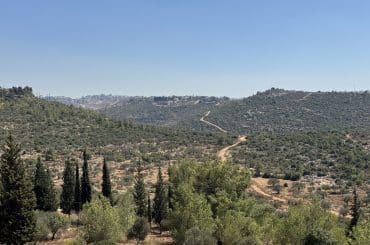
Then he offered the flip side of the Unicef story: he had been the treasurer of his Hebrew school, he had the responsibility of collecting the blue boxes of money for the Jewish National Fund. A lot of that money went to plant trees in Israel. Forests where Palestinian villages had once stood, trees to cover up the villages. “There’s a direct line between me and my community and the stories we’re telling here tonight.” Then he seemed to speak to Jews directly: “This type of reflection is going to be important for the community, as a whole, as we move out of the mindset of a people under siege.”
A lot of people keyed off of Horowitz’s comments. “We didn’t grow up understanding this issue,” a woman named Naomi said. Another woman said, There were a lot of Jews in agony in that room tonight. And their own families were divided, people weren’t speaking to one another over this issue. What do you say to one another? Horowitz told about the conversations he’s had with his mom. “She is concerned that the Jewish people are safe,” he said. So he tries to move her concern to a general issue of human rights, and get her to see what has befallen Palestinians’ human rights in Israel. I raised my hand, and got up and told a story about my mother, how she says that the refugees should have been absorbed by the Arab countries, what do I tell her?
It was a restless night in the Jewish soul. I took the subway into Manhattan with Horowitz. He’s 30ish, reddish-haired, unpretentious, really smart. I told him how guilty I used to feel, how upset I’d get about discoveries, like when I was in Syria and I realized how much of Israel’s history was a neocolonialist landgrab. I said he seemed a lot better adjusted than me on these issues. He said No, he’d just been at them longer, was further along in his journey.
I mentioned the most upsetting thing we heard that night, an Arab oral history they’d played at the start, a guy from Lydda, the late Ismail Shammout (who died in Lebanon) who had been forced with other villagers out of their homes at gunpoint by Israeli soldiers. They thought it was going to be like the British, they’d get harassed and their homes searched, then they could go back. But the soldiers had led them out of town in a long line. On the way he’d seen the shops’ windows broken, the glass on the ground. I looked at Adam and neither of us had to say anything about that glass detail.
Jews are going to have to do some grieving over the Nakba too. Even after 60 years.