Aaron Levitt, who was once a Chabadnik, went to a Sabbath dinner in Jerusalem for old time’s sake. Go to his blog for the full report (also picked up at JSF). I must say that Levitt’s experience with the invisible help was my exact experience when I visited a Chabad house one night. Excerpt:
Most of us were already seated and chatting when the soldiers arrived, carrying their automatic weapons. One of the Australians almost immediately asked a soldier, "Hey, can I use your gun to kill an Arab? After Shabbat, of course." I don’t remember the exact response, but the soldier certainly didn’t chastise him, and neither did anyone else. A few minutes later, I turned to the speaker and told him that I didn’t find his joke remotely funny. His only response was to say, "I wasn’t joking", at which point I told him that the joke wouldn’t have been funny coming from an Arab who was speaking about a Jew, it would be even less funny if the Arab were serious, and so it was in his case…
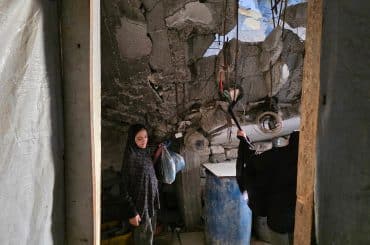
At some point, all the diners go to wash their hands in the kitchen, where a very petite, dark-skinned, "foreign worker" (maybe Thai, or possibly Filipino) is washing dishes.
I actually caught a glimpse of this woman earlier in the evening, but her presence has been so completely ignored by everyone else that I thought I might be mistaken. Presumably, hiring a foreign worker is better than employing a potentially ‘uppity’ Palestinian who might feel she has actually has rights in her homeland. I find it extraordinary that, in our round of thanksgiving, nobody (notably our hostess) has even mentioned this woman. I thank her, now, and it takes some time and a second attempt for her to even recognize that she’s being addressed, though she has a great smile when she does realize I’m expressing my appreciation for her work.
As dinner progresses, the soldiers actually turn the table to a discussion of sniping techniques, the relative merits of different automatic weapons, and whether the IDF should issue bayonets to its troops…
A bit later, my original companion asks me privately to explain something I mentioned to him about mapping work I was doing in the the village of Lifta. At this point, I am fervently wishing that I had never come, swearing to myself that I never will again, and the last thing in the world I want is to be subjected to a gang-bang on the supposed evils of Palestinians. Hoping I can still salvage some small positive from the dinner, however, I present my case: Basically, I say, I have come to perceive Israeli Jews/Zionists as seeing no inherent human value in ‘the other’ (in this case, non-Jews, and primarily Palestinians), but viewing them basically as a contaminant of the Zionist ideal, a ‘demographic time-bomb’, or what have you. They are hated and persecuted by some, ‘tolerated’ by others, but viewed as a vital and desirable piece of the tapestry by almost no one. This kind of world view led to the ethnic cleansing of Lifta, a large Palestinian village west of Jerusalem, in 1948. It is also, in my mind, the same thinking that lay at the core of Nazi atrocities against the Jews, and all the other persecutions of our people over the centuries. My hope is to show the beauty and history of the village, its life and its people, and use that beauty to remind Israelis/Jews of the humanity and inherent value of its inhabitants.